Friday, August 29, 2008

Cheney in red


You may accuse me of cynicism if I note that the experience of watching televisually adept political rallies held in athletic stadiums makes me think of the late Leni Riefenstahl.

I might confirm your characterization by asking whether you noticed that Barack Obama wore a red tie for his big speech last night.


The magic podium that came up through a trap door on the stage in front of the faux-Corinthian columns from which the 21st century Apollo emerged and then went back down when it was time for the onstage family fest customary at such public rituals was also red, or at least it looked that way on the CNN HD broadcast I was watching.

The candidate's wife and children, when they emerged for their big photo op, were also wearing red, as was the Vice President's wife.


This apparently deliberate signaling of a mood of revolutionary change is interesting to me as a longtime observer of the media semiotics of the use of color to depict American political parties. In the recent past, the media convention has been to associate red with the Republicans and blue with the Democrats. As you may be well aware if you have ever been castigated at a dinner party for "living in a red state," or heard one of your neighbors rationalize "we live in a blue dot in a red state."


Having long felt that much of the purported difference between America's dominant political parties is, viewed in the context of other polities with greater political diversity, a bit of a tribal "red team/blue team" delusion, I have found the adoption of this contemporary cultural parlance particularly annoying. You may say, that's convenient for me as someone who lives in a "blue dot in a red state." (To which I might point out, my color is brown.)

These particular color associations with the two parties are a relatively recent development. The default associations used to be the opposite.

While it is probably silly to think that the networks intentionally assigned the colors, the fact that they have stuck with such memetic power suggests they capture some deeper emotional/tribal associations in the age of the GWOT. Surely the gurus of brand marketing would tell you that color associations are among the most important tools in the semiotic toolkit of mass manipulation of public opinion. Why else would they have fought so hard some years back to ensure that corporations can obtain federally registered trademarks for the use of particular colors in connection with particular types of goods and services. Consider, for example, that one of the primary trademarks of the Discover Card is the "orange glow," and that United Parcel Service has morphed its brand image to simply "Brown." And in politics, there is of course the longstanding example of "the Greens."

For an excellent discussion of this phenomenon, consider this 2004 article by Phil Patton in the AIGA Journal of Design:

One Fate, Two Fates, Red States, Blue States

One fate, two fates, red states, blue states—have red and blue replaced red white and blue as our national colors?

We refer to the red states and the blue states so regularly now that the association seems long established. But only the 2000 presidential election established the linkage of blue with Democrats and red with Republicans. In earlier years, the television networks and magazine maps had reversed the association. In 1984 rival networks associated red with Democrats and blue with Republicans. The Reagan sweep of that year was called "Lake Reagan" in one context.

In many ways the link goes against tradition. Red has long stood for the left and one has to suspect that the first usage of it to represent Republicans was inspired by an effort to seem non prejudicial.

The end of the cold war made red baiting and pinko artifacts of a time past; the critical mark of the change may have come when the old red baiter, Richard Nixon, visited “Red” China.



On the other hand, blue was the color of the Union army uniforms, by contrast to gray, and has a historical link to the party of Lincoln. But in the Revolutionary war blue was the color of the Continental army uniform: red that of the British, of course.

Wrapping the candidate in the flag is the hoariest cliché of bumper stickers and posters. Post 9/11, with every politician in the land sporting a flag lapel pin, even clothing seemed to aspire to flagdom: red tie, white shirt, blue suit became common.


The colors of the flag are more than ever the staples of campaign graphics. (And despite Nader in 2000, who today could imagine that Jimmy Carter in 1976 adopted green, a hue that these days is as likely to evoke Islam as environmentalism?) But this year’s campaign graphics seem to have lost the traditional white of the trio. John Kerry’s stickers show a hopeful sea of Democratic blue, with flailing strip/stripes of red and a single tiny white star. They recall the Bank of America’s recent abbreviated flag logo.


It is as if in all the flag waving of the last few years the white in the red, white and blue had vanished. The blue-red opposition has come to stand for a wider sense of political and cultural polarization—between cultures, incomes and classes. Has white vanished out of fear of suggesting surrender? Does it mean all hope of truce or compromise has vanished?


I have to think that it is not a coincidence that the traditional association of red with the party to the left expired sometime after the death of the Soviet Union. Which also happened in parallel with the Reagan-era association of the G.O.P. with a more aggressive military posture, and, in the age of the Iraq War, with an openly scarlet military adventurism. The idea of popular revolution being dead, the party of blood on the streets becomes the party of Mordor-like mechanized military might. Shock and awe is red, not blue.

As are rednecks, especially as seen from certain urban quarters.

(Can it be any accident that the W.-era Republican red tie fetish recalls the historic wearing of red bandanas by Scottish Presbyterians to represent their having signed manifestos of religious identity in their own blood, a practice which is the true origin of the term "redneck"?)

And blue, of course, is the color of dipassionate professorial cool, of Tory reserve, of the Establishment. The color of Yale University, National Public Radio, and those cryptically named pharmaceuticals that keep you from getting in a bad mood.

Phil Patton suggests the real message (and cause for alarm, literally) comes from the spectral dipole:

Red and blue joins red and green—stop and go—and even Stendhal’s red and black as a basic binary.

Each color has its associations. Blue is cool and dispassionate, red heated. But it is neither the red or blue alone where the meaning lies, it is in the combination.

It is a pairing with overtones of alarm. Light bars atop police cars strobe warnings in red and blue. Not long ago activists protesting gang violence in Irvington, New Jersey marched with mock coffins, alternately covered with red and blue representing the Bloods and Crips gangs.
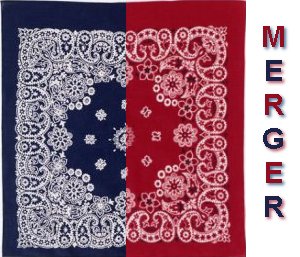


Is our division into red and blue a new national emblem in itself, like Swedish blue and yellow? Usually it takes three colors to make a national color scheme: French tricolore, German black red and yellow, Jamaican green yellow black. Red and blue meet white in the Russian flag. Red and blue were the colors of Paris joined with the white of the King of France in the tricolor.

Any melding of blue and red suggests an impossible purple—the color of royalty, rich as the vain dream of national union hoped for by nation builders who bring shabby deposed kings back to conflicted nations—an early scenario for Afghanistan. But purple has also occasionally been used to indicate “toss up” states on this year’s electoral map: the overtones of bruise are appropriate.

At best, red and blue might inspire a contemplative Rothko glow, a study of a wider and more profound opposition. The pairing was seen differently by the great blues singer Robert Johnson, who in his song “Love in Vain” considered a departing rail car and the loss it meant, rolling out of the station “with two lights on behind. The blue light was my blues and the red light was my mind.”


My own suggestion is that, as a revolutionary act of independent thinking (and given that you can't watch television without being reminded that you have a patriotic duty to get a new one before analog transmissions from the ether go the way of the vacuum tube), each American make habit of manipulating the color balance on her television set to thoroughly subvert the color schemes of the political semioticians who want to control your mind when you walk into the ballot box in November. Flush out all the red and all the blue, and see what happens.


Wikipedia on colors, their associations and etymologies:

Red

Blue

Red states and blue states.

Thursday, August 28, 2008

MEMORY: 22

First
Previous


“Lassie, I’m nae a performing dog what’ll sit up and do tricks on command for ya,” Flavius growled. “Nae matter what ya ken of me, with all this talk about ‘lesser sentients’ and the like, I’m more than a plaything for the women of the Eternal Dominion. I’m descended of Bellona's bridgroom and Sajal be damned, I’ll nae jump to when ya snap yer fingers. I’ll thank ya to remember that!”

The color’d drained from Anacaona’s face as Flavius raged, her eyes casting furtive glances left and right at the other diners who’d interrupted their conversations to stare at the commotion. When she spoke, her voice was a timid squeak.

“I... I apologize for my affront to your dignity. You shame me. I will not bother you anymore.”

Flavius rolled his eyes. “Are ya daft? I’ve been marching with Bonnie Prince Charlie for six months, down to Derby and back up through Glasgow. I wore out two pair of boots chasing around with him, but dinnae chase a single lassie the whole time.” He leaned back, crossing his arms. “I’ve gone so long without, I’d say ‘Aye’ to yer blind gran if she offered. Of course I’ll have a go at ya, but it’ll be on my terms, nae yers.”

Anacaona blinked at Flavius, struggling to process what he’d just said.

“I hope ya ken what yer in for,” Flavius said, popping the last few spondl into his mouth. “A stout Scot is nae to be trifled with.”

The tables abruptly split apart, carrying the uncertain Anacaona away. On cue, one of the aerial waiters swooped down to gather the empty plate.

“Aye, beastie. Take it away and bring me something savory,” Flavius muttered.

Through the crowd, Flavius spotted Parric. Remembering the mysterious featherscale, he waved as his table drifted along.

“Hoo! Parric! Over here!” he shouted, drawing startled stares and whispered comments throughout the dining hall. “No, nae that way, ya stupid table. How do ya steer this damned thing? Oh, bugger it.”

Flavius grabbed the side of the table, planted his feet on the floor and threw all of his weight to the side. The table groaned, a piercing, hollow echo of metallic agony that reverberated through the dining hall. But it slid toward Parric.

“Excuse me. Coming through here,” Flavius said, grunting as he shoved the table along. “Sorry about that. I dinnae ken it’ll stain. Was that yer foot? My fault. Out of the way, now.”

Finally, Flavius shoved his table into Parric’s. They neatly merged together. Parric stared at the fused seam, then looked up at Flavius. “Well,” Parric said, “you’re nothing if not subtling.”

“Watch it, beastie,” Flavius said, waving a finger. “I’m in nae mood for yer--”

An aerial waiter interrupted him, setting a steaming plate before him of thick, ropy coils drizzed with a translucent blue sauce and a stylish garnish of what looked like garden weeds. The waiter rotated in place, setting before Parric a dish of what looked like boiled eggs, except for the fact they were a startling purple in color and stood about a finger-length above the plate, supported by nasty looking red spines that radiated out from them.

“Egh,” Flavius said, prodding his entree suspiciously. “I ken the lot of ‘em are barking mad, what with this food they expect us to eat. D’ya ken what that last dish--that spondl stuff--they served the rest of us was?”

“Peq testicles,” Parric said, scooping up several of the spiny eggs in his beak. The spines made a satisfying crunch as they splintered.

“Right. And so I-- bastard!” Flavius’s face twisted in horror. “Yer having me on!”

Parric shrugged his antennae. “They grow back.”

Flavius slumped in his chair, face buried in his hands. He moaned pitifully before peeking at the current course in front of him. “Tell me, beastie. Is that one of them aphro-whatsits, too?”

“I’m believing so. The Empress Malinche is making many changes to the menu,” Parric said. “She is watching you closelying. She is seeming pleased with your appetite for spondl.”

Flavius groaned. “Just throw me to the wolves now, and get it over with.” He grabbed his drink and emptied it with a single gulp. The taste was bitter and woody, but it burned nicely on the way down. The edges of his vision flickered in a way that promised more to come. “I dinnae suppose yer plate there’s filled with the spiky balls of some exotic beastie as well?”

Parric shook his head. “No, these are... well, they’re not having a name. Or rather the name is a descripting of the preparing process. I’m finding this most curious, actualling.”

“How’s that?”

An aerial waiter refilled Flavius’ flute. It only made it halfway back up its thread before Flavius drained his glass, forcing it to return for another refill.

Parric leaned over. “It’s not a foodstuff widely knowing outside of my home. The first two courses, they are commoning. I’m eating them here previously. But this...”

“Parric, by ‘home’ do ya mean--”

“My home cosm.” Parric crushed the last spiny egg in his beak, gulping it down with relish. “It is actualling something of a delicacy. I’m at a loss as to how they are learning of it.”

“I ken I might have an idea how,” Flavius said, pulling up his sporran. “Open yer maw.” He reached in, and with a flourish pulled out the crimson featherscale. “What do ya think of this?”

Parric’s antennae sprang straight up. “I’m thinking three things,” Parric answered slowly. “And two of them are bad.”

Continued

Wednesday, August 27, 2008

Hari Puttar and the Copyright Lawyers of Covent Garden


In the department of you can't make this stuff up, envision if you will the upcoming Bollywood satire of Harry Potter, as implied by this squib from yesterday's times:

ARTS, BRIEFLY
Warner Brothers Sues Over Indian Film
NY Times, August 25, 2008

Warner Brothers has filed a lawsuit over an Indian film whose title it says is too similar to that of the Harry Potter series, The Guardian of London reported. The studio is suing Mirchi Movies over “Hari Puttar: A Comedy of Terrors,” which is scheduled to be released Sept. 12. The film, which does not appear to be based on the J. K. Rowling books that form the basis of the Warner series, is about a 10-year-old boy who moves to Britain and becomes involved in a series of adventures. Munish Purii, the chief operating officer of Mirchi Movies, said: “We registered the Hari Puttar title in 2005, and it’s unfortunate that Warner has chosen to file a case so close to our film’s release. In my opinion, I don’t think our title has any similarity or links with Harry Potter.” A spokeswoman for Warner Brothers said it would not comment on litigation. An Indian court was to hear the case on Monday.

Based on the official website, a more accurate pitch would be "Hindu Harry Potter does Home Alone at a Defense Ministry War-on-Terror Hogwarts." The dance numbers on that one are going to freaking rock.

Not that anything will ever match the wonder of Koi Mil Gaya, pitched as "Forrest Gump meets Close Encounters of the Third Kind and E.T. (with a healthy does of Flowers for Algernon) in Bollywood." Complete with a dance number involving little aliens who are, yes, Krishna blue.

Check it out and see if this isn't enough to make Dick Cheney want to play with pink unicorns:

Special! Blackwater! Olympics!


Already missing Bob Costas beach bikini volleyball fun? Envisioning Shawn Johnson dismounts as you leave work? Awkwardly following the debate over Ben Stiller's use of "the 'r' word" in his new satire, Tropic Thunder? Wondering what the fine patriots at Blackwater have to do with all of that? Well, they are playing bocce ball for the Special Olympics. From the Blackwater press release:


The game Bocce Ball has elements of bowling, horseshoes, shuffleboard and billiards. To start play, the pallino, a white ball the size of a golf ball, is rolled onto an 8’ X 60’ grass court. The pallino then becomes the target. Players roll larger balls to see who can come closest to the pallino. Players can move the pallino with their balls or knock opposing balls further away. The game is enjoyed by players of all ages and athletic abilities. The Special Olympics serves a unique group of people, and this event brought a widespread of involvement from the surrounding communities to support this cause. A corporate sponsorship request was sent to Blackwater for sponsorship participation in the 1st Annual Bocce Ball Tournament. Blackwater gladly accepted and became a corporate sponsor at the gold level. Gary Jackson, President of Blackwater stated, “There is nothing more worthy than helping others less fortunate.” Blackwater employees and their families volunteered their time to be the official judges for this tournament, assisted in locating community volunteers and teams, and even recruited other employees for teams to participate in the tournament for this event. It was estimated 100 four-man teams competed in the tournament. There was great food, frozen drinks an exciting and fun Bocce Ball Tournament with the businesses and other groups competing against each other. This event was wrapped up with a dance under the starts at Waterfront Park in Elizabeth City, North Carolina.

Do you suppose they're giving out these cute logoed Teddy bears from the Blackwater pro shop as trophies?


Wonder what it would be like to get one of these sweet open positions at Blackwater? (Richard Butner, they are looking for a proposal writer in the NC HQ!) Check out this choppers' eye view virtual tour.

If all that's not special enough, then you better start training for this:

Blackwater Escape and Evasion Adventure Race

November 7th – 8th

Blackwater Extreme Racing and Don Mann Productions are proud to announce the Blackwater Escape and Evasion Adventure Race, a distinctive and exciting athletic event unlike any other. The Blackwater E&E will challenge adventure racers, triathletes, military personnel and anyone else looking for an innovative endurance competition.

This 24-hour race will pit teams of two against one another in the traditional adventure racing disciplines of trail running, mountain biking, paddling, and orienteering. But, as the name implies there is more to this race than just reading a map and finding checkpoints. Racers will also be challenged along the course by a series of Special Operations type events and surprises that could only be made possible by the combined expertise of the Blackwater Extreme Racing staff.


What the competition needs is a couple of teams of scrawny sci-fi types to go all meta on their asses. It'll be like Rocky meets Full Metal Jacket on the set of Starship Troopers!

Tuesday, August 26, 2008

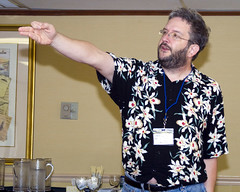
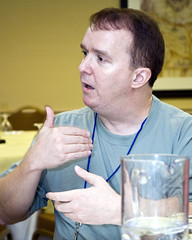
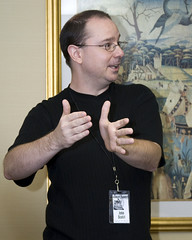
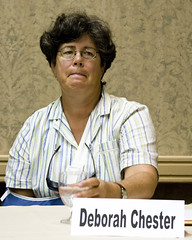
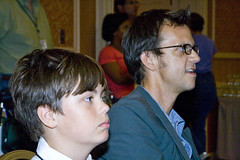
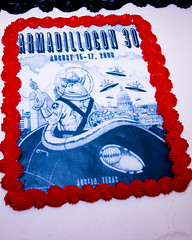
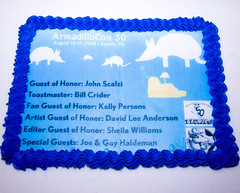
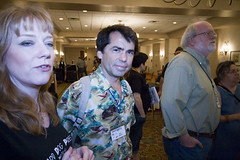
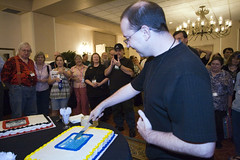
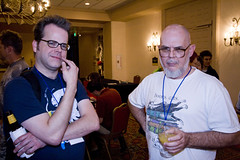
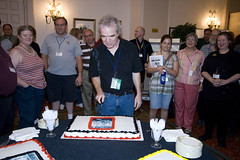
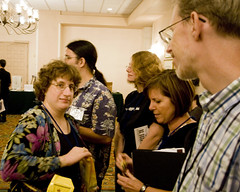
Belated Armadillocon pictures

Sorry folks, but amongst a host of other demands on my time, I've been remiss about posting these shots from that fine convention down Austin way. Armadillocon was a week and a half back, but I assume some people would still find these of interest.

Dillocon08001Dillocon08002

Dillocon08003Dillocon08004

Dillocon08005Dillocon08008

Dillocon08007Dillocon08010DaveDuggins

Dillocon08009Dillocon08006

Dillocon08011

Dillocon08012

Dillocon08013Dillocon08014

Dillocon08015Dillocon08016

Dillocon08020Dillocon08017

Dillocon08018Dillocon08019

Dillocon08021Dillocon08022

Dillocon08023Dillocon08024

Dillocon08025Dillocon08026

Dillocon08027

Monday, August 25, 2008

Three-panel cave painting

I have remarked in other fora of my disdain for the skiffy geek yearning for the Singularity, suggesting that, in a world where the media narratives of popular culture have so completely infiltrated our brains, our consciousness already spends a good chunk of its time in The Matrix, with mind's relationship to body mediated through Abercrombie-infused delusions and sex-waxed Narcissism.

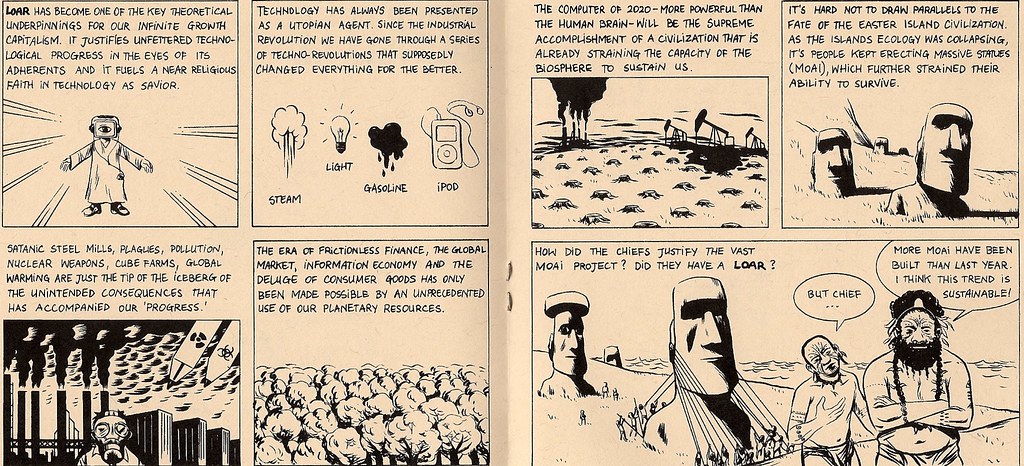
But I'm not sure I really nailed what bugged me about the concept until I came across Tom Kaczynski's brilliant treatment of the issue in the thinking man's comics collected in his Cartoon Dialectics, Vol. 1.


Who knew a few panels of pen and ink could weave the threads among Kurzweil's Age of Spiritual Machines, Jared Diamond's Collapse, Erik Davis's Techgnosis, Hakim Bey's T.A.Z. and Business Week better than any critical essay? Who knew there were comics that combined the alienated suburban emotional frisson of Dan Clowes with the critical edge of Mark Dery? Like Eightball with footnotes! (or at least, in this case, an actual bibliography.)

I have been reading comics since the late Silver Age, but frustrated in the last few years by my inability to find new independent comics auteurs who I really connected with. So much beautiful work, so full of the ennui of contemporary life, but somehow striking me as a bit too satisfied with the kind of cloying, navel-gazing, unwittingly self-important memoir that also infects the sort of contemporary American fiction cranked out by MFA programs. In other words, lots of work of exceptional quality and authentic emotional depth, but short on big ideas and more macro-scale intellectual punch. For this reader's tastes, at least.

You might suggest that to search for that in comic books is a fool's quest. These birds would disagree.


Last year, thanks to one of the staff members at Austin Books, I discovered the work of Anders Nilsen and his current serial project, Big Questions (specifically, Big Questions #10). Opening up the pages to pure wonder, with scruffy smart-ass birds talking to each other as they watch some dude in the woods rummage through a plane crash, sharing thoughts on the availability and worth of a box of donuts scattered in wreckage. Capturing better than any other work of art I have come across the feeling of being an alienated early 21st century American roaming the little hidden-in-plain-sight borderlands where wild nature collides with human urbanity and the random detritus of our material culture. A better realization of the power of slipstream than any purely written work I can think of from the last few years. Mapping our psychic landscape with pen-and-ink sonar pings of mind's subtle and generally unnoticed interactions with the interstices of the city. Pure psychogeographical mapmaking.


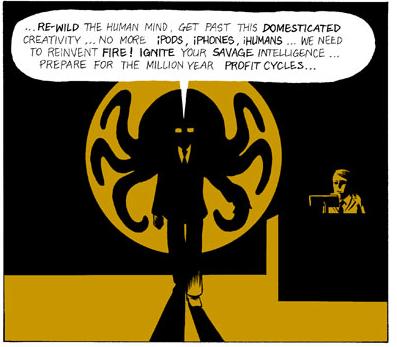
Last month, thanks to the guidance of the proprietor of Austin's new Domy Books, while searching unsuccessfully more more issues of Big Questions, I discovered the Fantagraphics serial anthology Mome, and, therein, the work of Tom Kaczynski. Flipping the pages of the tome, I was immediately captured by Kaczynski's "Million Year Boom," with its opening page scene of a new economy Ronin landing in another city and traversing an exurban landscape I know too well, with its trapezoidal office buildings harboring secret projects:

"My cab was a bathysphere stumbling upon some ancient submerged civilization."


"Million Year Boom" ingeniously discovers the latent wonder of a familiar alienated Office Space scenario, as the protagonist shows up for a corporate branding assignment in some emotionally remote exurbia, and slowly discovers a conspiratorial Business 2.0 stealth company planning to reap entrepreneurial benefit by egging on the release of the savage nature lurking in the sliver of woods left behind the office building, and in the primate brains of the men occupying that building. The artist-author, like his protagonist, manages, without premeditation or planning, to discover some profound truths encoded within a corporate brand finally produced as a 21st century cave painting of blood, sweat and semiotic design at the end of a trail of excrement and allergens. Mandatory.


How appropriate that the marriage of meat and abstract mind is rediscovered in a medium of ink on paper.

Tom Kaczynski: Robot26.

Fantagraphics: Mome.

Anders Nilsen.

Saturday, August 23, 2008

That clip art...it's alive!

David Rees's brilliant Get Your War On is now animated. And, amazingly, it's even better than the comic. Or, at least, just as good.


Get your Zeitgeist smelling salts right here: Get Your War On, at 23/6

For more on some of GYWO's cultural virus, see "Anthems for the Earnest," NFOTF, October 1, 2007.

Friday, August 22, 2008

M.J. Engh honored by SFWA as 2009 Author Emerita

Here's a bit of news from the Science Fiction & Fantasy Writers of America:
M.J. Engh honored by SFWA as 2009 Author Emerita

LOS ANGELES -- Mary Jane Engh, author of Arslan and Wheel of the Winds among other works, will be honored as Author Emerita by the Science Fiction & Fantasy Writers of America for the 2009 Nebula Awards® Weekend in Los Angeles, Calif.

The moved was announced by SFWA President Russell Davis. The Nebula Awards Weekend will be held April 24-26 in Los Angeles, Calif., at the Luxe Hotel Sunset Boulevard, with the awards presentation banquet to be held on the UCLA campus to tie in with the Los Angeles Times Festival of Books.

“Well, I hope ‘emerita’ doesn't mean ‘over the hill,’ but I'm truly honored -- blown away, in fact,” Engh said. “It's nice to know that somebody has noticed me.”

Under the pseudonym Jane Beauclerk, Engh published her first science fiction story, “We Serve the Star of Freedom,” in the July 1964 issue of the Magazine of Fantasy & Science Fiction. Over the next four decades, her short fiction appeared in a wide range of markets including Universe 1, Isaac Asimov’s Science Fiction Magazine and Arabesques.

In 1976 Engh published her first novel, Arslan, about a future United States conquered by a third-world power, to widespread critical acclaim. She followed that with Wheel of the Winds in 1988 and Rainbow Man in 1993.

“The reason I haven't been turning out SF in recent decades is that I'm up to my neck in historical projects,” Engh said. “I've been working on The Womb of God, a projected trilogy of historical novels on the life and times of the 5th-century Roman empress Galla Placidia, and--the biggest time-absorber--collaborating with my historian friend Kathy Meyer on a massive reference work to be called Femina Habilis: A Biographical Dictionary of Active Women in the Ancient Roman World from Earliest Times to 527 C.E.

“Plus, I do have a few chapters of a science fiction novel I hope to finish someday,” she said.

Engh’s other works range from non-fiction (2007's In the Name of Heaven: 3,000 Years of Religious Persecution) to children’s fiction (1987's The House in the Snow) as well as poetry. Her honors include the National Endowment for the Arts Creative Writing Fellowship Grant, 1982, the Mellon “Starving Artist Award,” 1997, and the Women’s Classical Caucus Oral Paper Award for 1999, shared with Kathryn E. Meyer.
Engh lives in eastern Washington state where she shares a house and a very large garden with her younger son and daughter-in-law, one dog and four cats. She maintains a website at www.mjengh.com.

About SFWA
Founded in 1965 by the late Damon Knight, Science Fiction and Fantasy Writers of America brings together the most successful and daring writers of speculative fiction throughout the world.

Since its inception, SFWA® has grown in numbers and influence until it is now widely recognized as one of the most effective non-profit writers' organizations in existence, boasting a membership of approximately 1,500 science fiction and fantasy writers as well as artists, editors and allied professionals. Each year the organization presents the prestigious Nebula Awards® for the year’s best literary and dramatic works of speculative fiction.

Thursday, August 21, 2008

Eaten by Michael Phelps?


Courtesy of Lawrence Person, further evidence that the crew at The Onion has been trolling this blog:


Michael Phelps Returns To His Tank At Sea World
The Onion, August 21, 2008

ORLANDO—Fourteen-time Olympic gold medalist and SeaWorld main attraction Michael Phelps returned to his seven-million-gallon water tank Wednesday to resume his normal schedule of performing in six shows a day for marine park crowds every day of the week.

Phelps, the 6'4", 200-pound aquatic mammal, and the first ever SeaWorld swimmer to be raised in captivity by foster swimmers (Mark Spitz and Dara Torres), was recaptured by trainer Bob Bowman in a hoop net baited with an entire Dutch apple pie following Phelps' final Olympic event last Sunday. Phelps was then tethered to the rudder of a container ship bound for St. Petersburg, guided down local waterways, and introduced back into his home habitat, the tank in SeaWorld's 5,500 seat stadium, known to park officials and visitors alike as "Phelps' Happy Harbor."

"Michael seemed really excited to be back," said Bowman, adding that the male swimmer became playful upon entering his tank, breaching the water and sounding repeatedly. "He just started swimming freestyle and backstroke, and only stopped to slide belly first onto the tank's platform so he could be fed dozens of fried egg sandwiches."


Cf., "Eating Michael Phelps," NFOTF, August 15

Of course, their take on the story is funnier.

More seriously, what better confirmation of the weird subtext of the media narrative of this All-American mutant wonderboy? Our attention was drawn the other day to reports that Phelps even has noticeable physiological advantages over normal humans, with "paddle-sized hands," "flipper-sized feet," and legs that are disproportionately short relative to his massive torso. We can't wait to see his web-footed children.

(Hyper-specialization may be where capital wants you to go, but that doesn't mean you can't hold out for a more diverse, but still accomplished, life.)

Lost Books, Part IX: Black Alice

Just so we're clear on this right at the beginning, Black Alice - by the late John Sladek and the more recently departed Thomas M. Disch - is neither science fiction nor fantasy. I suppose a case could be made for calling it a psychological horror story, and there are some decidedly Phildickian aspects to the plot and characterisation... but bizarre as the world it describes may seem forty years later, Disch and Sladek did not invent it.

Alice, the only child of Roderick and Delphinia Raleigh, is an extremely bright but decidedly troubled eleven year old girl. Neglectful parents and a quietly sadistic governess had driven her almost to the brink of schizophrenia before her great-uncle Jason realized what was happening and replaced the governess. Two years later, Alice still converses with a voice in her head, named 'Dinah' after her only confidante of the time, the daughter of the household's black cook.

Roderick, who married Delphinia for her inheritance, is discomfited when his father-in-law leaves his entire estate to Alice - bypassing Roderick, who is too lazy to work and tires of having to beg Jason for money. When his plan to have Alice institutionalized fails, he finds accomplices who will kidnap Alice and demand a million-dollar ransom. Inspired by John Howard Griffin's Black Like Me and possibly Ralph Ellison's Invisible Man, they force-feed Alice drugs that will darken her skin, dye and curl her blonde hair, and tell her she is now a black girl named Dinah... confident that even if she escapes, no-one will believe a black girl who claims to be missing heiress Alice Raleigh.

Alice is then left with Bessy, a madam who Roderick has known from his days in Kappa Kappa Kappa fraternity, but whose business has dwindled to only two prostitutes in a former funeral home in Virginia - the masculine black Clara, and the beautiful but severely retarded blonde Fay. Alice quickly works out who is behind the scheme, and does her best to leave a trail of clues that will lead the FBI to her... but the only FBI agent in the area, Owen Gann, is deep undercover with the Ku Klux Klan, and can't afford to have his secret known, because the local Klan is busy preparing for a visit by busloads of civil rights activists from the north.

Apart from an amazingly twisted and satisfying thriller plot (especially for a novel less than 200 pages long), Black Alice can also boast wonderful characterisation. Apart from Alice, with her internal battle to retain her own identity, Disch and Sladek give us insight into: Roderick, who seems to have studied Nietzschean philosophy under Leopold and Loeb; Bessy, much possessed with death (her own); Gann, chosen for his role because of his Southern upbringing, and torn between his job and his loyalty to the sort of people he grew up with; Jason, a sympathetic lawyer; Peter Boggs, a sympathetic Klansman (in stark contrast to the perverted Cyclops and Dragon above him); Fay; and many others.

It is, of course, out of print. I'd like to think it's because its American setting, with its murderous racism, now seems more alien than most sf futures and darker (no pun intended) than many dystopias, too fantastic to be believable as the past. I'd really like to think that...

Tuesday, August 19, 2008

MEMORY: 21

First
Previous


Flavius recoiled from the creature, throwing up his arm between them. The thing stared at him briefly, nictating membranes sliding quickly across the eyes before its spindly arms abruptly produced a translucent, frosted dinner plate with crusted orange balls delicately arranged upon it. It deftly set the plate before Flavius as another arm deposited a tall flute of burgundy liquid on the table. It cocked its head without saying a word, the swiftly retreated straight up.

Mouth agape, Flavius watched it go. Half a dozen stubby legs pulled effortlessly up an impossibly thin silken strand to the ceiling of the dining hall. An instant later it disappeared onto a balcony encircling the ceiling, cleverly hidden by an optical illusion of the architecture.

More of the creatures tumbled down from the ceiling, their fat, segmented orange bodies punctuated by rings of long, hairy spikes. An array of spindly forelegs held assorted drink refills, finger bowls and any other luxury an Imperial diner could want. They expertly completed their tasks at the various drifting tables on the floor, and instantly scurried back up its silken thread.

“You really need to eat your spondl before it melts through the crust, Flavius of Clan MacDuff. It defeats the purpose otherwise.”

Flavius pulled his attention from the acrobatics above. His table had joined with another, and the occupant was a familiar one. Like others of the Eternal Dominion, her skin was reddish-copper and her hair a glistening silver, but her features were broader than the delicate Empress’. She was thick-shouldered and muscular by Dominion standards, but compared to the lassies of Scotland she was positively fey. Flavius racked his brain for a name before Memory offered it up.

“Sajal Anacaona, I’d nae thought to see you here,” he said, remembering the Sajal were mid-level Dominion nobility far outside the Imperial line of succession. “Of course, I nae thought to see me here again, either.”

“It’s safe to say many here shared those sentiments. Your departure was quite the topic of conversation.” She picked up one of the orange spondl with long, over-jointed finger and held it to her lips. She nipped the crust with her teeth, then sucked the filling out with far too much skill to be anything other than seductive.

Flavius grabbed a handful of spondl off his plate and shoved them into his mouth. The honeyed crust crumbled between his teeth, releasing a minute burst of alcoholic burn. The creamy brine of the filling made for a pleasant contrast on his tongue.

“Oh my,” Anacaona said, barely suppressing a grin. “I see Her Royal Majesty’s boldness isn’t misplaced.”

Flavius swallowed, eyeing Anacaona suspiciously as her lips worked over another spondl. “And just what d’ya mean by that?”

“Only that spondl is reputed to be a strong aphrodisiac, and Her Royal Majesty had it added as the second course right after your audience in the audience hall,” she said airily. “The scandal is all anyone’s talking about. His Imperial Majesty cannot be pleased with this affront, I would think. And spondl, of all things...” Anacaona shook her head. “I can’t imagine a dish that clashes more with the dry elegance of Brusselia cuisine, can you? At least it’s fresh spondl...”

“Yer having me on.”

Anacaona leaned forward on her elbows, smiling wickedly. “I am not. Ask anyone you share a table with this evening. They’ll tell you exactly what I have.”

“But those whatchercallem, the nuse--”

“Aren’t steeped in Her Imperial Majesty’s blood.”

“Emperor Camargo-- er, His Imperial Majesty said they’d kill me if released.”

Anacaona shrugged. “That’s a risk she’s willing to take.”

Flavius opened his mouth to say something, thought better of it, then resorted to beating his temple with the heel of his palm. “Bugger me,” he muttered.

“That is a possibility. Her Imperial Majesty’s tastes are reputed to be quite varied.”

“If she’s that damn horny,” he said, measuring his words carefully, “why dinnae she just go off and shag Camargo and be done with it?”

Anacaona stared at Falvius, eyes wide and mouth open, only partly scandalized by his use of the Tricentennial Emperor’s familiar name. “You’re serious? You honestly don’t know?”

“Dinnae be a tit, you. I’m nae from around here, remember?”

Anacaona looked away with a hand over her mouth, composing herself. When she looked back, the mirth had gone from her face. “Full citizens of the Eternal Dominion are different from the lesser sentients--”

“Aye, that’d be me.”

She frowned at him, but continued. “There is a degree of physical compatibility with lesser sentients, but there’s a genetic disconnect. Crossbreeding cannot happen.”

Flavius shrugged. “And? That’s one of the first things I learned, going on three lives ago.”

“Try to understand this,” she said in a whisper. “We of the Eternal Dominion, we mate once. Copulation involves a physical bond between the man and woman and lasts weeks, ending only when the man dies, his body utterly spent. Staggered gestations immediately begin in the woman, and continue until her death. Empress Teotalco outlived her Emperor an unheard-of seven years, birthing forty-three heirs. That’s also a record.

“To consummate their union would be the death of his His and Her Imperial Majesties, both. They choose to avoid this as long as possible, you see, but the need remains. Our base drive for copulation defies all attempts to tame it, but it can be sated for a time. That’s why Her Imperial Majesty will have you tonight, nuse or no nuse.”

“This is a bonny bag of shite. If the nuse dinnae kill me, His Imperial Majesty will do the honors.” Flavius considered the situation. “Parric’s gonna be pissed.”

“You have alternatives, you know,” Anacaona said.

Flavius snorted. “Such as?”

Anacaona lowered her eyes, her cavalier confidence suddenly fleeting. “I’m of the Eternal Dominion, too, and share this curse. I’d shelter you this night, Flavius of Clan MacDuff. If you’re willing.”

Continued

"They're still applauding"

The great Howard Waldrop ("That's MISTER National Treasure to you!") has suffered a series of major ailments in recent months, culminating in heart surgery and an extended recuperation at the veteran's center in Temple, Texas. Traditionally, Howard gives the final reading at Armadillocon to close things out (Joe Lansdale and Neal Barrett, Jr. subbed admirably during Howard's years-long exile to the Pacific northwest to fish during the 90s). This year, since he couldn't be at the convention, a novel solution was struck--a round-robin reading of Howard's brilliant "The Ugly Chickens" by a number of con guests, with Howard himself providing the finishing touches via the miracle of modern technology. I'll let Lou Antonelli take it from here, as he was uniquely positioned for the final act:
The reading back in Austin started at 4 p.m. and while Howard's pals back in Austin were reading "The Ugly Chickens" we all visited and had a nice time.

When they got close to the end, Brad called and Barb and Howard began to follow along, so Howard was able to jump in and finish up. Howard's spirits and wit remain strong, but he's still a little frail physically (or else he wouldn't be in the hospital). Since I'm a journalist I always carry a camera, and so I took digital pics for posterity of the event.

What impressed me was how, when he began reading,Howard sounded his old self. It was like he was back at the first Armadillocon. I guess that came through to the folks back in Austin, from all reports. After he finished, Howard just sat there for a while listening on the cell phone. Finally he said with a big smile, "they're still applauding".

Go read the whole report at Lou's blog. It's well worth your time. Also, make sure you add the forthcoming anthology Fast Ships, Black Sails to your must-have list. Howard's got a story therein that is pure Waldropian gold. You will never, ever look at Certain Pirates in the same light ever again.

Friday, August 15, 2008

Eating Michael Phelps?


Aquaman is a dorky Super Friend, and Prince Namor is like Heathcliff with gills.

Watching the Olympic swimmers torpedo their way through Beijing's magic aqua cube, I try to summon both prototypes, but can only think of Flipper, the lovable TV dolphin with a heart of gold.

I watch the network's self-parodic profiles of chlorinated Midwestern übermensch Michael Phelps, with the "can you believe that, Bob?" banter about his daily 12,000 calories of pancakes and Ann Arbor strip mall moo goo gai pan, and I wonder if his next gig will be jumping for energy bars dangled by his trainers at the main arena of Sea World. Do you suppose he can leap from the water and do back flips? Swim backwards the length of the pool with a beach ball balanced on his nose?


Every time they break for an interview with him or one of his teammates, I half expect him to be unable to speak in human language, to instead answer all questions with a series of seal barks or ventriloquized whale sign. If only.

Perhaps there is something de-evolutionary about fully aquatic humans, living in their simpler human world of nothing but swimming, eating and sleeping down in the tranquil silence of the deep blue.

I think of Patrick Duffy as the Man From Atlantis of late 70s American television, bizarro occupant of the otherwise undiscovered congruence of Jacques Cousteau documentaries and The Six Million Dollar Man. Interviews with superhuman swimmers should be more like this choice clip:


All variations on homo superior, right? I'm with John Tierney, when he argues in Tuesday's Science Times that we should abandon the self-evidently anachronistic idea of the "natural athlete," as quaint as the idea of gentleman amateurs in an era where the Olympics (at least the big events that make the American networks) are little more than the ultimate two-week product placement opportunity, advertisements on the back of young people segregated from society for the technologically-assisted pursuit of pure athletic perfection.

"Let the Games be Doped"

Let the super-swimmers really indulge their de-evolutionary tendencies, transforming them into dolphin people. Orcas with dorm rooms, maybe with a special event where they get to chase the color commentators through the pool with predatory vat-grown incisors. And blowholes!


The losers could be handled Soylent Green style, served as exotic entrees in Beijing's culinary underground, Anthony Bourdain licking his lips over the well-seasoned shoulder meat.


Maybe it's just me.

Thursday, August 14, 2008

It's that time again.

Those yahoos (in the Swiftian sense) at San Jose State have posted the results of the Bulwer-Lytton Contest, so I have to continue my (likely Quixotic) effort to defend the man. The following is the appendix to my Encyclopedia of Fantastic Victoriana:

In his lifetime Edward George Earle Bulwer-Lytton, 1st Baron of Knebworth (1803-1873) was a popular, prolific, and influential writer. But thanks to the vagaries of time and changing literary tastes Bulwer-Lytton’s name has become synonymous with bad writing, to the point that the English department of San Jose State University has, since 1982, held the "Bulwer-Lytton Fiction Contest" for the "opening sentence of the worst of all possible novels." The decline in Bulwer-Lytton’s reputation is at least somewhat understandable, as many aspects of his style have not aged well. Bulwer-Lytton’s work can be stiff, wooden, and melodramatic. He often unsuccessfully strains for affect. He had a fatal weakness for prolixity, fustian, and bombast. He is little-read today.

But Bulwer-Lytton deserves better. Never mind that he wrote in the style of his era, and that to single him out for writing like his contemporaries is unjust. Never mind that other writers who are his stylistic inferiors are not targeted so; no sober critic would read Walter Scott or Fenimore Cooper, and then read Bulwer-Lytton, and declare that Bulwer-Lytton is more deserving of derision. Never mind that, as Jaime Weinman says, "It was a dark and stormy night" isn’t really that bad. (I can find several opening lines in Dickens that are worse).

Bulwer-Lytton deserves praise and admiration. Few writers, of any time or of any country, were as influential during their lifetimes. Few writer possessed his commerical instincts or had as great an insight into the tastes of the reading audience. And few writers were as consistently experimental over as long a period of time. The following is a summary of his accomplishments:

Pelham (1828) was the most popular and influential of the Silver Fork genre of novels. The Silver Fork (or "fashionable novel") genre described the improper behavior of the aristocratic set, as told to the public by (supposedly) one of the aristocrats themselves. The Silver Fork novel was popular from the 1820s until the 1840s and was the transitional genre between the novel of the upper classes and the domestic realism of the Victorian novel proper. Pelham made the fortune of the publishing firm of Colburn and Co. and may have been the best-selling novel of the 19th century. Pelham also set the style, still the standard today, for men wearing black evening dress rather than blue.

Paul Clifford (1830) and Eugene Aram (1832) were the first two major Newgate novels and essentially established the genre. Neither novel was quite as popular as William Harrison Ainsworth’s Rookwood, but both novels were successful (and scandalous), and Rookwood and the succeeding Newgate novels would not have been written without Bulwer-Lytton’s precedent.

The Last Days of Pompeii (1834) was not Bulwer-Lytton’s first historical novel (the undistinguished Devereux (1829) was), but it was his first success in the genre. It is the best historical novel of the 1830s and was seen by critics as having topped the work of Sir Walter Scott. Bulwer-Lytton followed Pompeii with Rienzi, the Last of the Roman Tribunes (1835), The Last of the Barons (1843), and Harold, the Last of the Saxon Kings (1848). Scott deserves credit for the creation of the modern historical novel, but Bulwer-Lytton’s historical novels were among the most popular in the genre in the 1830s and 1840s, and The Last Days of Pompeii created the subgenre of historical novels set in Rome, a group which would later include Walter Pater’s Marius the Epicurian (1885) and Lewis Wallace’s Ben Hur (1880). Bulwer-Lytton’s historical novels set the standard for applying scholarship and research to the writing of historical romances, and The Last of the Barons and Harold were among the first historical novels to apply contemporary social political issues to the past: in Barons, the negative effect of the Industrial Revolution on England; in Harold, the question of what it is to be "English" and a celebration of the romantic Toryism of the Young England movement of the early 1840s.

England and the English (1834) was an important criticism of English culture which was politically radical in its call for education and child labor reform.

Athens: Its Rise and Fall (1837) is one of the best and most readable Victorian histories of ancient Greece.

Ernest Maltravers (1837) is the novel in which the influence of the Germans on Bulwer-Lytton is the most pronounced. Bulwer-Lytton was greatly influenced by the German thinkers and writers, Goethe and Schiller especially, and he translated Schiller’s lyrical poetry and wrote essays on Wieland, Lessing, Herder, and Klopstock. Bulwer-Lytton admired and liked the Germans and helped spread an appreciation for German thought among the English, and in Ernest Maltravers Bulwer-Lytton did a passable attempt at emulating Goethe.

Night and Morning (1841), another of Bulwer-Lytton’s Proto-Mysteries, was reviewed by Edgar Allan Poe in the same issue of Graham’s Lady’s and Gentleman’s Magazine in which appeared Poe’s "The Murders in the Rue Morgue," Poe’s first C. Auguste Dupin story. Though not wholly complimentary of Bulwer-Lytton, Poe nonetheless praises Night and Morning’s plot construction. Poe probably did not read Night and Morning before he composed "The Murders in the Rue Morgue," but it is likely that the complicated plot of Night and Morning had some effect on Poe’s composition of "The Mystery of Marie Roget" and "The Purloined Letter." Moreover, Night and Morning’s detective Monsieur Favart, though an imitation of Eugène François Vidocq, is an early example in crime fiction of the police detective character. Both Charles Dickens and Wilkie Collins knew of Night and Morning, and it is arguable that Favart was an influence on Dickens’ creation of Inspector Bucket (in Bleak House) and on Collins’ creation of Sergeant Cuff (in The Moonstone). The mystery genre would be different without the example of the Newgate novels to draw upon. The mystery genre would not exist without the work of Poe, Dickens, and Collins, all three of whom were influenced by Bulwer-Lytton.

Zanoni (1842) and A Strange Story (1861-1862) created the occult fantasy genre. Bulwer-Lytton had predecessors, including William Beckford (in Vathek), but it was Bulwer-Lytton, Zanoni and A Strange Story which were influential on and imitated by later writers of occult fantasy.

The Caxtons (1849) was not the first major domestic novel–Thackeray’s Vanity Fair (1847) has that honor–but Bulwer-Lytton’s prestige (by the mid-point of the century Bulwer-Lytton was seen as England’s leading novelist) gave significant impetus to domestic fiction and helped make it fashionable.

The Haunted and the Haunters (1859) was the first modern haunted house story. It is set in the London of the day and uses psychic phenomena rather than the rationalized supernatural of the Gothics. The Haunted and the Haunters has been imitated dozens of times and is one of the two or three most influential haunted house stories ever written.

The Coming Race (1871) was multiply influential. It is a significant early work of science fiction and uses concepts which would become standards in science fiction, including a version of atomic energy in the vril force. The Coming Race is the best-written of the 19th century Hollow Earth novels and was influential on later utopian novels, including Samuel Butler’s Erewhon (1872). And the mystical vocabulary and ideology of The Coming Race were adopted by Helena Blavatsky and incorporated into the philosophy of Theosophy.

The preceding list does not include Bulwer-Lytton’s work (1831-1833) as an editor on the New Monthly Review, one of the most popular of the monthly fictional magazines; his political career as a Member of Parliament (1831-1841, 1852-1866) and as Secretary of State for the Colonies (1858-1859); his satires, including The New Timon (1846), with its then-shocking attack on Tennyson, and Money (1840), which like England and the English retains its bite today; his great influence on modern occultism, including the Order of the Golden Dawn; his influence on other writers, particularly Dickens; his efforts on behalf of other writers, both toward creating effective copyright laws and, through the Guild of Literature and Art, to support struggling writers and artists; his extensive critical work on the theory of fiction; and his attempts to experiment with narrative structure and to expand the possibilities of contemporary fiction, especially in My Life (1853), in which the narrative is interrupted by criticisms from the characters.

The callow call Bulwer-Lytton "Barely Literate," and the annual "Bulwer-Lytton Fiction Contest" invites similarly shallow jibes, but Edward George Earle Bulwer-Lytton is as deserving of respect and appreciation as any other writer of his age.

Tuesday, August 12, 2008

Do you think they're still calling him "Pootie-Poot" on Pennsylvania Ave.?


Pics as seen here on August 22, 2007, Vlad's Siberian Vacation


NYT: Russia, and Putin, Assert Authority

See also: Wikipedia's List of nicknames used by George W. Bush

Monday, August 11, 2008

Mike Davis reconnoiters the Borderlands


Pic: Cruising the Border Fence, San Diego-Tijuana, 2008

At Bomb Magazine this month, Lucy Raven drives around the San Diego-Tijuana border with Mike Davis, discovering pirate urbanization, the border fence, drug tunnels, Iraqi groceries, war dolphins, and the urban warfare simulators at Yodaville, where poor immigrants masquerade as insurgent Iraqis:

LR How do the public sector and the public servants of San Diego function in the context all of these other, privatized operations?

MD San Diego not only supplies research and technology for the Bush-era hybrid of empire and homeland-security police state, but it also provides—together with nearby desert areas of Riverside and San Bernardino counties—an extraordinary proving ground for their application and integration. These days there are approximately one quarter-million soldiers, sailors, and marines, either officially based or in training, in our Pentagon beaches and deserts. The border—now reinforced with National Guard and Coast Guard detachments as well as ICE and its friends—has become an integral part of this virtual (and real) warspace.

Since most tourists and non-military residents—I suppose beguiled by pandas and wet t-shirts—don’t even register the monumentality of these mega-bases and naval installations, they are unlikely to read the surrealistic fine print. For example, about 50 miles east of San Diego along the border is an obscure naval facility called La Posta Naval Reserve Base. In fact, it is “virtual Afghanistan” where Navy SEALs and probably the elite Marine recon guys train before they go to Afghanistan, because it so strikingly resembles that landscape. Forty or fifty miles northeast of La Posta, still in San Diego County, is the Survival, Evasion, Resistance, Escape (SERE) facility at Warner Springs where SEALs try to survive in the mountains but are inevitably captured and brutally interrogated. You might have seen the SERE (Florida) sequence in G.I. Jane where Viggo Mortensen beats the shit out of Demi Moore. SERE training has been invoked in the defense of waterboarding and torture, since our commandos and pilots themselves undergo what the Spanish Inquisition used to call “The Question.”

Live here for a while (I grew up in the San Diego backcountry in the ’50s and early ’60s) and you will inevitably have eerie, unexpected encounters with the brave new world that a trillion dollars of recent military expenditures is summoning into being. On hot days I like to run at the harbor with a sea breeze in my face. Frequently, in the mornings, there are dolphins doing Sea World–like stunts in the water; after an encore, they hop aboard the flat back of a Navy fast-boat which roars back to the “marine-mammal weapons facility”—or whatever it is actually called—at Ballast Point. The dolphins, of course, are the advanced descendants of pioneering ancestors domesticated and weaponized in the ’70s. Together with some killer whales and a few sea lions, they are now a routine part of the naval arsenal and were used to penetrate Sadaam’s harbor defenses during both Iraq wars. They are also rumored (most recently by the London Independent) to be efficient underwater assassins with a gunlike device attached to their friendly faces.

The military also operates its own versions of Disneyland. San Clemente Island, just over the horizon, west of the Encinitas surf shops and pickup bars, is one of the Pentagon’s most valuable assets. It’s about 25 miles long and has been bombarded, strafed, and invaded almost daily since the early Second World War. Recently they opened a 21-million-dollar American embassy on San Clemente: smaller than Madonna’s house, but still useful for practice by Marines and SEALs.

More well known perhaps are the stage-set versions of Fallujah and Sadr City. These “urban warfare simulators” include “Yodaville” at the Yuma Marine Corps Air Station just across the Arizona border, and the MGM-quality complexes at 29 Palms and Fort Irwin in the Mojave Desert, where Arab immigrants impersonate unruly natives and give young Marines and soldiers an extra jolt of Baudrillardian hyper-reality.


Pic: "Welcome Space Brothers": Mike Davis goes all BLDGBLOG on the Model Unarian City

In the Parking Lot of San Diego Christian College

MD This is the local megachurch and Christian college: probably the only curriculum in the world where you can pursue a double major in aviation and creation studies. The spiritual and earthly architect is Tim LaHaye, one of the authors of the Left Behind series, who now lives in L.A., but was the pastor here when I was in high school. The campus used to be a convent and Catholic girls’ school.

Presumably the Rapture will begin at this very spot: North Greenfield Drive in El Cajon. The real estate agents, used car dealers and trophy wives will be beamed up to paradise in a flight path ordained by their fierce Republican God while the white trash, the Chaldean Catholics, the Chicanos, and all of us pagans are left to burn. This is why I truly regard the Unarians—those pleasant reincarnations of Joan of Arc and Rudolph Valentino—as tantamount to the Age of Reason (or at least pleasant tolerance) in medieval El Cajon.

LR It looks like they give you a good parking space if it’s your first time.

MD If we don’t leave, they will come out and shanghai us for a sermon. Honestly, if I was a more adventurous student of paranormal popular culture, I’d attend some of these megachurches. But neither my wife nor I are good spies. We blurt out the goods at the first opportunity. We were once at the Alamo and one of the tour guides, a daughter of the Texas revolution, came up to us and said, “Welcome to the birthplace of Texas independence. Do you all have any personal connection?” And my wife says, “Oh, I do. My great-great-grandfather, General Juan Amador, helped execute the survivors.” I thought we’d have to get an ambulance for this poor lady.


Mike Davis, by Lucy Raven, Bomb, Issue 104, Summer 2008


The Essential Mike Davis:

City of Quartz (1990), the original neo-Marxist dissection of Los Angeles as the quintessential postmodern city.

Ecology of Fear (2000), a study of Los Angeles as the setting of disaster movies real and imagined.

Planet of Slums (2006), a deep exploration of the mass-produced improvised interstitial cities of the world.

The latest, Buda's Wagon (2007), tracing the history of the car bomb from its first known use, when (who knew?), on a September day in 1920, an angry Italian anarchist named Mario Buda exploded a horse-drawn wagon filled with dynamite and iron scrap near Wall Street, killing 40 people.


Also at Bomb: excerpts from Rachel Kushner's brilliant debut novel, Telex from Cuba

Friday, August 8, 2008

Friday funnies


From Dan Piraro's consistently clever daily, Bizarro. Courtesy of the fine time travelers at King Features Syndicate, who at their Daily Ink site will sell you a daily blast of funnies (including a nice selection of vintage Roy Crane, Alex Raymond, and Lee Falk) for a paltry fifteen bucks a year.

Thursday, August 7, 2008

The Kappa Fatwa


You knew all along that the mysterious anthrax attacks on The National Enquirer, the U.S. Senate, and leading broadcasters that made you afraid to open your mail in the days after 9/11 were the home-grown product of some media-addled American mind acting out from some obscure private workspace. This one is so made-for-TV ready, it even includes these nutty limericks that you can't help but imagine Bruce Dern singing with his crazy eyes in the denouement of some ABC special movie presentation:

I'm a little dream-self, short and stout.
I'm the other half of Bruce - when he lets me out.
When I get all steamed up, I don't pout.
I push Bruce aside, them I'm Free to run about!

Hickory dickory Doc - Doc Bruce ran up the clock.
But something then happened in very strange rhythm.
His other self went and exchanged places with him.
So now, please guess who
Is conversing with you.
Hickory dickory Doc!

Bruce and this other guy, sitting by some trees,
Exchanging personalities.
It's like having two in one.
Actually it's rather fun!"


Most amazingly, though, is the revelation that much of the trigger was the scientist's lifelong obsession with the sorority Kappa Kappa Gamma, which he believed had issued a fatwa against him.

Dr. Ivins provided CW-4 one of his alternate e-mail addresses as goldenphoenix111@hotmail.com. A search of the internet for postings under goldenphoenix111 identified the following posting dated February 20,2007, on a website at www.abovetopesecret.com:

"Wildswan, you are quite right about what you said about KKG. If people look hard enough and dig hard enough, have friends, relatives, perhaps financial resources, etc., then they can pretty much find out about whatever GLO they want. Kappas are noted for being lovely, highly intelligent campus leaders. Unfortunately, they labeled me as an enemy decades ago, and I can only abide by their "Fatwah" on me. I like individual Kappas enormously, and love being around them. I never choose an enemy, but they've been after me since the 1960s, and REALLY after me since the late 1970s. At one time in my life, I knew more about KKG than any non-Kappa that had ever lived. Unfortunately I've forgotten a lot. I've read the history of KKG that was written several decades ago about its founding. Question for you: Did your chapter use the combined service, or did you separate your services into the "RedRoom and WhiteRoom"? did you use special blue or white blindfolds? You can reach me at goldenphoenixlll@hotmail.com ... as a phoenix rises from its ashes ..."

This posting is significant in that in his own words, Dr. Ivins defines the depths of his obsession and knowledge in the sorority KKG. Additionally, as previously described above, the letters used in the 2001 anthrax mailings were mailed from a blue collection box located at 10 Nassau Street, Princeton, New Jersey. The sorority, KKG, has an office at 20 Nassau Street, Princeton, New Jersey, located on the same side of the street and 60 feet to the right from the blue collection box.


How many other dream warriors do you suppose are out there, cruising the frontage roads, swiping their building access cards, playing back the cut-up narratives of their televisually informed lives against the insides of their foreheads? Fortunately, not so many of them have access to weapons of mass destruction.

For the full story, check out this masterpiece of invisible literature: the affidavit of the joint FBI-Postal Inspector Task Force in support of its application for a search warrant. Revealing, among other things, that if you are going to send letter bombs, you should not use envelopes swiped from the stationery supply closet at your day job:

Envelopes used in the anthrax attacks

In the 2001 anthrax attacks, four envelopes were recovered. The four envelopes were all 6 3/4 inch federal eagle envelopes. The "federal eagle" designation is derived from the postage frank in the upper right-hand comer on the envelope which consists of the image of an eagle perched on a bar bearing the initials "USA." Underneath the lettering is the number "34," which denotes the postage value of 346. The eagle, lettering, and denomination are referred to as the indicia. The eagle and the bar are stamped in blue ink, while the denomination is stamped in grey ink. Approximately 45 million Federal eagle 6 3/4" envelopes were manufactured by Westvaco Corporation (now known as MeadWestvaco Corporation) of Williamsburg,
Pennsylvania, between December 6,2000 and March 2002. These Federal eagle 6 3/4" envelopes were manufactured exclusively for and sold solely by the U.S. Postal Service between January 8, 2001 and June 2002.

Subsequent to the attacks, an effort was made to collect all such envelopes for possible forensic examination, including the identification of defects that occur during the envelope manufacturing process. As a result of this collection, envelopes with printing defects identical to printing defects identified on the envelopes utilized in the anthrax attacks during the fall of 2001 were collected fiom the Fairfax Main post office in Fairfax, Virginia and the Cumberland and Elkton post offices in Maryland. The Fairfax Main, Cumberland, Maryland, and Elkton, Maryland post offices are supplied by the Dulles Stamp Distribution Office (SDO), located in Dulles, Virginia. The Dulles SDO distributed "federal eagle" envelopes to post offices throughout Maryland and Virginia. Given that the printing defects identified on the envelopes used in the attacks are transient, thereby being present on only a small population of the federal eagle envelopes produced, and that envelopes with identical printing defects to those identified on the envelopes used in the attacks were recovered fiom post offices serviced by the Dulles SDO, it is reasonable to conclude that the federal eagle envelopes utilized in the attacks were purchased from a post office in Maryland or Virginia.

Of the sixteen domestic government, commercial, and university laboratories that had virulent RMR- 1029 Ames strain Bacillus anthracis material in their inventory prior to the attacks, only one lab was located in Maryland or Virginia, where the relevant federal eagle envelopes were distributed and sold by the U.S. Postal Service: the USAMRID facility at Fort
Detrick, MD.


Casting call: the dogged postal inspector who, against all odds, tracks his man over a period of eight years, swabbing mailboxes, tracing envelope manufacturing, and interviewing befuddled Kappas.

Tuesday, August 5, 2008

V-2 Schneider?


So earlier this summer, in a groovy little used book shop in the mountains of North Carolina, I picked up this vintage bit of English rocket envy. Part of the Ballantine Books WWII series, a kind of proto-Osprey from the 70s, with its high contrast black and white photos that make the time of their subjects more distant than they actually were.

Now I flip through it, and come across this scene of collegiality at that little office park they had up in Peenemünde.


What about it catches my eye? The dude with the pipe and the guy to his right. Not so much because pipe-man looks like the Sith counterpart to Mark Trail or Bob Dobbs of the Church of the Subgenius (though he does), but because my media-addled brain is certain these two dudes are dead ringers for Ralf und Florian, the principals of Kraftwerk.


Why does the mind associate hazy photos of V-2 scientists with the mysterious musicians behind albums like Radio-Activity? Perhaps because, as George Steiner most eloquently provoked In Bluebeard's Castle, we have not yet answered the question: How could the culture that produced Kant, Hölderlin, Beethoven, Nietzsche, Rilke have gone mad? Is it possible that “high culture, abstract speculation, the obsessive practice and study of the arts, could infect human consciousness with a virus of ennui, of febrile tedium, from which, in turn, would grow a fascination with savagery… I asked myself whether my entire schooling and the intellectual and formal values which it embodied had not made the cry in the poem, the desolation in the sonata, come to seem more real, more immediate to my imaginings than the cry in the street.”

Put more simply, chances are that a new American or English documentary about the activities at Peenemünde in the 1940s would involve snippets of Wagner and/or Kraftwerk. Because, apparently, they go together.

Saturday, August 2, 2008

MEMORY: 20

First
Previous


The peq blinked at Flavius, considering the question. “I’m not sure, Sir. That’s why I asked.” It licked its lips with a broad, black tongue. “If Sir is having some difficulty, I will find someone to assist if I cannot. If Sir is not having difficulty, might I suggest dinner? The first course will have already been served, but you should make it in time for the second. Her Imperial Majesty will hold me personally responsible if you are not there by the third course.”

“Food. Right ya are, lad,” Flavius said, opening the impenetrable sporran and slipping the mysterious featherscale inside. “I’m near enough wasted away to skin and bones as it is. Lead the way and I’ll follow.”

The peq nodded and departed through the door. Flavius followed.

The halls were busier than those he’d gone through earlier. Pairs of peq worked here and there, cleaning and polishing the walls and floor. Liveried subjects of the Eternal Dominion passed them in the opposite direction, casting sidelong glances at Flavus, two women stopping and gaping openly as he went by.

For all the increase in foot traffic, the passages were still practically empty compared to the steady bustle he remembered from before.

“Say, lad, where’re all the people?” Flavius asked, looking around. “Last time I was here, a body couldnae take two steps without bumping shoulders with another.”

“Eternal Prime,” the peq answered.

“Right. And that is...?”

“The prime cosm of the Eternal Dominion,” the peq answered, as if speaking to an exceedingly dim child. “The Ruling Hand is coming into session, and most of the staff has already transferred over to make the Utq'in Palace ready to receive the Imperial court.”

They turned up a stairway, much larger than the earlier one. The bannisters were sheathed in mother-of-pearl.

“The Ruling Hand is comprised of one hundred and twenty-seven Fingers,” the peq continued. “Each Finger is the direct sovereign over his or her defined territorial interests. Each Finger is, of course, a non-successionary sibling...”

Flavius pondered the featherscale as the peq led him to dinner, expounding on the political intricacies of the Eternal Dominion with far more enthusiasm than he’d shown for anything else.

Where had the featherscale come from? Could it be from Parric? Did the featherscales change color when shed? Flavius doubted it. The alternative, though, was far more puzzling. In all his time with Parric, he’d never so much as seen another of Parric’s kind. Flavius tightened his grip on Memory instinctively, but no misplaced recollection straggled forth.

Parric never spoke of his own kind, Flavius realized. Not if he could help it, at any rate. The Tricentennial Emperor had referred to Parric as a T'ul-us Tzan. The Vistring Complexity had welcomed Parric as an Aspect of Creation. Knowicent called Parric a Crafter of Onimik... and Parric seemed to accept all monikers equally. No, not equally. He seemed most comfortable with Crafter of Onimik, but that might simply be a result of dealing with Knowicent so much. Nobody’d ever bothered to explain to Flavius where--or what--Onimik was. Flavius suspected Onimik was less of a place than it was another abstract Nexial concept he’d regret trying to wrap his mind around.

Why would another Crafter have been in Flavius’ room sometime in the past two weeks? He couldn’t decide if the portents were good or ill. He’d have to as Parric once they managed a moment of privacy.

“Here we are, Sir, the petite dining hall,” the peq said, stopping in front of a door with intricate carvings that depicted either a spectacular feast or a particularly gruesome battle.

The doorman, tall and copper skinned, nodded at the peq. “You’re lucky, peq. They’ve just served the second course.”

The peq bowed in acknowledgement. “Then I am grateful to live another day. My obligation here is fulfilled.” It then turned and ambled away.

“Flavius of Clan MacDuff, your table is anchored and waiting for you,” the doorman said, opening the door to usher Flavius inside. “I know Their Imperial Majesties are both hopeful you join with them--”

Flavius sucked in his breath. During his previous stay within the realms of the Eternal Dominion, they’d eaten in the field in the Second Cosm, and during the brief visit to Un-pic Ja’ab he and Parric had eaten in their rooms.

“If this is the petite dining hall lad, I’m afraid to see the grand one,” Flavius muttered.

The hall was more cathedral than dining room. The soaring, vaulted walls arched overhead and glowed white with an inherent light. On the floor, dozens of round tables the diameter of Flaviius’ outstretched arm drifted languidly about in an intricate dance, merging to bring their seated occupants together in polite conversation before separating again to connect with a different table. In the center of the hall a raised stage held a quartet playing bizarre instruments. The performers blew into mouthpieces, stimulating an array of strings to sound which they then touched lightly to mute various notes. The melody by omission haunting and strange, yet oddly relaxing.

Flavius spotted Parric coiled around a table on the opposite side of the hall, merged with that of some chattering courtier. “Huh.” Flavius snorted. “Bastard didnae even wait for me.”

He examined his waiting table then sat down on the attached cupped seat. Immediately the seat shifted to bring him closer to the table while the whole thing drifted into the dining floor crowd.

“Damn. Cannae they do anything normal around here?” Flavius said, looking under the table for any signs of locomotion and finding none. He straightened, and found a massive orange-and-black head with bulbous crystalline eyes staring at him, inches from his face.

Continued

I'm traveling, so I'm afraid there won't be a new installment of MEMORY next week folks. Sorry.

Friday, August 1, 2008

Joy Rider

So I'm stopped at a red light and this dragonfly alights on my car's windshield wiper. Its long, slim body is a lustrous sage color. It's a cool insect. The light changes, I gently accelerate, but instead of flying away, the dragonfly clings to the wiper and stays put. It faces into the relative wind, wings aflutter. I wonder if the dragonfly foreleg may be trapped in the wiper's jointed mechanism. When stopped at the next light I tap the windshield under the dragonfly. The dragonfly promptly flies away. It certainly wasn't stuck to the windshield wiper. I think it was joy-riding—enjoying forward motion without all the usual effort of flying.

Bird owners report that parakeets, cockatiels and parrots invariably like riding on the owner's shoulder. And a couple of weeks ago I saw a dog enjoy joy-driving. Two friends of mine and their little dog had a layover in Houston, so I drove to their airport hotel to take them out to eat, dog and all. It turned out that Cozy Dog, a delicate Yorkie, loves to perch on a driver's lap, put her front paws on the hub of the steering wheel, and "drive"—ears pointed forward, bright eyes looking at the passing scenery, obviously enjoying the experience. It goes without saying, humans like every imaginable sort of joy-riding just as much. Witness all the lines for roller coasters at the amusement park. We're all joy riders at heart.

For a lot of us, reading is joyriding too. Especially reading science fiction. SF is the refuge of bright but tired minds: people who enjoy stretching the minds' diaphanous wings out in the slipstream of the imagination and letting a story carry them to new places.

~ ~ ~ ~ ~ ~ ~ ~ ~ ~ ~ ~ ~ ~ ~ ~ ~ ~ ~ ~ ~

Traveling is joy-riding too. Travel is a cognate of the word travail, meaning labor pains (as well as a medieval instrument of torture.) In the old days, travel was like that. Endless exertion, exhaustion, and mortal danger. Now we've got cars and trains and planes, all these engines that do the labor.

For me personally, however, travel is peculiarly travailous. I have an ingrained aversion to the prospect of travel. I honestly don't think it's in my genetic makeup to be a reluctant traveler. My mother joined the Women's Army Corps in 1943. She stayed in the service for nine years, with final a rank of master sergeant, and thoroughly enjoyed all the places she saw in the Army. One of my own earliest memories is the tarmac at the Salt Lake City airport. I was with my mother on the way from our home in Pocatello, Idaho to her home in Troy, Alabama. I remember cheerfully trying to help Mom with her bags. I was three at the time. Unfortunately for me, this was right after she divorced my father. Besides losing my home, I never saw my father again. My grandfather, Mom's father, was an abusive old womanizer who died of natural causes not long after Mom brought me back to Troy. I soon lost Mom too, in a way, because she sank into a decades of chronic depression. The end result for me: being royally traumatized about traveling. Thanks Mom. Or as a therapist commented, when I told her about the Salt Lake City memory: "Let her carry her own damn bags!"
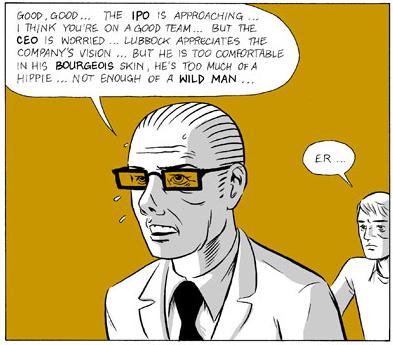
The travel-and-change phobia has been my constant companion in life. The prospect of going to college, going to graduate school in California, moving back to Houston several years later, and even relocating from one house or apartment to another in Houston, all conjured the shades of hell for me for weeks. Travel opportunities like a cruise, a vacation, or a science fiction convention in another part of the country, just give me the cold shakes for a week or so beforehand.

Even for me, though, some kinds of travel are relatively easy. After my grandfather's death, my grandmother, my mother and I moved to be with my mother's sister in Columbus, Georgia. That's where I grew up until I left home to go to college. (Read: tore myself away from home like tearing off a full-body bandage hoping and praying not to fall apart or bleed to death without the bandage on.) College was in Houston. Trips back home revealed that I like going west much, much, much more than going east. Every time I ever drove or flew back home to Georgia was traumatic. Going west, back to college, was always better. Not easy, but better than the prospect of traveling east. It was forty years before I stopped disliking pine trees because they remind me of the Southeast.

Once I actually set out on travel, I typically love it. It's the dread beforehand that nearly drives me crazy. Friends who've traveled with me can attest to this. After they pry me out of my house and put my baggage in our car or airliner or small airplane, and the wheels start rolling, I come out of anxiety-disorder-land and turn into a happy traveler. Every time I come home from anywhere, it literally, but very pleasantly, surprises me that my home is still in one piece, that my life is intact, that there there's food in the pantry, that all is well. That I can actually go anywhere without losing everything.

Things change. Not always for the worst, not even when it looks like it's going that way. A year and a half ago it became apparent that my mother has Alzheimer's. It looked like an utter nightmare on my doorstep. And part of it was going to be a lot of traveling to Georgia, where she still lives. In blessed irony, it has turned out better than I could have imagined. After a rather spectacular learning curve, I figured out that she should be in Assisted Living, found a remarkably good facility, got her there, and got a handle on her finances. I had unexpected, priceless, revelatory help all the way. From professional caregivers and Assisted Living staff to helpful financial professionals; from old friends and new acquaintances struggling with the issues of parents with Alzheimer's, to wonderful cousins in Columbus, I've had all kinds of good advice and unexpected help. I've been terrifically lucky. How many people have cousins who work in the estate sale business and know all the pathways taken by older folks in declining condition, and also know how to sell all kinds of belongings and the house too? They live five minutes away from the assisted living facility, and help my mother in small and large ways every week. They put me up when I go to Columbus. And I enjoy their roomy house, their neighborhood with a really good walking park, and most of all, having family. Thanks, this said in an utterly sincere tone, Roy and Judy.

It turns out that Mom is happy in Assisted Living. She's made lots of friends there and the staff like her. She somewhat resembles the good-natured, adventurous WAS she was years ago. I'm pretty sure the structure of Army life was very good for her, the structurelessness of being a housewife was bad, and the social vacuum entailed in being a divorced woman in the South in the 1960's was even worse. The mother I grew up with was inhibited and depressed. She organized her mental life around worrying about me, which didn't do my mental life much good. After she retired from teaching, she took up walking and dancing. Being active not only got her to the age of 85 in good physical health, it also gave her the social life she had lacked since her divorce. She brightened up. She connected with people. To give the devil its due, Alzheimer's may have knocked out some socially crippling inhibitions starting as much as eight or ten years ago. I also credit Alzheimer's with her becoming the mother who is vocally proud of my writing career, tells people her daughter is a writer, praises me for being smart and a hard worker, and cheers me on. I never heard anything like that from her for the first twenty years of my writing career, or while I was in graduate school or college either. But right now, in the golden interval between early Alzheimer's and the day it drastically disables her, I've been infinitely surprised to get the kind of affirmation from my mother that I always needed and never had before.

Best of all, through the journey of dealing with my mother's Alzheimer's, I got my grandmother back. Ruth Thomas Howard was a hard-working, intelligent, deeply religious, generous and charitable woman who did more than her share to raise me. But ever since my grandmother died, when I was eleven, it was as though I couldn't clearly remember her or feel what I once felt for her and what she felt for me. Maybe by that time I had overdosed on loss, but my friend Pat gave me an analogy that feels apt. Pat, like me, grew up an only child very much in the glare of parental fixation. After her mother died, Pat experienced something like static that went away. She was able to hold her grandmother more clearly in her mind and heart. Me too. The static went away, starting when I was clearing out Mom's house and finding some of my grandmother's things and the dishes she used to serve company on. She did love table fellowship, and she was a good cook and hostess. The dishes spoke to me.


At the end of my most recent trip to Georgia, I hit the road in my mother's Chevy Impala which my cousin Judy had cleverly loaded up with all of the things from my mother's house that I wanted to bring back to Houston. Included were Mom's army footlocker, my grandmother's favorite chair and her Singer sewing machine, plus a quilt and some dishes, scads of books, and all kinds of mementos from my childhood and college years. That was one well-stuffed car. I was overjoyed not only because this trip was going west (west is good!) but also because I could feel it healing my life. Now, in my Houston home, I have my grandmother's favorite chair, in my bedroom. Her Singer sewing machine graces my living room. I find it easier to remember her here and now than in my mother's house with the air between us full of that parental static. Last week I had people over for dinner, and channeled my grandmother while making preparations and making sure everybody had good food, drink and fellowship. It felt good and it was fun. A few weeks before that, I was at church, St. Stephen's Episcopal in Houston, which has a nice small church building with enough old wood that the air smells like the church I grew up in. That Sunday the director of music had skillfully sprinkled the liturgy with old Southern hymn music. There happened to be an empty spot on the pew beside me. I imagined my grandmother sitting and smiling there. When I later mentioned this to the Rector, she commented, "The community of saints is real!"

On the road trip back from Georgia in the well-stuffed Impala, I detoured from I-10 in Mississippi to go down to the coast and see how Biloxi and Gulfport have fared since Hurricane Katrina. Three years later the damage still shocked me. But when I stopped to wade in the Gulf of Mexico, the water was warm and soothing. I saw how in Biloxi in the U.S. 90 medians a lot of the stumps of shattered palm trees have been carved into birds and dolphins, like totems of life coming back.

Things change. Sometimes the change is utter disaster. But sometimes healing or recovery, or resurrection, comes after that.

~ ~ ~ ~ ~ ~ ~ ~ ~ ~ ~ ~ ~ ~ ~ ~ ~ ~ ~ ~ ~

So next week I'm off to Denver for the World Science Fiction Convention. I'm driving the Impala. It's really too big a car for me, and the gas mileage around town too low, and the styling a bit stodgy for my taste, so I may not keep it too much longer. But it's a comfy, cushy road trip car with lots of luggage room. I'll stop in Oklahoma to pick up another writer. If we want to, we can hit the dealers' room hard in Denver and easily pack the loot home. After the WorldCon, I plan to venture to Vernal Utah. I have part of a novel situated somewhere in that vicinity and I need to look around. In other words I'll go even further west. West is good.

This being the brink of a trip, that ol' debbil Travel is in play as always. I am half convinced that disaster will strike. I'll never make it home again. Or if I do I'll find my home burned to the ground or blown away by a hurricane. So it feels; I know those things aren't quite as probable as they seem. As a matter of fact, this is the least traumatized I've ever been about prospective travel. Things change and sometimes it's for the better.

Once the wheels are rolling westward, I intend to make it a joy ride.


You will survive


Who knew the NY Times had a "Wildlife Activities and Interests Section"? Must be an Internet thing.

Today being the first of August, the month in which we are all most likely to get lost in a thick green woods full of impenetrable bramble, froggy swamps, and predatory beasts, the paper of record provides fearful Manhattanites and their cross-country peers a variety of handy tricks for surviving lost in wild nature:

UNLESS John D. McCann, the managing director of Survival Resources, based in Hyde Park, N.Y., is wearing a suit for some sort of business meeting, he always carries in his pants pocket an Altoids tin. There are no mints inside it. Instead, he painstakingly packs the tin — which he explains can double as a mini-frying pan if you’re ever marooned in the wilderness — with a remarkable assortment of worst-case scenario supplies.

The contents include — but are not limited to — matches that Mr. McCann hand-dips in Thompson’s WaterSeal to waterproof them, a tiny magnesium fire starter, a small lens for igniting fires should the matches and magnesium fire starter fail, an L.E.D. flashlight, a button-size compass, a thin square of mirror to signal potential rescuers, 20 water purification tablets, a meticulously folded freezer bag to store potable water, a packet of antibiotic ointment, butterfly bandages, a sewing bobbin with 20 feet of fishing line, a dozen hooks, six weights, laminated instructions on tying knots and snare wire for capturing small animals. All in one Altoids tin.

Survival Resources markets primitive-living provisions, and Mr. McCann, 55, also teaches survival kit design, among other do-or-die subjects, to students attending its Survival Skills Weekends in Verona, N.Y., near Syracuse. Consider it an Eagle Scout crash course for adults.


Very cool. Perhaps this is what results from a society that combines persistent inducement of fear by the government with the lingering secret yearning for the liberating release of the "Cozy Catastrophe," of the trappings of civilization being torn down so you can roam the streets with the maximum liberty of, say, Charlton Heston in the Omega Man (who still kicks Will Smith in I Am Legend's butt), or physician Tom More in Walker Percy's Love in the Ruins, evading sniper fire by the interstate cloverleaf, busting gin blossoms while his three female companions wait in abandoned Howard Johnson's nearby.

If you go to the Survival Resources website, you can find samples of their pre-packed survival kits:


Turns out this John McCann actually has a whole book on the subject: How to Build the Perfect Survival Kit. The principle guiding this specialized craft? "An emergency can arise at anytime."


"Readers will learn about the nine component categories: Fire & Light, Signaling, Navigation, Water & Food, Shelter & Protection, Knives & Tools, Multi-purpose Items, and Miscellaneous Items.

"Armed with the kit-building techniques found in this book, You Will Be Prepared To Survive!"

Wow. What would you put in yours?

Is it possible that slipstream matriarch Kelly Link has read Mr. McKann's book, been personally tutored by him, or even worked as one of the elven kit-making assistants at his redneck Rivendell? In her effusive generosity to her friends and colleagues, Kelly has long been known for her love of giving extremely thoughtful gifts (particularly books), often to people she has just become acquainted with. As a technique to ensure the survival of the giver's memory in a position of prominence and fondness in the recipient's mind, it's hard to beat. This summer, under the tutelage of my betters at the Sycamore Hill Writers Workshop, I learned of Kelly's production of a custom line of post-McCannian survival kits, establishing herself permanently in the pantheon as Athena to an elect handful of literary Perseii. Among the recipients, the incredibly talented and architecturally inspired Richard Butner, who most likely can be found traveling undercover as a 13th century rogue at a Renaissance Faire near you.


Richard was kind enough to share with me recently the breakdown of his secret kit, and I can attest that it is a marvel of thoughtfulness, Yankee ingenuity, fabulist imagination, and Japanese-style packing techniques.


Without revealing trade secrets of the creator or the user, I will note that it contains, in order of importance:

- stuff to write with
- perfectly aged spirits
- Italy's finest hangover remedy
- things to figure out where you are and where you're going
- stuff to cut shit with
- stuff to fix the consequent cuts to oneself
- things that illuminate
- things that tie
- things to play with.

Nice. Richard's highly advanced twee-ometer is not included, having been surgically implanted within his body.

For a full literary exploration of this theme and a great summer novella, go read (or reread) Geoffrey Household's Rogue Male (now reprinted by increasingly awesome New York Review Books with a brilliant introduction by Victoria Nelson), a marvelous proto-Rambo tale in which an English gentleman, hunted by Nazi agents after nearly assassinating Hitler as a sporting play, literally goes to ground in an underground den of his own making in a tiny pocket of interstitial nature on the side of a country road.


Now go make your own kit, and head off the trail.