Showing posts with label Secret history. Show all posts

Friday, February 23, 2007

The Warporn Eucharist

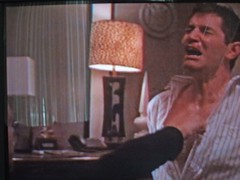
The February 19 issue of The New Yorker has a great article by Jane Mayer on the impact of the television War on Terror fantasy "24" on real-world public policy. Jack Bauer's imaginary L.A.-based domestic covert ops wing of the CIA, it turns out, is housed on the ground floor of a refurbished pencil factory in the San Fernando Valley, where America's enemies are interrogated every Monday night for the entertainment of prime time zombies like yours truly. The article notes that American TV now feeds us one hundred instances of torture a year, versus four before 9/11.


"The show's villains usually inflict the most gruesome tortures: their victims are hung on hooks, like carcasses in a butcher shop; poked with smoking-hot scalpels; or abraded with sanding machines. In many episodes, however, heroic American officials act as tormentors, even though torture is illegal under U.S. law. In one episode, a fictional President commands a member of his Secret Service to torture a suspected traitor: his national-security adviser. The victim is jolted with defibrillator paddles while his feet are submerged on a tub filled with water. As the voltage is turned up, the President, who is depicted as a scrupulous leader, watches the suspect suffer on a video feed. The viewer, who knows that the adviser is guilty and is harboring secrets, becomes complicit in hoping that the torture works. A few minutes before the suspect gives in, the President utters the show's credo, 'Everyone breaks eventually.'"


The article catalogues Agent Bauer's menu of techniques for immediate revelation, from brutish stab wounds to mock live video executions of a prisoner's family members. It then recounts the efforts of actual military interrogators to persuade the producers and writers to imbue the show with a more realistic portrayal of government agents conducting their interrogations in accordance with the law, citing their concerns that 24's representations of intelligence collection are distorting the public's view of reality, and influencing public opinion in an unhealthy way. Quoting a December 2006 report of the Intelligence Science Board:

"Prime-time television increasingly offers up plot lines involving the incineration of metropolitan Los Angeles by an atomic weapon or its depopulation by an aerosol nerve toxin. The characters do not have time to reflect upon, much less to utilize, what real professionals know to be the 'science and art' of 'educing information.' They want results. Now. The public thinks the same way. They want, and rightly expect, precisely the same kind of 'protection' that only a skilled intelligence professional can provide. Unfortunately, they have no idea how such a person is supposed to act in 'real life.'"
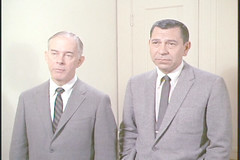


Recall a prior generation of L.A.-based Watchmen enduring a stressed out Zeitgeist: the Jack Webb police procedurals Dragnet and Adam-12, in which lonely sentinels of law and order exhaustedly administered Miranda due process to murderers, car thieves, pill popping moms, and spoiled Bourgeois hippies. Alas, Jack Bauer's lineage is more Bud White than Joe Friday – Judge Dredd with a Blackberry.


The intriguing allure of this brutalist cultural thread is compounded when Mayer name-checks some of the Washington notables who are big fans of 24: Karl Rove, Tony Snow, Laura Ingraham, Clarence Thomas, ex-Justice Department torture analyst John Yoo, Mary Cheney, Lynne Cheney ("an extreme '24' fan"), and Homeland Security Secretary Michael Chertoff. Justice Thomas' wife Virginia organized a Heritage Foundation symposium on the show, at which Secretary Chertoff praised the ethical credibility of the show's real-time bet-the-world utilitarianism: "Frankly, it reflects real life."


9/11 happened to a culture that had long before obliterated the barriers between consensus reality and the narrative delusions of technicolor media dreams. Consider the disturbing number of lawyers practicing today who were lured by "what's your movie" aspirations to realize their own inner Arnie Becker and Ally McBeal. Is it any surprise that our neoconservative sentinels and their dark dauphines enjoy spending their down time inside an action movie funhouse mirror of their day jobs? Celebrating situational nihilism as the dutiful resignation of the protective pater familias (the unappreciated Vietnam Vet meme never dies). How long before they start making cameo appearances? Or one of the taciturn mutual fund commercial terror-fighters gets recruited to head some bogus White House task force?

Skeptical that a pulp action TV serial could have a bona fide impact on public policy and its practitioners? Consider this intriguing lecture held last night at the University of Texas' Harry Ransom Center:

"Daniel Posnansky, retired faculty member of Harvard University, presents the Carl and Lily Pforzheimer Lecture "Arthur Conan Doyle on America: British-American Foreign Policy in the New Millennium" on Thursday, February 22, at 7 p.m. at the Harry Ransom Center.

"Posnansky will discuss the ways in which Arthur Conan Doyle and Sherlock Holmes influenced American foreign policy for decades after Doyle’s death, and continue to do so. He will bring samples of original materials from his personal collection, including letters of Harry S. Truman and Franklin D. Roosevelt, that quote Holmes and discuss his strategies for pressing foreign concerns."
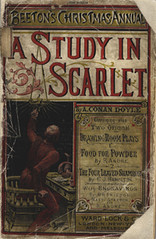


Any preference for Chertoff channeling Bauer versus FDR channeling Holmes?

Of course, Jack Bauer's raw and unlawful interrogation techniques are tame compared to the thinly disguised warporn at your local cineplex and Blockbuster outlet. Every few weeks brings a new torture-based shock thriller to amuse America's teens. Saw I-III, in which abductees are compelled to maim themselves to survive. Hostel, which envisions an underground torture club of paying tormentors and kidnapped victims in some corner of Slovakia that didn't make the latest "Let's Go." Turistas, The Descent, etc....these are not your brother's Reservoir Dogs.


When a colleague at the day job last fall said her weekend plans as a suburban mom included hosting her daughter's 12th birthday party at a showing of Saw III, my incredulity was compounded by further investigations at the parental film guide Kids-in-Mind.com. Dig the accidentally Ballardian, clinical catalog of the film's suburban Abu Ghraib, invisible literature for an age of terror:

VIOLENCE/GORE 10 - A man is screwed into an apparatus that we are told will twist his limbs: We see screws through his hands and feet and a metal ring around his head, the machinery begins to twist (we hear popping and cracking and tearing and see blood spurting), the man screams in agony, each limbs is twisted, and we see bones protruding through the twisted skin; then his head is twisted and we see the stretched skin on his neck and we hear a loud crunch when his neck breaks.

► We see a man with chains attached to him by rings that pierce his skin, his lip and Achilles tendons: we see him pull the rings out one by one, while he screams and blood flows, and he tries to reach for a bomb to de-activate it, but it explodes leaving him in pieces.

► An explosive device is detonated and blows a woman's head off (we see the blood and matter that remains above her shoulders).

► A man uses what looks like a toilet tank cover and pounds it down on his foot repeatedly crushing his ankle and foot (the man screams with every blow and we hear cracking and popping); he then snaps the ankle bone (we see the bone pushing through the skin and the foot is very bloody) in order to be able to slip out of a shackle that holds him attached to a pipe.

► A man uses a power saw to cut another man's throat (blood spurts and we see the man gag and spurt). A man shoots a woman in the throat (blood spurts and pours), she falls to the floor, and she gags and dies. A man is shot in the side of the head (we see part of his head and face blown off and blood spurts from the additional resulting neck wound).

► A woman wakes up from being unconscious, with a heavy metal ring around her neck, and an apparatus attached to her ribs (we see bloody hooks attached to her sides and blood drips on the floor); she reaches into a container of acid to retrieve a key that will free her (her hand is eaten away by the acid and the liquid turns bloody), her time runs out and the apparatus that she is attached to rips her rib cage apart (we see her fall limp and see bloody tissue flapping around).

► A medical procedure is performed on a man's head and we see the entire procedure: the scalp is cut and folded back, the skull is drilled into, a saw is used to cut a piece out (blood sprays on the surgeon's face) and the brain is exposed (we hear squishing, cracking, the whirring of a saw and drill and there is a lot of blood).

► A man with a very bloody foot wound drags himself through a dark hallway (we see his foot flopping around), he beats a woman with a metal pipe, she kicks him in the bad foot and he falls to the floor, he bites her on the leg, punches her and slams her head into a wall (we see her bloody head and face), and she spits in his face, kicks him and leaves.

► In a flashback to a sequence from the first "Saw" a woman locked into a head apparatus must cut a key out of a man's stomach in order to save herself, and she does so.

► A man injects himself with a drug that reduces his heart rate, his head is covered with blood and he lies down in a pool of blood on the floor (presumably it is animal blood, not his own).

► A nude woman hangs from her hands, which are chained to a metal frame, and she is sprayed with water periodically; the room she is in is a large freezer, and she is eventually completely encased in ice.

► A woman shoots a woman in the back, blood sprays on a plastic sheet, and she falls into a man's arms (we see blood on her clothes).

► A woman wraps a plastic bag around a man's head, he flails trying to get away, and he hits his head on a toilet (we hear the crack and see blood in the bag); he flails for a little bit longer and then falls dead.

► Armed police break into a room and are shocked by what they find: We see a room with very bloody body parts strewn around and bits of internal organs and tissue on the floor. A man shines a flashlight around a dark room and sees a dead man lying next to a severed foot (the man has blood on his face and the foot is covered with blood).

► A woman squeezes the blade of a saw and cuts her hand (we see blood pouring onto the floor and on her hand). A woman cuts herself on the leg with a large knife (we hear squishing and see old scars from previous cuts). A man struggles to reach a key, his cheek becomes frozen to a bar and when he pulls away from the bar the skin tears off (he screams and we see a bloody patch).

► A young boy is brought into an emergency room on a stretcher and has a bloody head wound and a bloody wound on his side (ER staff examine and stabilize him).

► A woman places an explosive collar around another woman's neck and explains what she needs to do to be set free. A woman locked in a locker room is attacked by someone wearing a pig mask, and she wakes up tied into a chair and struggles to get free.

► A man is chained around the neck to the bottom of a large vat, many decayed pig carcasses with wriggling maggots are dropped into a crusher, they are liquefied, the man in the vat is sprayed with the liquid and it begins to fill up (he is freed before he drowns). A man finds himself trapped inside a wooden crate, and he pounds on the crate until it falls from its perch and breaks apart on the floor below (he ends up with a bloody gash on his head).

► A woman attacks a man and incapacitates him (we see her knock him to the floor, then straddle him and we see him unconscious later). A woman shoots her gun through a closet door, reaches in to find something and is grabbed from behind and incapacitated.

► We see several disjointed sequences of a boy dying after having been struck by a car (there's no blood, and he is lying motionless on the pavement).

►  A man lying on the floor and chained to a pipe in a dark room struggles to reach a gun and then a flashlight. We see a young girl locked in a room.

► A woman with a knife threatens another woman. We hear a man screaming that he is going to kill someone. A man yells at a woman and she appears frightened. A husband and wife argue.

► We hear that a man has an inoperable brain tumor. A man finds a tricycle and a doll lying on the floor in a dark hallway and he remembers his son's fatal accident.

► A man has a seizure; he vomits, begins to thrash violently and spits blood. A man vomits (we see goo and hear him gag).

Roll over, Walt Disney. Time to turn on CNN for the latest beheading video. The news is a snuff film, and so is the matinee.

Postulate: When your nation is unleashing mayhem with remote control bombs on the other side of the planet and gurgling waterboards in the windowless buildings where no one can hear you scream, even though the resulting real-world carnage never appears on your dinnertime news feed or coffeetime front page, you know it's out there. It lurks in your subconscious, and needs to be processed. Pop culture provides a sugar-coated safety valve. Acted out in a waking dream, one where your filmic alter egos are both the victims and the perpetrators. In the gated cortex of the American mind, the motion lights flicker on after midnight, illuminating the lurking predators 'R us. Grab some buttered popcorn and a 48 ounce Diet Coke.



When the mainstream media mainlines warporn, one wonders what kinds of deeper moral crises this already-savage century is incubating in the minds of the world's adolescents. The imminent rise of the next generation will tell us whether this dark carnival of cathode ray mayhem is a prefatory Dionysian revel of 'obscene enjoyment,' or a more grounded ethical percolation designed to perform cultural C.P.R. on exhausted Christian aspirations for utopian love.

Tuesday, January 16, 2007

The Day After


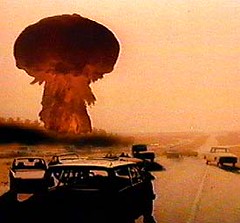
Fox has amped up the fear factor by opening the new season of 24 with a nice little mushroom cloud over Los Angeles. We watch with Jack Bauer from the vantage point of a perfect California cul-de-sac, where Jack has just rescued a family that was naive enough to help out the Arab family next door, only to discover they are *actual terrorists* (the son who makes suburban dad fetch the nuclear detonator amusingly played by the guy from Harold & Kumar Go to White Castle with a healthy dose of Spicoli — a perfect postmodern soldier of Hassan-i-Sabah). The pilot episodes warmed up the suitcase bomb with several scenes of intense torture inflicted by both sides (our hero scarred by Chinese interrogators like a Mel Gibson messiah), detention camps of American citizens straight out of an Alex Jones fever dream, and the lives of millions balanced on edge as the IT guys fight their Dilbert-meets-Melrose Place office battles.


24 has achieved near media ubiquity and all the best ads, reflecting its gift for mainlining the Zeitgeist since it premiered the same month as the September 11 attacks. The genius of 24 is its simulated realism, situating our contemporary geopolitical anxieties in the milieu of of Hollywood's imaginary version of Los Angeles.

The cliffhanger-on-speed plotting of 24 keeps us from ever giving much thought to the colossal anachronism at its narrative heart: the fate of the world persistently determined by the acts of a small group of meta-cops in the L.A. branch of a non-existent domestic ops division of the CIA. We buy it implicitly, our imaginations having been so well-nursed by Hollywood over the past century: Los Angeles is the primary soundstage of our dreams and nightmares. The streets the cops cruise, the deserts the cowboys cross, the planets Kirk beams down to. And, most importantly, the venue where most apocalypses occur. (Just ask Mike Davis.)


The world of 24 operates in accordance with the logic we believe — the narrative logic of police procedurals and disaster movies (informed by hundreds of hours of seminars in which nascent screenwriters internalize Joseph Campbell's distillation of the heroic über-myth). Jack Bauer is a direct descendant of Adam-12 Officer Pete Malloy and his kin, the law and order paranoia of the 60s amplified into the nuke next door (too bad they went for James Cromwell as Bauer's dad rather than Martin Milner). Just as Martin Milner matured from the frat boy beatnik Hemingway of Route 66 to become the lonely dutiful white guy playing patrol car whack-a-mole as the world went mad, Kiefer Sutherland leads the way as the Brat Packer devolved into a post-Clancy fighting machine who's not afraid to torture the enemy when it suits his real-time utilitarian calculus. And 24's terrorists are straight out of the Starsky & Hutch playbook — quintessential California Windbreaker Hoods mixed with a little Yellow peril.


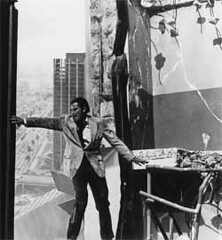
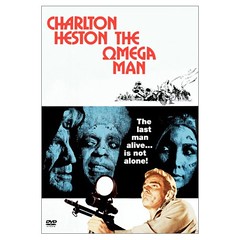
As Hurricane Katrina played out last year, you could hear the collective gears grinding as our actual societal response to the disaster failed to conform to the Hollywood disaster movie paradigm. The master narrative calls for Charlton Heston, the solitary American professional who achieves heroics through self-reliant individualism, in some cases literally holding the world together as it cracks apart. Mass catastrophe, it turns out, is not amenable to resolution by lone Western heroes. That only works on the micro-scale -- the lone yuppie father, loading his family into the Volvo to escape to the Houston Four Seasons Hotel, to the in-laws in a nice white neighborhood in Memphis, barely evading the hordes of vampiric zombies that will rape and eat them all if they fail to make it out before the giant tidal wave hits.


Watching Kiefer Sutherland tackle the horns of the GWOT's dilemmas with the taciturn decisiveness of a rodeo cowboy is far more therapeutic than confronting the failure of reality to conform to the master narrative. See, e.g., the unresolved effort to find Osama in his Blofeldian mountain lair; the failure of Iraq's fractured society to gestate some saccharine Jimmy Stewart fantasy democracy. Nb. the quickly forgotten staged mythology of Jessica Lynch. Kiefer Sutherland's real-world analog may be Pat Tillman.

Is the real challenge for our leaders to do a better job of imposing the American myth on the reality-based community? We await the imminent appearance of "Jack Bauer for President" buttons.

Friday, January 5, 2007

A Secret History of 1975

Memories of the Ford Administration


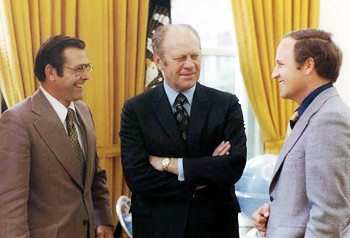
The years of the Ford Administration, from late summer 1974 through the end of the Bicentennial, lurk in my memory as cultural interstitia. A minor Midwestern limbo between "the Sixties" and "the Seventies" during which nothing appeared to happen, but powerful memes of future change were cryogenically sealed in the sub-basement with the remains of Walt Disney.


During those years, they renovated the old mall in my hometown (which had originally been built on the site of a monastery much older than the surrounding suburb) to double its size. The central feature of the new wing was a rounded bi-level courtyard anchored by such mid-70s retail landmarks as a Spencer's Gifts, a leather clothing store, a Biorhythm reading machine, a pet store specializing in hamsters, gerbils and Habitrails, a magic supply store, and a B. Dalton bookstore.


On the ground floor, the developers installed a larger-than-life bronze sculpture of a nude and anatomically correct man with a handlebar moustache riding a gigantic tricycle. No explanation was provided.

I seriously doubt such an aesthetic enigma would have been viable in any other period than the Ford Administration. After the Sixties had blown gaping holes in all of the cultural conformities of the Fifties, and before the consequent opportunities for hedonism morphed into the coked out Seventies.

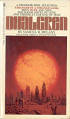
In that B. Dalton, you could still find fresh how-to books of American insurrection, from The Anarchist's Cookbook to The Monkey Wrench Gang. If you were the sort of kid who frequented the science fiction shelves, amid the Bama bronzes and the Frazetta cheescake, you might discover the featured new Bantam paperback of 1975: Samuel R. Delany's Dhalgren. A Frederik Pohl selection!


The cover offered your average pre-adolescent nerd a familiar fantasy of wandering the post-apocalyptic landscape, a power meme drilled in by a steady stream of Charlton Heston cozy catastrophes. The interior was something much more, its tale of a mysterious Midwestern city cut off from the rest of civilization by an unknown catastrophe serving as the narrative vessel for an experimental novel of consciousness. The inhabitants of the book willingly linger in their meandering dystopia, wallowing in the implosion of conventional social structure. A prescient masterpiece, but not exactly mainstream commercially accessible fare. Only during the Ford Administration would such a work sell a million copies.

For me, Dhalgren tunes the existential frequency of that peculiar period as well as any other contemporary work. A crackled transmission from a mirror reality, accidentally tuned in on translator channel 72.

The dream of revolution becomes a non-sequitur, running out of gas. Enjoy the laser show and pass the spliff.


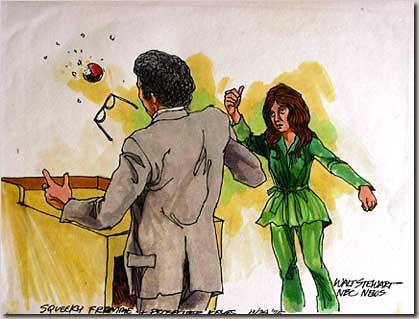
Presidential assassins become openly surreal. Only during the Ford Administration could one of Charlie [Manson]'s Angels emerge as a risible self-parody of political violence (check out RU Sirius' awesome post this week at 10 Zen Monkeys on"The Chicks Who Tried to Shoot Gerald Ford").


Urban legends trump real news in the aftermath of Nixon and the War. Rumors abound, spread by boys as their neighborhood matinee houses are repurposed as grindhouse pornos. The secret post-history of the cast of Leave it to Beaver: Wally was a cop, Eddie Haskell was Alice Cooper, and the Beav got fragged in Nam.


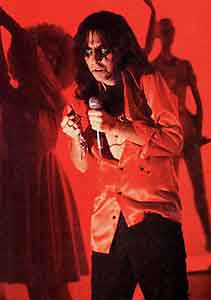
Somebody's dad's friend who worked at the hospital told astonishing tales of the midnight emergency room visit of a famous rock star when he played his recent show at Veteran's Auditorium (see Number 6). Put your finger on the turntable and turn it counterclockwise for the real story.


The 20th century utopian dream of radical change was definitively snuffed by the masterful anti-climax of President Ford's primary executive act, the anthems of the earnest replaced with self-amused irony stoned on pop culture junk food.

At my elementary school, designed on an experimental open plan, we buried a Bicentennial time capsule. Therein, we hermetically sealed a variety of artifacts of the end of the jet age, the clandestine history of that eighteen-month epoch backmasked onto forgotten vinyl LPs in the voices of children possessed by the frequency modulated spirits of the cathode ray, the sound of an Emergency Broadcast System test played backwards. The capsule is not to be opened until 2076, but on some days it seems the secrets are already seeping out, deep sleeper culture agents lurking among us, awaiting activation orders from headquarters.

Tuesday, December 26, 2006

The Noriega Playlist

A Christmas story of how Billy Idol defeated Manuel Noriega and ended the 1980s.


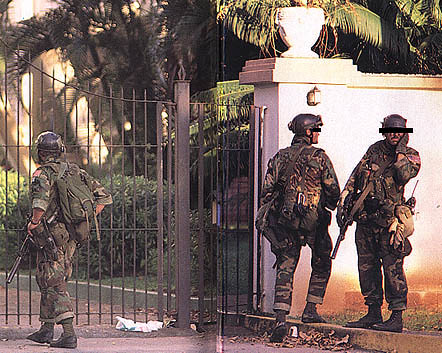
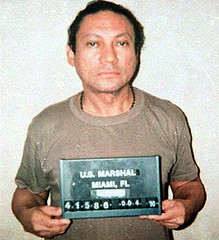
Fifteen years ago, on Christmas Day 1989, Panamanian strongman Manuel Noriega sought refuge inside the Papal Nunciatura (the Vatican equivalent of an embassy) in Panama City. American troops quickly formed a perimeter outside. While the idea of the 75th Rangers going commando on the Vatican has a certain alt history elan, cooler heads prevailed and negotiations for Noriega's surrender commenced.


President George H.W. Bush had initiated the invasion, styled Operation Just Cause, five days earlier. (Originally, the code name was "Operation Blue Spoon," incorporating elements of "Operation Nifty Package" and "Operation Acid Gambit," all derived from earlier Panama invasion plans maintained in the "Prayer Book," including "Operation Purple Storm" and "Operation Bushmaster." For an obsessively detailed studied of the peculiar etymology of Pentagon code names and what information is encrypted within them, check out William Arkin's Code Names or his killer blog Early Warning at The Washington Post.)

(As dramatic as the invasion sounds, it had a lot of competition for 1989 holiday viewers' attention. The Iron Curtain was dramatically crumbling, and the preceding week had also carried dramatic coverage of the revolution in Romania, which included amazing footage I vividly remember of a bunch of armed civilians taking over the live studio broadcast of the Romanian national television network, picked up real-time by CNN. Bush and Gorbachev declared the end of the Cold War, free elections were held in Mongolia, and the Simpsons premiered.)

On Christmas morning, U.S. Army General Maxwell "Mad Max" Thurman (a/k/a "The Maxatollah") talked mano a mano with Monsignor Jose Sebastian Laboa at the gate of the Nunciatura. The compound was near several high-rise hotels. As Thurman turned to leave, a reporter hollered from an upper floor window of the Holiday Inn: "Hey, General Thurman, how 'ya doin'? Merry Christmas!"

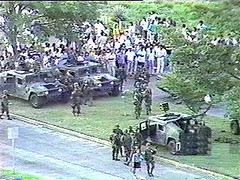
Fearing reporters could eavesdrop on his negotiations using parabolic microphones, Thurman ordered a music barrier be erected around the embassy. The 4th PSYOP Group rolled in a fleet of Hummers mounted with loudspeaker arrays. Conveniently, this being Panama, there was already an Armed Forces Radio station in the city under American command.


The first day, December 25, it was all Christmas music. By December 27, the PSYOP troops had taken over the Armed Forces Radio playlist, and they unleashed a barrage of the same tools of psychological warfare they deployed back home from the windows of their Chevy Novas: classic rock.

Noriega loved opera. He got Styx.


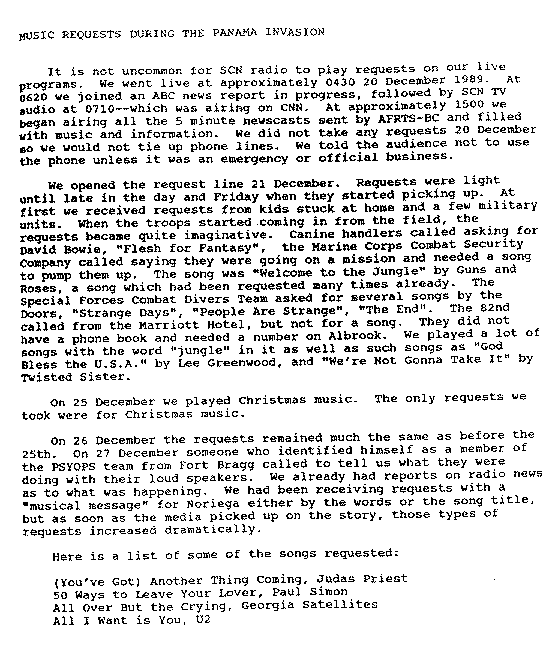
The station had been playing requests for the troops since the invasion began, as reported in a post-op memorandum:

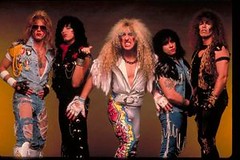
"When the troops started coming in from the field, the requests became quite imaginative. Canine handlers called asking for Billy Idol, 'Flesh for Fantasy,' the Marine Corps Combat Security Company called saying they were going on a mission and needed a song to pump them up. The song was 'Welcome to the Jungle' by Guns and Roses, a song which had been requested many times already. The Special Forces Combat Divers Team asked for several songs by The Doors, 'Strange Days,' 'People Are Strange,' 'The End'...We played a lot of songs with the word 'jungle' in it as well as such songs as 'God Bless the U.S.A.' by Lee Greenwood, and 'We're Not Going to Take It' by Twisted Sister."


Unsurprisingly, the whole thing took on its own manic momentum, the reporters delighting in the Col. Kilgore meme as the Zeitgeist injected itself into this minor historical moment, speaking volumes to the imminent spirit of the age.

The complete playlist is available at George Washington University's National Security Archive. Among the highlights:

(You've Got) Another Thing Coming - Judas Priest
Blue Collar Man - Styx
Danger Zone - Kenny Loggins
Dead Man's Party - Oingo Boingo
Don't Look Back - Boston
Electric Spanking of War Babies - Funkadelic
Heaven's On Fire - Kiss
If I Had A Rocket Launcher - Bruce Cockburn
In My Time of Dying - Led Zeppelin
Iron Man - Black Sabbath
Judgment Day - Whitesnake
Jungle Love - Steve Miller
No More Mister Nice Guy - Alice Cooper
Paradise City - Guns & Roses
Panama - Van Halen
Paranoid - Black Sabbath
Refugee - Tom Petty
Renegade - Styx
Run Like Hell - Pink Floyd
The Party's Over - Journey
This Means War - Joan Jett
Wanted Dead or Alive - Bon Jovi
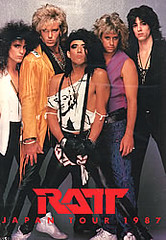
Wanted Man - Ratt
War Pigs - Black Sabbath
We're Not Gonna Take It - Twisted Sister
You Shook Me All Night Long - AC/DC
Your Time is Gonna Come - Led Zeppelin


Noriega surrendered on January 3. He is currently imprisoned in a federal correctional facility in Miami, scheduled for release next September. (Check out This American Life's story of the 10-year-old girl from a small town in Michigan who became Noriega's pen pal.)


The use of rock music as instrument of psychological warfare has evolved since then, as evidenced by the confirmed reports of enemy combatants being tortured with Metallica and the "Barney" theme in a shipping container on the Syrian border (as brilliantly explored by Jon Ronson in his excellent Men Who Stare at Goats). Though revolutionary at the time, and considered excessive by President Bush 41 and General Colin Powell, The Noriega Playlist now seems a kinder and gentler riff from a time when our geopolitical nihilism was young.


I have created an iMix at the iTunes store with the bulk of The Noriega Playlist for your holiday listening enjoyment. We are open for comments as to what might be a likely playlist for Tehran or Pyongyang.

(I will be headed to primeval territory not far from the Nunciatura for the next 10 days, so don't count on another post from me until January 5 or so. Happy New Year!)