Showing posts with label utopia. Show all posts

Thursday, December 14, 2006

A Personal Perspective on ISAAC ASIMOV'S UTOPIAS and others

Part Two


Though attempts at true, unambiguous Utopias, perfect or ideal societies, are rare in science fiction, they do exist. In most, a threat to the utopian status quo is central to the plot, or the utopia is not yet founded and must be built in the face of opposition, or both. Examples include Robert A. Heinlein’s Beyond this Horizon and The Moon Is a Harsh Mistress, Ayn Rand’s Atlas Shrugged, Marge Piercy’s Woman at the Edge of Time, Theodore Sturgeon’s Venus Plus X, and ‘If All Men Were Brothers, Would You Let One Marry Your Sister?’, Arthur C. Clarke’s Childhood’s End, Pat Murphy’s The City, Not Long After, George Turner’s ‘Shut the Door When You Go Out’ and ‘I Still Call Australia Home’, and Spider and Jeanne Robinson’s Stardance trilogy.

All of these stories have, at their core, simple solutions to problems that the authors suggest prevent this world being perfect. The Heinlein novels propose heavily armed anarchy with a tax-free user-pays economy. Rand’s ‘Galt’s Gulch’ abolished altruism and sanctified financial reward as the only worthwhile reason for doing anything. Piercy’s future enabled sexual equality by removing the burden of pregnancy from women. Sturgeon’s ‘Ledom’, even more radically, was populated exclusively by fashion-conscious hermaphrodites with little or no testosterone, while his Vexvelt becomes paradise because of the abolition of incest taboos. Clarke’s ‘Golden Age’ is founded on realistic technological advances and the abolition of nationalism, and funded by the abolition of military spending. Murphy’s San Francisco is an artists’ commune trying to non-violently resist armed invaders. Turner’s Gaia has humans perfectly attuned to the living planet, while his world in ‘I Still Call Australia Home’ has stabilised the population and created a sustainable society by creating a feminist religious state that resembles that of Tepper’s ‘Women’s Country’ without the warriors. The Robinsons’ trilogy ultimately sets humanity free by allowing them to survive unprotected in space, making them telepathic, and - ultimately - abolishing gravity altogether, which may not be the least practical of the solutions suggested but is certainly the most difficult to try as a small-scale experiment.

Debating how well any of these societies might function would take many volumes, but all serve to demonstrate one of the problems with creating a fictional utopia: how many readers will think it’s a dystopia instead? I would even suggest that the more perfect the match between a fictional utopia and the writer’s personal vision of paradise, the fewer people would actually want to live there.

(To be concluded)

Friday, December 8, 2006

A Personal Perspective on ISAAC ASIMOV'S UTOPIAS and others

Part One

Being a science fiction writer by trade, I’m slightly embarrassed to admit that my favourite utopian story is not science fiction at all, but the movie Local Hero (1983), in which a rootless Houston oil executive falls in love with a small Scottish seaside town that he’s been instructed to buy. While he becomes increasingly reluctant to do his bit to turn the town into a refinery and destroy its beauty, the townspeople envy his life as much as he envies theirs, and are eager to close the deal… and as much as I love the movie, I wouldn’t choose to live in the town, either (for one thing, it has no library). Unlike too many science fiction utopias, Local Hero acknowledges that paradise is personal; one size does not fit all. While science fiction writers have often succeeded in imagining worlds that are better in some ways than the present - more comfortable, more exciting, more just, and so on - I suspect that no-one will ever envision one that will be widely accepted as ‘ideal’ or ‘perfect’, a true utopia.

As an example of this difficulty; in 1999, I received a cheque from the publishers of Asimov’s Science Fiction with a rather cryptic note that this was payment for a story of mine that they wished to reprint in the anthology Isaac Asimov’s Utopias. One detail not mentioned was the title of the story. I was, of course, pleased to receive the cheque, but I was still curious. There were two stories I’d had published in Asimov’s which I thought might qualify as taking place in Utopian settings, and I wondered which they might have chosen… so I e-mailed the editors to ask. They couldn’t remember the title, but they were sure it belonged in the anthology.

Utopia, it seemed, was in the eye of the editor.

Later that year, editor Gardner Dozois invited me, and four of the other authors with works in the anthology - Brian Stableford, Tom Purdom, Kage Baker, and David Marusek - to join in an on-line chat titled “Find Utopia”. In it, he offered the following explanation of his choice of some of the stories:

One thing I realized when putting this UTOPIA anthology together, is that there are very few stories that are about good-functioning Utopias. That's because a well-functioning Utopia is BORING. Where's your plotline?

MOST Utopian SF stories, and most of them in the book, are about Utopias where something has gone WRONG, or they've come up against some major problem. OR from the perspective of somebody in the society for whom the Utopia ISN'T a Utopia.

The story of mine the editors chose was ‘Transit’, set in a future where humanity has settled many planets with the help of a more technologically advanced alien race, where material comfort is assured by robotic factories, and where ‘monosex’ humans - males and females as we know them - are outnumbered by human hermaphrodites such as the narrator. It was an interesting choice, because I had not set out to create a utopian society in this story, which is essentially a teen romance between a hermaphrodite and a young Muslim woman, both of whom must contend with their respective fathers’ xenophobia. If I had intended to create a truly utopian society, such prejudices would be extinct and the Romeo and Juliet-inspired plot would have had to go… and as a writer, I’ll give precedence to plot over setting any time. As Tom Purdom remarked in the chat: SF is supposed to offer stories, not just ideas about the future… I think in SF we still think of the future as a time when things can be better. But better. Not ideal. Not perfect.”

True to this formula, the other stories in Asimov’s Utopias describe worlds that are in some ways better than the present, but do not seem to aspire to perfection: all are stories, with conflict and at least the possibility of unhappiness. Though the book’s blurb states that “science fiction writers present their own provocative visions of what an ideal world is really like”, the individual stories belie this. Ursula LeGuin’s ‘Mountain Ways’ “reveals the price you must pay when you give up on all you are supposed to believe in.” Bruce Sterling’s ‘Bicycle Repairman’ concerns a “struggle to remain independent in a dangerous and uncertain future”. The protagonist in Brian Stableford’s ‘Out of Touch’ does little but complain; David Marusek’s ‘Getting to Know You’ is set in a crowded subterranean hospice for the dying; Kage Baker’s ‘Smart Alec’ must contend with a world which is safe but where “nobody gets to have any fun”.

(To be continued)


Friday, December 1, 2006

Starring Ethan Hawke as Bakunin, Billy Crudup as Belinsky, and Jerry Mathers as the young Kropotkin

(Revolution, Utopia, Science Fiction and Popular Culture)

Am I the only one puzzled by the well-coordinated establishment media plugging of the new Lincoln Center production of Tom Stoppard’s The Coast of Utopia, featuring a cast that includes a bunch of Hollywood actors subtextually marketed as the ones that can read?
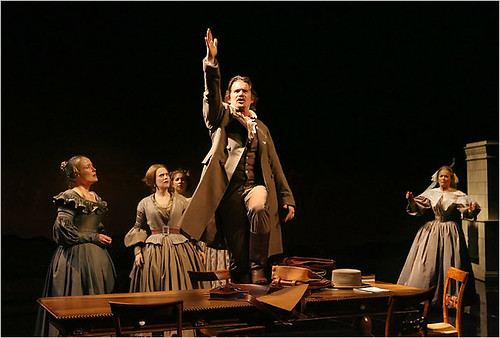
It’s such a fearless dance with self-parody, you have to admire it. I only wish it were a musical. With Hugh Jackman belting out some bombastic number about Fichte, Schilling, Kant and Hegel. That would completely rock.

The Sunday profile of Stoppard by Daphne Merkin is so over the top in its Byronic adulation…

"…Stoppard would be a striking presence in any setting, with his glamorous half-rocker, half-brainiac looks: the poetically shadowed dark eyes, voluptuously puffy mouth, pre-Raphaelite head of tousled graying hair and elegantly insouciant style of dressing, which all three times I meet him feature as its centerpiece a chicly weathered (but brand-new) leather jacket that looks like something out of a John Varvatos ad and one or the other natty pair of shoes — today’s are a Tod’s white canvas number, and on another occasion he wears a pair of elegant leather sneakers by Zegna.)… I look at him and am struck by the aura of louche glamour he carries — like a lounge lizard who reads Flaubert — daring you to cause ripples in his carefully arranged and well-defended image…"

…that this minor spectacle feels like a fresh illustration of Thomas Frank’s thesis about how good American business is at co-opting revolutionary spark to turbocharge the machine.
Here, some presumably earnest effort (a sprawling trilogy, no less) to explore the personal social experiences behind the birth of 19th century anarchist theory and revolutionary action, repackaged as the Russian Les Miz. After all, we outspent them into the dustbin of history, so now they’re a bunch of harmless Bohemians no more threatening than characters from Woody Allen’s Love and Death.

(And it's probably good, though I personally will have to wait for the road show to make it to Texas, no doubt featuring Donny Osmond and the rest of the cast from the touring version of Joseph and the Technicolor Dreamcoat).
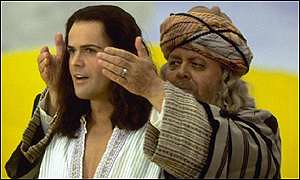
If this is what it takes for the American Mandarins to start thinking about Utopia again, who can complain? They apparently can’t count on either of the formerly likely sources: political activists and science fiction writers.

Fredric Jameson addressed the question with exhaustive cogency in last year’s Archaeologies of the Future: The Desire Called Utopia and Other Science Fictions.

Is the idea of Utopia rendered completely frivolous in a world that has made the cyberpunk dystopia so completely real? In a world where the pragmatic inevitability of market capitalism seems to have proven the inherent truths of its basic assumptions about the innate self-interest at the core of human nature?

The line of Utopian political theories traced by Edmund Wilson in To the Finland Station, from Fourier’s whimsically considered theories of young boys as society’s natural garbage collectors to Lenin as the ultimate Red World Historical Figure riding the rails to his date with History at the dawn of the 20th century, died with the Soviet Union and the permanent discrediting of Marx as a viable source of tenable theories of political economy. The last vestiges of socialist rhetoric have disappeared, even in their disguised forms, from the mouths of mainstream left-of-center politicians. Leaving a diluted nothing in their place, a non-ideology, an ad hoc set of reactions to the putative realism of their opponents - a kinder, gentler market capitalism.

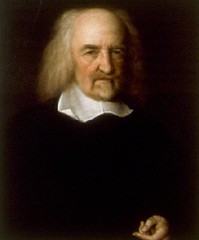
Without Utopian aspirations for a better world, daring to imagine alternate paths whereby our entropic Hobbesian tendencies can be transcended in this life, our political discourse loses the weighty counterpoint to dismal (if pragmatic) realism that is essential to produce moral progress apace with the technological and creative progress propelled by capital.

Who let the Wolves out?


This intellectual and moral vacuum is a natural opportunity for science fiction to realize its social potential. But credible visions of a better society are scarce among the recent products of the self-proclaimed literature of ideas. It's so much easier to look backwards and spew out a few more Alternate Hitlers.

Any notable candidates for a compelling utopian vision among SF of the last ten years or so? Jameson has a nice piece on Kim Stanley Robinson’s Mars trilogy as a work of political realism exploring efforts to implement Utopian theories on a new world.



He has to look back further for the rest: Aldiss, LeGuin, Van Vogt, Stapledon, Dick.

How about some next generation revolutionary heroes, even if they don’t have a fresh program? China Mieville carries the Wilsonian torch in Iron Council (To the Perdido Street Station, as Michael Dirda suggested?)

One is hard-pressed to find any others - maybe Robert de Niro’s guerilla plumber in Gilliam’s Brazil?


Surely an age dominated by the mainstream dystopian vision of the immanent present depicted in Fox’s highly addictive Jack Webb-meets-William Gibson serial 24, in which American Presidents who oversee torture interrogations of pernicious political journalists are depicted as tough-minded realist champions of our precious way of life, is worthy of a fictional bookend that imagines a happy ending to the current geopolitical apocalypse-in-progress.

The United Federation of Planets doesn’t count.

Neither do Che Guevara T-shirts, even when they are mixed with the visage of Cornelius.


The best I can find: A couple of seasons back, 24 had an interesting narrative thread that wasn’t fully played out. Mia Kirshner plays Mandy, a hot American revolutionary living in an apartment complex full of other twentysomethings, into which she lures CTU Agent Tony Almeida. Melrose Place with AK-47s. How’s that for high concept?



Surely it’s only a matter of time before a culture that has produced as many bona fide Utopian experiments as ours, a culture that is premised on a revolutionary mythology, finds those threads resurgent in popular culture.

Consider the possibility for a spinoff that follows the adventures of 24’s L.A.-based anti-CTU: real American revolutionaries, bisexual Abercrombie narcissists with white teeth, clean pores, and credit cards, dedicated to blowing up all the ugly shit. It would make a hell of a reality program, worth it for the product placement alone.

And when you read that Mia Kirshner’s qualifications include studies of “Russian literature and the 20th century movie industry at McGill” (how’s that for a double major?), you’ve got to wonder how the Mandy Manifesto would read. HALO-drop her onto the Coast of Utopia, and see how revolutionary pulp action matches up against literate monologues.