Tuesday, July 1, 2008

More Apollocon!

You didn't think I was finished posting images, did you?

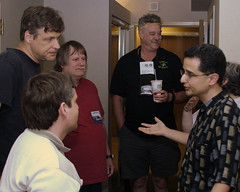
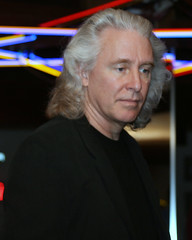
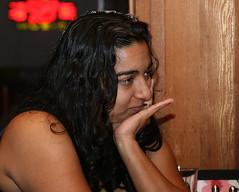
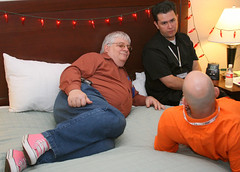
apollo08_32apollo08_31


apollo08_33apollo08_36


apollo08_34apollo08_35


apollo08_37apollo08_41


Apollo08_38apollo08_39


apollo08_40apollo08_46


Okay, about the plane image below... Saturday afternoon, around 5:30 or so, I stepped out to the parking lot to put some stuff up in my car, and was met a serious thundering rumble. The con hotel is right in the flight path of Houston Intercontinental, so jets flying overhead isn't anything new. But this cargo jet took "overhead" a wee bit too literally. The shot was taken with my 28-135mm lens at the 28mm setting. No zoom at all. This plane cleared our hotel by maybe 100 feet, tops. Ditto for the buildings across the street. Another con-goer in the parking lot looked at me, then we both turned and scanned the immediate skyline for signs of smoke and/or fire from the expected crash. Seriously, the plane looked to be struggling. When nothing immediate happened, the guy wondered aloud if we should call 9-1-1. I assume they made it to wherever they were going safely, because I saw nothing about a devastating crash on the news, but boy, that wasn't a pleasant sight.

apollo08_42apollo08_43


apollo08_44apollo08_47


apollo08_45apollo08_48


These last two are my favorites. For obvious reasons.

apollo08_50apollo08_51

Monday, June 30, 2008

Apollocon in the rear-view mirror

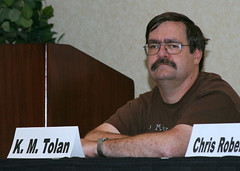
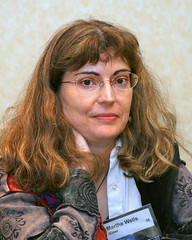
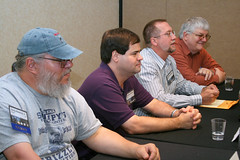
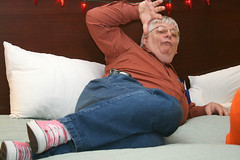
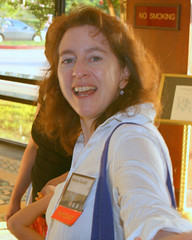
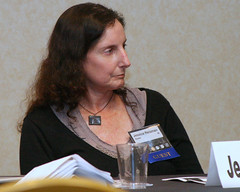
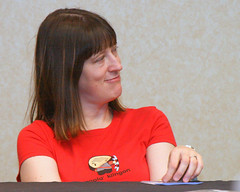
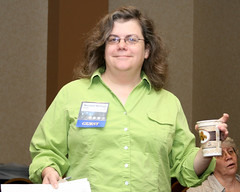
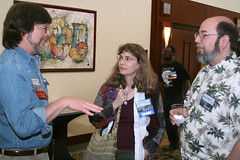
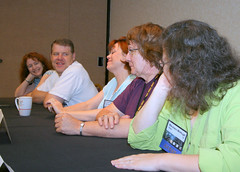
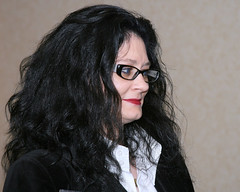
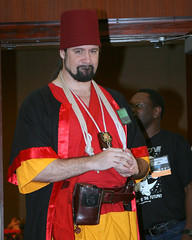
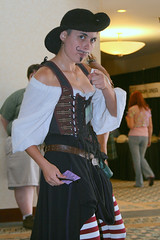
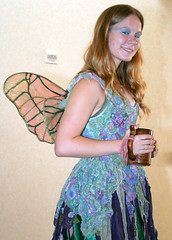
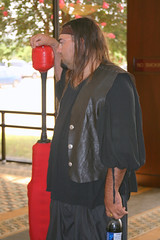
Apollocon, Houston's contribution to the SF firmament, has come and gone. I, for one, had a fine time, fumbling my way through several panels in the role of moderator and striking up all manner of interesting conversations over the course of the weekend. I lugged my camera along, and wasted little time in ticking a bunch of folks off with my shutterbug activities.

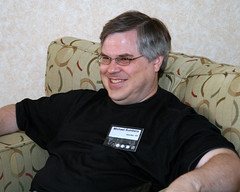
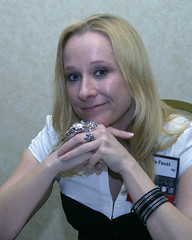
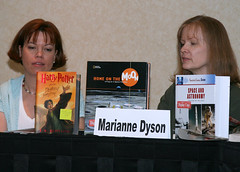
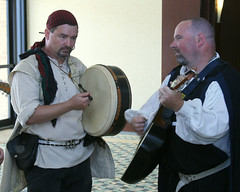
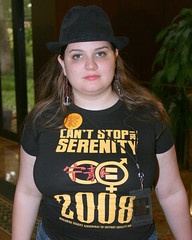
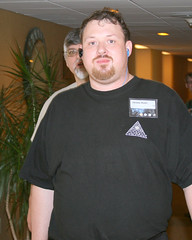
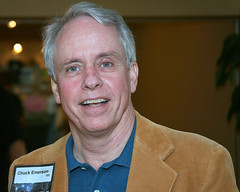
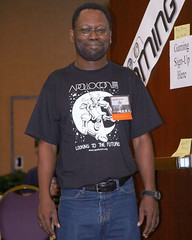
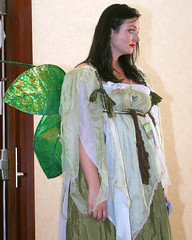
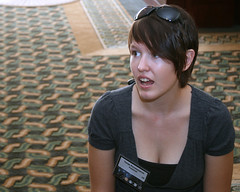
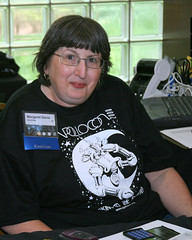
Here's the first processed batch of images for your enjoyment. Notice that a whole troop of folks from the Texas Renaissance Festival stopped by. I haven't identified the people in the pictures yet, but they know who they are--and anyone wanting to go into Flickr and help out with all the IDs are more than welcome to do so:

Apollo08_01Apollo08_03


Apollo08_04Apollo08_02


Apollo08_05Apollo08_06


Apollo08_08Apollo08_07


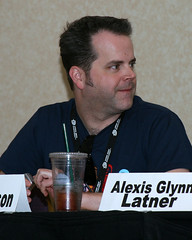
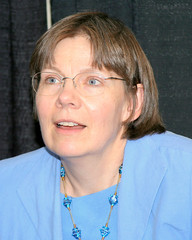
Apollo08_10No Fear of the Future contributor Alexis Glynn Latner


Apollo08_13Apollo08_12


Apollo08_14Apollo08_11


Apollo08_15Apollo08_16


Apollo08_17Apollo08_18


Apollo08_19Apollo08_20


Apollo08_27Apollo08_21


Apollo08_22Apollo08_24


Apollo08_23Apollo08_25


Apollo08_28Apollo08_30


Apollo08_26Apollo08_29


You'll notice that No Fear of the Future contributor Alexis Glynn Latner is well represented here, while Chris Nakashima-Brown isn't. Apparently, Mr. Nakashima-Brown had better things **coughcoughSycamoreHillcoughcough** to do than support area conventions. That's fine. We'll remember that the next time he phones at 3 a.m. needing help with a quarter-scale paper mache reconstruction of the Texas School Book Depository...

Friday, June 27, 2008

Salvador Dalí's Fantastic Voyage


I spent last week attending the Sycamore Hill Writer's Workshop with a dozen of my betters, an intense and rewarding experience.

The "story" I brought to the workshop included a rather odd "scene" in which CNN's Anderson Cooper and a team of other 21st century reality celebrities are miniaturized in the style of the 1966 Richard Fleischer film Fantastic Voyage, exploring the interior anatomy of Osama bin Laden, only to be overtaken by hijackers. Hey, it could happen. The episode is marketed by the network as "Anderson Cooper's Fantastic Voyage."


So, imagine my surprise this morning when, polishing up this segment for submission as a short short, I discover a real world work of art based on the movie by no less than Salvador Dalí. Titled, natch, "Salvador Dalí's Fantastic Voyage" ("le Voyage Fantastique").


Bizarrely, the studio managed to recruit the Catalan surrealist to produce the world's most far out lobby cards ever. The Salvador Dali Society explains:

Inspired by the classic Science fiction film of the same name, Salvador Dalí painted Fantastic Voyage welcoming an eerie sense of surrealism and fantasy that transports the viewer into their own "Fantastic Voyage." The film concerns a group of American Scientists frantically working to save the life of a colleague. The task at hand involves a mission inside the scientist's body to remove a deadly blood clot. To accomplish this, the crew shrinks their vessel and themselves in order to access the clot. The film starred Stephan Boyd and Racquel Welch.

Dalí worked with the film's studio, 20th Century Fox, to promote the movie's New York release. The campaign was documented by filmmakers Albert and David Maysles and subsequently made into a short eight minute film titled Salvador Dalí's Fantastic Dream. The footage shows Dalí crusading around New York City using his celebrity to draw attention to the film's premiere.
The movie intrigued both critics and audiences and went to achieve box office success and was the recipient of many awards. It has since become a landmark in cinema, often praised for its use of special effects.

Dalí's painting seems to suggest an all together different "Voyage." The voyage in the film entails going inside of the human body. Dalí interprets the voyage as not going inside of the body but inside of the mind to explore its vast dimensions. Thus we are presented with a portrait of Dalí's subconscious. One can visualize the path laid out for the viewer as Dalí's "Voyage." We see reminiscense of older work suggested by the grand piano and telephone. Here Dalí sought to embody the spirit of the film rather than copy it.


We await with excitement the recruitment of Damien Hirst to produce anatomical marketing collateral for Saw V.

MEMORY: 16

First
Previous


Bolts of green flame spewed from the cuayabs.

“Hold!” shouted the commander. Instantly, the lethal jets veered away from the flaming cage imprisoning Flavius and Parric, dissipating harmlessly.

Flavius held Memory warily as he shot a questioning glance at Parric. Parric shrugged, dismissing the Crafting he’d constructed.

“Commander Balam, sir. Third flight squadron of the Ninth Wing,” the commander said, holding his fingers to the side of his helm. “Affirmative, two of them. One looks to be a barbarian--”

Flavius stiffened.

“--and the other may be a minor Ketza’qua variant from the Farther Cosms.” The Commander Balam paused for a moment, listening, then nodded. “Affirmative, sir. Green. Four wings. Six eyes.” Another pause followed, then he rolled his eyes in exasperation. “Negative sir, I have no idea. The barbarian’s speech is little more than garbled belches and the Ketza’qua variant just cackles. Wholly uncivilized. Hurts my ears just to listen to it.”

“I’d love to hurt his ears...” Flavius muttered.

“They can? Understood.” Commander Balam cast a disdainful glance Flavius’ way. “Affirmative. He is armed with a sword that fits that description.” A long pause followed, and the commander frowned. “Are you certain? We could execute-- Yes, sir. Immediately, sir.”

Balam snapped around and barked at the militia men maintaining the cage. “Disengage the restraints. The commandant says these lesser sentients are expected and are to be conveyed to Un-pic Ja’ab immediately.”

Balam’s wej settled to the ground. “Come on, you two, if you can understand me. You’re wanted upstairs. Unless you prefer to fly yourself.”

“No, riding will be fine,” answered Parric, slithering onto the wej as the two militia men gave him a wide berth.

“Gad! It stinks of vinegar,” one complained.

After a moment’s hesitation, Flavius sheathed Memory and followed.

Balam narrowed his eyes at Flavius. “You’re trouble, aren’t you? I’ve seen your type before. Just remember the commandant can rescind his order to suspend your execution at any time.”

Balam gestured sharply. The wej leapt from the ground.

“Nae a very friendly fellow, is he?” muttered Flavius to Parric. “Still, ya’d a given him a right good comeuppance, eh Parric?”

“Actualling, I’m concerning myself more with the Emperor. It’s not looking like we’ll be sneaking in undetected as in our original planning.”

“Oh, ya ken that, do ya?”

“Don’t be a smart assing.” Parric watched the great Ketza’qua as they approached. It’s scales were the size of warriors’ shields, the edges tinged with a glossy black that formed a striking pattern in outline. The scales rippled as it breathed and shifted, clattering against themselves like a her of horses galloping down a cobblestone street. Here and there, scales peeled back to reveal immature Ketza’qua of varying sizes budding from the parent. As they swung around the creature in a wide loop, a team of wejii came into view, grappling with one of the daughter Ketza’qua. Two had lassoed the head from opposite directions and struggled to hold it steady as a third darted in to try and cut the twenty-foot-long creature free. It writhed ferociously.

“They are separating naturally when twice that size, but the Ketza’qua are easier to domesticating when immature,” Parric explained.

“What would anyone want with ‘em for?” Flavius stared at the struggling wejii, incredulous.

“Some are installing on other palaces throughout the Eternal Dominion,” Parric said. “Others are auctioning off to other empires spanning other cosms.”

“What? Ya mean to tell me they run these things through Tradefare?”


Parric snorted. “There’s not enough wealthings in Tradefare to buying a dead Ketza’qua, much lessing a live one.”

As they flew past the head, the Ketza’qua’s slitted green eye followed the wej it rose above all the trusses and catwalks to the palace proper.

Flavius shuddered. “That’s one beastie that dinnae look too happy.”

“No,” Parric agreed. “It doesn’ting.”

The wej cleared the palace ramparts, settling on a broad plaza decorated in a mosaic depicting the Tricentennial Emperor holding five cosms in his outstretched hands. Crimson-clad palace guards--each wielding double-ended cuayabs--filed out onto the plaza in a double line. Flavius stopped counting when the number topped two dozen. It seemed the palace was disgorging its entire populace.

Commander Balam leapt lightly off the wej, his cuayab held lightly at the ready. With his free hand he gestured down the path between the twin rows of palace guards. “I’m to escort you to the audience hall. It seems you’re honored guests.”

Balam set off down the row at a brisk pace. Flavius and Parric followed, with the other two militia men falling in behind them. Twin bronze doors untwined and they found themselves back in the familiar sleek, sensuous corridors seemingly sculpted of liquid wood.

“Still nae going according to plan, eh?” Flavius said to Parric. “Damn suspicious, their being so ready for us. If they can keep that Ketza’qua beastie under the yoke, I dinnae see why they cannae send those eight-legged uglies after me as well.”

“Yes, the thought is crossing my mind,” Parric answered. “I may be guilty of misjudging the Emperor.”

“Right. So then, ya think we can fight out way out through a hundred or so of these red-suited bastards?”

“I’m doubting we’ll get the chance. The Emperor is killing you once already, for certainting. I’m expecting he’ll try to finish the job, permanenting.”

An interwoven set of doors before them untangled and pulled themselves open, revealing a brightly lit hall beyond. Balam stepped to the side, patting his cuayab meaningfully. “Watch yourselves,” he warned. “If you so much as--”

Flavius dismissed him with a wave of his hand, and with his hand on the hilt of Memory, strolled boldly through the doorway, into the audience hall to meet his doom.

Continued

Monday, June 23, 2008

Well how do you get to be Caesar? I didn't vote for him...

Forgive me the cheesy title--just saw Spamalot this weekend and the aftereffects are lingering. But here's another product of my day job that you folks might find of interest, this one dealing with Julius Caesar's invasion of Britain in 55 B.C. I had a lot of fun writing this one up--follow the link for some nifty images in the gallery.
Tide and time: Re-dating Caesar’s invasion of Britain

Julius Caesar landed an invasion fleet on the shores of Britain in 55 B.C., expanding the boundaries of the so-called “Known World” and inadvertently sparking a dispute between historians and scientists for centuries to come.
Now, a team of astronomers from Texas State University-San Marcos has applied their unique brand of forensic astronomy to the enduring controversy surrounding the precise location of Caesar’s landfall, concluding that the historically accepted date for the event--Aug. 26-27, 55 B.C.--is incorrect. The Texas State team’s proposed new date of Aug. 22-23, 55 B.C., reconciles all the conflicting evidence and offers both sides of the debate some measure of vindication in the process.

Texas State physics professors Donald Olson and Russell Doescher, along with University Honors students Kellie N. Beicker and Amanda F. Gregory, publish their findings in the August 2008 edition of Sky & Telescope magazine, on newsstands now.

O Caesar, Where Art Thou?

“Most history books say Caesar’s landing date was Aug. 26-27 and he sailed to the northeast of Dover to land on an open beach near Walmer and Deal,” Olson said. “That cannot be correct. The afternoon tidal streams could not have carried his fleet to the northeast on that date.”

The origin of the debate, ironically, lies in the strongest historical evidence: Caesar’s first-hand account of the landing and ensuing campaign, which mentions the phase of the moon and chronicles in considerable detail information regarding time of day, landmarks and distances traveled once his fleet reached the famed white cliffs near present-day Dover. Caesar’s narrative describes how, once the winds and tides were favorable, the fleet sailed seven miles along the coast before finding a suitable beach to put ashore. Unfortunately, the actual direction the fleet sailed is one detail Caesar omitted, and in that single oversight lies the bone of contention.

Because of specific coastal and inland land formations referenced by Caesar, historians such as classics scholar Thomas Rice Holmes and archaeologist Charles Francis Christopher Hawkes have long maintained that the fleet sailed northeast along the British coast, coming ashore near the present-day town of Deal. The terrain to the southwest, they argue, simply does not match Caesar’s descriptions. On the other hand, men of science such as Astronomer Royal George Biddell Airy and Admiralty Manual of the Tides coauthor Harold Dreyer Warburg insisted a northeast voyage was impossible since at the historically accepted date and time of Caesar’s landing the tidal currents would be flowing strongly to the southwest--carrying the Roman fleet in the opposite direction from Deal.

Deal or No Deal?

The Texas State researchers traveled to Britain in August of 2007 to study the problem first-hand. In a fortuitous set of circumstances, the equinox and lunar cycle coincided to closely replicate the tidal conditions Caesar experienced--such an alignment wouldn’t occur again until 2140. Extensive on-site research including the collection of tide gauge data, GPS tracking in a freely-drifting boat and a host of other factors confirmed that the tidal currents indicated a landing site southwest of Dover, while the topographical evidence supported a Roman landing at Deal.

The first break in unraveling the mystery came via an obscure account of the landing by Valerius Maximus, a Roman writing in the 1st century A.D. In Valerius’ work Memorable Deeds and Sayings: Of Courage, he recounts one Roman soldier’s bravery as the tide was falling during the fleet’s landing. The tide, however, would be rising during the fleet’s landing if the date of Aug. 26-27, 55 B.C. were correct.

The second break came from historian Robin G. Collingwood, who in 1937 identified a probable transcription error in a sequence of dates relating to Caesar’s landing, essentially rendering one of the Roman numerals for four (IIII) instead of seven (VII) or even eight (VIII). Applying Collingwood’s revisions to Caesar’s landing changes the date to Aug. 22-23--and reconciles all the previously conflicting evidence.

“If that’s the case, then everything falls into place,” Olson said. “Three things fall into place: the topography matches the ancient descriptions; it matches with respect to the direction of the tidal streams; and it matches with respect to the water level.

“Our new result is, essentially, the old result--we’re taking the Roman fleet up to Deal and the open beach, but what you read in the history books, that it was Aug. 26-27, that cannot be correct,” he said. “The scientists were right about the tidal streams, and so were the historians about the landing site. With our new result, our new date, everything is reconciled.”

Saturday, June 21, 2008

Attack of the Feral Hogs


Further evidence that Joe Lansdale is now reporting for the NY Times from East Texas, under a pen name: today's front page features an article about good old boys hunting feral hogs from golf courses on the far side of Houston.

Bacon a Hard Way -- Hog-Tying 400 Pounds of Fury"

The preferred method for Clint and Dusty, the hard-working dudes featured in the article, requires an ATV, a knife, a Marlin .30-30, a good buddy, your daddy, your buddy's daddy, and seven pit bulls wrapped in Kevlar.


The menace:

These are dark, bristled creatures with sharp tusks, long snouts and fleet hooves. They descended from the unholy union of swine introduced to Florida by conquistadors, domestic pigs escaped from farms and Eurasian wild boars released by hunters. They can grow to three feet high and weigh as much as 400 pounds.

Capable of breaking through fences, the hogs dig up the earth rooting for grub worms. They run pickup trucks off the road. They prey on young livestock and woodland creatures. They carry disease. They gestate in four months and deliver litters of a half dozen.

But a landowner’s menace can be a sportsman’s delight. Even to old hands, wild hogs have proved hard to kill and harder to catch. They recognize traps. They move at night. They run quickly over short distances. They evade hunters in the thick brush. When pursued, they lead dogs into the water to drown. Failing that, they back up against a rock or a tree to fight.


The hunters:

Casting about for a more methodical approach [to eliminating wild hogs from his property], [Blaketree National Golf Course manager Scott] Cory was referred to [Clint] Watson, 33, a bulldozer operator who culled hogs from nearby ranches in his spare time. Mr. Watson had been building traps with [Dusty] Kennedy, 25, a student of construction management who had married into his family. They charged landowners $200 for the traps, keeping the right to sell their catch at slaughter for 25 to 30 cents a pound.

For this more sporting endeavor, Mr. Kennedy and Mr. Watson reached somewhat casual terms with their clients. The golf course, for example, provided free food and tee times, and the use of a cottage for their services.

Mr. Watson and Mr. Kennedy are quiet, reserved young men who carried knives on their belts and wore brown caps with references to a Bible verse: “God said unto them, Be fruitful, and multiply, and replenish the earth, and subdue it, and have dominion over the fish of the sea, and over the fowl of the air, and over every living thing that moveth upon the earth.”

On a morning with a forecast calling for nearly 100 degrees, Mr. Kennedy ate a breakfast of fried pork chops, put on jeans and long sleeves to protect against the brush, and set out around 3 a.m. At a shuttered filling station, he joined Mr. Watson. Their fathers, Bill Kennedy and Billy Watson, were along for backup.

Hauling coolers, ATVs and cages, their convoy rolled up Highway 90 in the starless blackness.

“When we first started, we went a long time without catching a hog,” Kennedy said. “I didn’t think we were ever going to catch one.”

Though a Marlin .30-30 rested by his knee, Mr. Kennedy had no intention of firing a shot. Cornering a hog was the job of the bay dogs, Toby and Buck, the bitch Fire and the pups, Whopper and Nub. Then the hunters would release the catch dogs, Josie and Roadie, to hold down their prey. Next it would fall to Mr. Kennedy and Mr. Watson to restrain the hounds and tie the hog. If all that failed, if a hog broke loose and went careering toward the road, the older men would make the kill with the rifles.

Not far from the town of Bedias, the caravan crossed a cattle guard onto a ranch owned by friends of Mr. Watson. The men fitted the bulldogs with layered vests of Kevlar and the bay dogs with four-inch nylon collars to protect their jugular veins. The hounds stood and tested the air, their yelps mixing with the croak of tree frogs in the yaupons.

“Oh, they know it’s fixing to be on,” Bill Kennedy said.

In the gray dawn, the hunters made their way through a thicket of greenbriers, wild lemon trees and bloodweeds. Nearby, the dogs began to yelp. The men gave chase, then waited as the sound died. Around them the trunks of small trees were marked with mud rubbed from the backs of wild hogs.

In time the men came to a clearing, paused for a dip of snuff and checked an electronic monitor for the whereabouts of Fire and Nub. Though their short sharp yelps were resounding, indicating they had bayed a hog, Fire and Nub had failed to summon the other dogs. The hounds seemed to believe this was a false alarm owed to Nub’s youthful enthusiasm.

Mr. Kennedy took the lead with the dogs. Mr. Watson stayed behind, listening. In the distance, the measured barking ended with an awkward yelp.

Through a walkie-talkie, Mr. Watson called for a report. “They was working on something, Whopper and Nub, but they ain’t got it bayed yet,” Mr. Kennedy responded. “I’m thinking about going in there, but I want to get more bay dogs in there.”

Mr. Watson moved toward the sound, then stopped. “Hey Dusty,” he radioed, “I smell a big old boar hog.”

The barking sounded again, and Mr. Watson charged through underbrush worthy of machetes.

Presently, Mr. Watson came upon Mr. Kennedy, red-faced and sweaty, covered in mud, bleeding from a cut that ran halfway across his cheek. Whatever his dogs had been chasing seemed to have gotten away. Mr. Watson called in the others.

The dogs emerged with no cuts or scratches. “No proof of a hog, anyway,” Mr. Watson said, kneeling to pat them.

It was 8 a.m. The older men were worried about the dogs in the sun. Mr. Watson proposed a search around the perimeter of the property. For hours, the hunters stomped through thickets and along creek beds. Following a riverside trail, they found a blue heron, a copperhead and a family of alligators.

“There just ain’t no hogs out here,” Mr. Watson said.


I bet they're laughing in Manhattan over that one. And I bet Clint and Dusty are having more fun.

Enjoy a lazy Saturday on that.