At The Telegraph, English writers come clean about the canonical books books they are ashamed to admit they have never read. And so, in many cases, just fake it.
Video link:
Science fictional analogs? Where to begin...
Thursday, July 31, 2008


Tuesday, July 29, 2008
At the museum
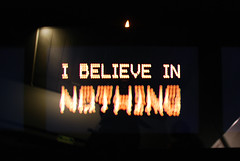
From Barcelona, veteran rock journo, adman and promoter Rick McGrath just posted his special report at Ballardian on the opening of the first-ever museum exhibit dedicated to the life and work of J.G. Ballard. "Autopsy of the New Millennium," at the Centre de Cultura Contemporània de Barcelona (CCCB). A magnificent project, it includes a the beautiful installation of an automobile drowned in the sands of time, pictured below. And who can't love a Ballardian blog in Catalan?
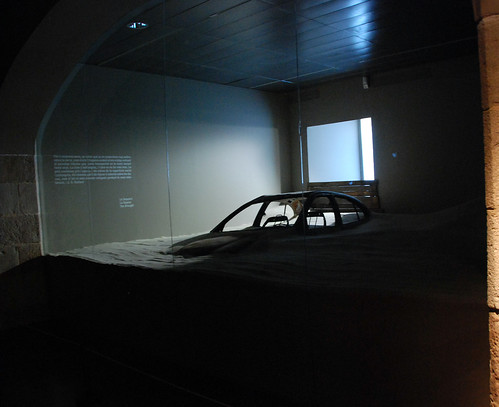
Very cool. A reminder of the need for Paul Virilio's unrealized project, the "Museum of Accidents."
"Contemporary civilization differs in one particularly distinctive feature from those which preceded it: speed. The change has come about within a generation," noted the historian Marc Bloch, writing in the nineteen-thirties. This situation brings in its wake a second feature: the accident. The progressive spread of catastrophic events do not just affect current reality, but produce anxiety and anguish for coming generations. Daily life is becoming a kaleidoscope of incidents and accidents, catastrophes and cataclysms, in which we are endlessly running up against the unexpected, which occurs out of the blue, so to speak. In a shattered mirror, we must then learn to discern what is impending more and more often-but above all more and more quickly, those events coming upon us inopportunely, if not indeed simultaneously. Faced with an accelerated temporality which affects mores and Art as much as it does international politics, there is one particularly urgent necessity: to expose and to exhibit the Time accident.

(At least the Museum of Accidents also has a blog.)
Perhaps we should undertake a virtual curation of this museum. We could start with the tabloid newspaper photographs of Mexican photojournalist Enrique Metinides, who mainlines the zeitgeist better than most.

[Enrique Metinides
Untitled ( Empleado de Teléfonos de México electrocutado en el km. 13 de la carretera México-Toluca), 1971
(Jesus Bazaldua Barber, a telecommunications engineer, fatally electrocuted by more than 60,000 volts whilst installing a new phone line. Toluca, Mexico, 29 January 1971)
Black and White photograph
20 x 24 inches/ 50.8 x 61 cm]
In other news, they've got some sweet jobs posted at Blackwater USA. Deltek Costpoint Administrator? Dude, I so want that action figure. Along with a complete set of poseable Blackwater attorneys.

Monday, July 28, 2008
Cold warriors versus the Smartistics
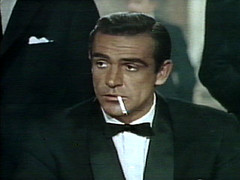
At the New York Review of Books, Geoffrey Wheatcroft joins the 50th anniversary Ian Fleming-James Bond pile-on with more flourish than most, as with these evocations of life in the Fleming household:
He got on with Ann on and off, as it were, in a curious relationship. Torture is conspicuous in the books, and an early Dr. No paperback cover (the kind of thing we don't see much in bookstores now) shows a girl with very little on dangling from manacled wrists while a vast black man stands over her to inflict horrible pain. But then Fleming knew whereof he wrote, warning Ann in one letter to ready herself for more of her own punishment and "be prepared to drink your cocktails standing for a few days."
Then again, he might have been settling the score. Returning to the small house on the Dover coast he'd been lent by Noël Coward, Fleming heard laughter from the sitting room, which fell silent when he entered, and he realized that Ann and her friends had been guffawing over passages from galleys of Casino Royale. He never cared for Ann's salon of writers and artists and one can almost see why. One of her friendships at least bequeathed an unforgettable legacy: amid the memorabilia—Ian's old typewriter, or a cable from Clay Felker asking for a piece on Russian spying for Esquire—a visitor to the show is stopped in his tracks by Lucian Freud's haunting small portrait of Ann.
And one more of the circle was Cyril Connolly (even if, come to think of it, Ann was exactly the woman he had in mind with his lethal coining "smartistic"). In 1963, Connolly published a parody of Fleming in the London Magazine. "M" has conceived an illicit passion for 007, who is told to get himself done up in drag, go to a nightclub, and entice a kinky visiting KGB general, who turns out to be "M" himself in disguise ("I'm sorry, James," he says forlornly at the unmasking. "It was the only way I could get you," at which Bond's "long rangy body flared out above his black silk panties," before he cuts his boss short: "I thought fellows like you shot themselves.... Have you got a gun—sir—?").
Geoffrey Wheatcroft, "Bondage," New York Review of Books, Volume 55, Number 13 · August 14, 2008
Friday, July 25, 2008
Don't try this at home

Who says Gonzo died with HST? In Vanity Fair, of all freaking precious places, between the perfume ads and airbrushed milk-fed starlets, Christopher Hitchens has himself waterboarded by some hooded dudes in North Carolina (Richard Butner and John Kessel deny all involvement, but I'm not fully persuaded):
You may have read by now the official lie about this treatment, which is that it “simulates” the feeling of drowning. This is not the case. You feel that you are drowning because you are drowning—or, rather, being drowned, albeit slowly and under controlled conditions and at the mercy (or otherwise) of those who are applying the pressure. The “board” is the instrument, not the method. You are not being boarded. You are being watered. This was very rapidly brought home to me when, on top of the hood, which still admitted a few flashes of random and worrying strobe light to my vision, three layers of enveloping towel were added. In this pregnant darkness, head downward, I waited for a while until I abruptly felt a slow cascade of water going up my nose. Determined to resist if only for the honor of my navy ancestors who had so often been in peril on the sea, I held my breath for a while and then had to exhale and—as you might expect—inhale in turn. The inhalation brought the damp cloths tight against my nostrils, as if a huge, wet paw had been suddenly and annihilatingly clamped over my face. Unable to determine whether I was breathing in or out, and flooded more with sheer panic than with mere water, I triggered the pre-arranged signal and felt the unbelievable relief of being pulled upright and having the soaking and stifling layers pulled off me. I find I don’t want to tell you how little time I lasted.

In other news: If Radovan Karadzic can remake himself as New Age healer, "Dr. David," what does the future hold for Dick Cheney? Maybe some kind of late-night infomercials on first generation cyborg implants, or how to make a killing in international real estate with no money down?

Thursday, July 24, 2008
MEMORY: 19
The spherical bath beckoned from an alcove on the far side of the room. A vermillion glow spilled through the panoramic window filling the opposite wall as the sun slipped below the horizon at the far end of the valley. Flavius sighed. The crushing weight of the previous week--had it really been a full week since he’d fled Culloden?--came down upon Flavius in a rush. His back ached. His feet throbbed. With every movement his joints seemed to grind bone against bone. Somebody or someone was still out there, trying to kill him, so naturally he was hiding out in the palace of the one person who, without a doubt, actually had executed Flavius in the recent past.
The idea made his head throb. The eerie familiarity of the Imperial court, the Palace of Un-pic Ja’ab and even the very room he now sat in was disconcerting. He ran his hand across the pale green carpet, the coarseness of the weave contradicted by the softness of the fiber. He remembered the sensation from before. Like the other memories from his wondrous sword, they weren’t quite comfortable--as if they were a well-made pair of new shoes not yet broken in.
Flavius’ head nodded forward before his stomach growled in protest, startling him awake.
“I hear ya,” he muttered, forcing himself to his feet. “No need to get testy on me.”
Flavius shed his grimy, tattered clothes along the way, not caring where they fell. He debated a moment on whether to carry Memory into the bath, ultimately setting the sword against the wall with a shrug. The bath wouldn’t harm it, but it’d be useless in such close confines and only get in the way. He hoisted himself awkwardly into the spherical bath--the entrance was designed for the long-limbed subjects of the Eternal Dominion--and slid the door shut behind him. Then Flavius flipped open the valves, letting the near-scalding jets of saffron-scented water pulse over him, burning away his deep aches from every angle.
Flavius sat there for many minutes before his angry stomach prodded him to action. He closed the valves and the bath immediately inhaled, drawing out every drop of moisture and leaving Flavius drier than when he’d entered.
He climbed out of the bath much refreshed and encouraged. Deadly acid hadn’t spilled forth from the valves in the bath, after all. Knife-wielding assassins hadn’t sprung upon him from the shadows. Perhaps Emperor Camargo’s claims that he bore Flavius no ill will were sincere.
The room had grown dark. A handful of stars twinkled in the evening sky as the scattered solar trees in the terraced gardens outside his window flickered to life. Flavius took in the ethereal scene, half expecting the fey folk to appear, dancing along the pathways.
Then he realized his clothes were gone.
A jolt of panic rushed through Flavius. He turned to where he’d left Memory. The sword remained in place. Quickly he snatched it up and turned to face whatever threat might be lurking in the shadows around him.
“Have at me then, if ya got an ounce of courage in ya,” Flavius challenged. “Have at me and quit skulking in the dark.”
Two round eyes blinked at him with reflected light.
“No challenge to you, sir. No threats, no skulking,” the peq said, shuffling forward. “Our lot’s not to fight. We’re only to serve.”
Flavius exhaled, but kept Memory ready. It looked like the same peq that’d led him to his room earlier, but he couldn’t be sure. They had a troubling sameness about them Flavius found confounding. “What’re ya doing in my room without my leave? What’ve ya done with my clothes?”
The peq looked puzzled. It blinked slowly, as if buying time as it chose its words carefully. “I’m in your room because I’m tasked with readying you for dinner, sir. Your clothes are laid out on the bed, ready for you to dress.”
“Lights up,” Flavius said, and the room’s rim lights glowed to life. Flavius looked to the bed. Lying there, neatly folded, was his finest dress kilt, white silk stockings, pale blue shirt with intricate black and white embroidery down the length of the sleeves... “Good God-- where’d ya get this?”
“From the wardrobe, sir,” the peq answered. “It is yours, is it not? It’s my understanding that you’d left it here--”
“No, yer right. Damn. I did leave it here.” Flavius opened the built-in wardrobe beside the bed. His travel pack sat there, clean and ready, next to a pair of polished black shoes and heavy leather boots. Above, neatly arranged on hangars, were several shirts and three separate kilts and the sporran he’d had made in Trammila that was magicked to only open at his command. “Open yer maw,” he said, and the sporran clicked open. A quick inventory showed the sporran contained a half-dozen Potentials, the finger-sized inter-cosm locator Parric’d long insisted he carry, a half-empty flask of single malt and a tin of powdered Absinthe. Flavius took a swig of the single malt and smiled as it burned its way down to his belly. “Ah, that’s the spirit.” He took another swallow, then shrugged and downed the whole thing.
The peq watched him patiently.
“Sorry lad, I’ve gone off and forgotten my manners,” Flavius said, capping the flask and putting it back into the sporran. “I’d offer ya some, but glutton that I am, I’ve finished it off. It’s this coming upon places I’ve already been, making claim to my property what I’ve never seen before... Rattles the nerves a bit, ya know. I’ve got some powdered Absinthe if ya like.”
“Sir’s generosity is too kind, but I fear your powdered consumable would strike me dead were I to ingest it,” the peq answered.
“Yer probably right,” Flavius said, closing the sporran. “It is pretty brutal stuff. Close yer maw.” The sporran clicked shut.
“Now, there was something... something... Ah! Dinner!” Flavius said, and started for the door.
The peq cleared his throat.
“What?”
“Perhaps sir would like to dress before attending dinner with the Imperial court?”
Flavius looked himself over, confirming that he was indeed naked. “‘S probably a good idea, that,” he said, returning to the bed. “I dinnae usually go out naked, mind you. It’s just I’ve nae eaten a decent meal in close to a month, what with Bonnie Prince Charlie’s war going sour and all. And that drink on an empty stomach...”
“Understood, sir.”
“It’s the empty stomach, ya see,” Flavius said, pulling the shirt on over his head. A silver brooch with wortleberries of blue sapphires so dark as to be almost black dropped to the floor. “Hello, I’d forgotten that bonny wee bauble. Did I ever tell ya how I got it?”
“Not to my knowledge, sir.”
“Oh, it’s a good story lad. Ye’ll like it.” Flavius got down on his hands and knees to search under the bed. “There was this dirigible captain what’d been doing business in Tradefare, regular like for years, loading up on exotic goods. Same’s everyone, right? Only this captain, when he’s getting back to his home cosm, he’s finding half his cargo or more missing. Gone, just like that. Now, I ken what yer thinking, but the crew couldnae pilfer this much cargo. Nae possible. And nae pirates, either. After three runs like this, he’s desperate, see? He’s lost so much, creditors are about to take his ship. So he goes to Knowicent and clever lass that she is, she refers him to me and...”
“Sir?” The peq cocked his ears forward when Flavius didn’t answer. “Sir? Is anything the matter?”
“You tell me, lad.” Flavius sat up, holding a featherscale between his thumb and forefinger.
It glinted brilliant crimson in the light.
Tuesday, July 22, 2008
Image association
Quick--when you see the image below, what's the first words that come to mind?
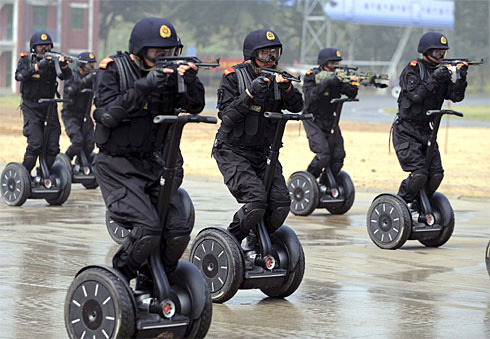
If you said "Chris Nakashima-Brown" then it's pretty clear your brain is as distorted as mine is. It's been pointed out elsewhere, but bears repeating: These Chinese anti-terrorism teams training on Segways have got the be the single most incongruous cavalry in the history of mobile combat. Net guns notwithstanding. All that's missing is Wagner's Ride of the Valkyries.
If you said "Chris Nakashima-Brown" then it's pretty clear your brain is as distorted as mine is. It's been pointed out elsewhere, but bears repeating: These Chinese anti-terrorism teams training on Segways have got the be the single most incongruous cavalry in the history of mobile combat. Net guns notwithstanding. All that's missing is Wagner's Ride of the Valkyries.
New Serbian Fantasy!

Looking for something to do to pass the time while you wait for the photos of Karadzic's disguise to appear in the press?
((Washington Post: "Karadzic hid in plain sight with false identity"))
Over at The Infinite Matrix, editor and publisher Eileen Gunn has a new story by Serbian dissident activist writer Jasmina Tesanovic, "Cats and Cars," a beautiful fable about life and love and all the lingering melancholy of the twentieth century.
What went wrong? The big question. Or was it all right, somehow, the way it had gone? The big answer sprang to his mind: whatever happened should be recognized as the true state of affairs. So he loved that, and he accepted that as some kind of temporary answer.
Then another development: the kids started bothering him, asking him for money, food, attention. Being rude, not nice, not as his kids had once been. Then, he himself started growing bald, fat and bad tempered. Then something large and general went wrong in the part of the world in which he lived. People were menaced, they became unsafe, uneasy about their futures, about the sense of their life. The end of the century? Middle age crisis? Loneliness?
All, and nothing.
For an interesting bookend in a similar theme, check out Bruce Sterling's "The Denial," collected in Visionary in Residence.

Eileen's new issue also has a Yana Dubynianska story, "Barge Over Black Water," and a reprint of Cory Doctorow's "Nimby and the D-Hoppers" from Asimov's 2003. Infinite Matrix is among the highest quality and most beautifully designed SF mags online; one can only wish it would go back to publishing new work more regularly.
If Nimby's not enough 2003 for you, you can rummage Eileen's archives for my "Script-Doctoring the Apocalypse," a bit of psyops fiction involving the use of Frank Frazetta as a Weapon of Mass Destruction.

Subscribe to:
Posts (Atom)