Friday, July 11, 2008

I am bad

Two or three of you might notice that there's been no installment of MEMORY this week. Yeah, I noticed that, too. And I have absolutely no excuse. Instead of writing in the evenings, I've been playing with my telescope--good seeing, bad seeing, it makes no difference. If there's a glimmer of starlight out there, I'm setting it up and scanning the skies. I'm also learnin' myself astrophotography, which dovetails into my overall photographic fixation of late. My early success last weekend spoiled me, as ensuing efforts on my part haven't shown the same dramatic levels of success. Case in point, M11, the "Wild Duck Cluster," which I shot last night (as opposed to writing):

M11-071108


Unimpressive, isn't it? This single-image shot is wholly unremarkable save that it documents my very first Deep Sky Object captured via astrophotography. Sky conditions were decent, with mild temperatures (for Texas in July, at any rate), humidity in the upper 60 percentile and clear skies. Unfortunately, continued strong light pollution in my neighborhood (street lights and residential flood lights) coupled with a bright half-moon and gusty wind severely limited my already-suspect ability to take any useable long-exposure images. Not to mention all the light pollution made it extremely difficult to focus.

Normally for DSO astrophotography, one takes a series of images--the more, the better, actually--and then stacks them using some software such as Photoshop, Deep Sky Stacker, Registax etc. Stacks of 20-100 images aren't uncommon, and the accumulated time of the exposures adds up to brighter, sharper images. Unfortunately, the wind was so strong that none of my images would register, that is, overlap each other with all the stars atop each other. Lots of doubling of stars, and squiggles and such. This is on top of my poor focus. The good news is that my slap-dash polar alignment was good enough to give me images with no noticeable star trails on 20-30 second exposures. There were definite trails on the 1 minute exposures I did, however. Out of all my shots, this one was the only one remotely salvageable.

M11 looked really cool through the eyepiece alone, however...

Thursday, July 10, 2008

Adopt a Scientist

Facing a dismal downward trend for government funding for astrobiology, the SETI Institute has created Adopt A Scientist. You too can help fund a scientist working in planetary science, astrobiology or the search for extraterrestrial intelligence! The levels of commitment are way above stocking-stuffer level. But the scientists include names you've heard of if you follow astrobiology: people doing good science with great professionalism and passion. Way to go, SETI.

Way down telescope way pt. 4

So, now we come to the traditional "First Light" report, in which a new telescope is pointed to the heavens and Oohs and Aahs are made approvingly by all in attendance. Technically, this is a second "First Light" report, since I've owned the scope for the better part of three decades, but as the original first light came more than 25 years ago, I think we can agree to dispense with technicalities.

The July 4 weekend had the family visiting my hometown of Columbus, Texas. The Houston Astronomical Society maintains an observatory site not too far away because of the relatively dark sky conditions there, and Columbus is where I did almost all of my observing with this scope. After checking out the nifty Clear Sky Chart for Columbus, Texas, it looked like I'd found the perfect time and location to break in the refurbished Meade 645, from here on out known as the Maroon Barsoom.

Cue reality. By Saturday afternoon things looked mighty grim. High humidity, overcast skies and a monster rain storm came through that absolutely drenched everything for an hour or more. I was starting to think the Clear Sky Chart was smoking something funny, but around sunset the clouds began breaking up and a light breeze dispelled the sauna conditions. It actually felt comfortable, so in a fit of optimism I started set-up. At this point I ran into my first problem. My folks' backyard is very large and in years past, offered pretty good views of most of the sky with the exception of parts of the southeast and a little bit of the northeast. Unfortunately, in the 20 years I've been gone, half a dozen pecan trees (which were insignificant back then) have grown to prodigious size rendering the backyard problematic for observation. I'd known they'd gotten bigger, of course, but since I'd not been lugging my telescope around with me, the impact of that tree growth never registered. Emergency location scouting revealed that a section of the front yard, near a bluff overlooking the Colorado River, offered fairly open views of the north, east and south. The west and southeast were right out, but it was the best I could do. There was a small concrete slab that offered a level place to set up the scope, chairs and a nearby power source. The crescent moon, Saturn and Mars were beyond my seeing, sadly, since I'd observed them many times in the past and would've liked to compare the scope's current visuals with my memory. Them's the breaks.

IMG_8408


I'd forgotten my wrench and protractor at home, so couldn't do a perfect polar align, but I did manage to get the scope fairly well aligned once Polaris was visible. I plugged in the tracking motor. So far, so good. I had my set of recently-acquired GSO plossl eyepieces ready to use. But what to observe first?

As a teen, I used this scope for planetary, lunar and comet observation pretty much exclusively. I just didn't understand the whole Deep Sky Object concept, which is sad since this scope was made to excel at that. So I thought I'd try to find my first DSOs. The Orion Nebula is the only DSO I'd ever found and observed on my own before, but that came through using Monkey Girl's tiny refractor and was barely visible even then. So I don't count it. I checked my Sky & Telescope sky chart for something easy... and decided on M51. I remembered trying to find this Messier Cataloged galaxy (best known as the "Whirlpool Galaxy" near the handle of the Big Dipper as a teen and giving up in frustration, so imagine my astonishment when I found it instantly. In succession I observed it with 40, 25, 15 and 9mm plossls. The 15 gave me my best views, resolving the smaller companion galaxy although I wasn't able to resolve any pinwheel or dust lanes. The 9mm was simply too dim to make anything out.

I have to point out at this time that neighbors across the street decided to turn on all of their outdoor flood lights around this time, butchering my carefully cultivated night vision. Drat.

Wondering what I should turn to next, I noticed that Jupiter had crept into a gap between the trees to the southeast. Yay! I started with a 20, then 15, then I added my old Meade 2x Barlowe to the 15... I have to say, the 15mm plossl is rapidly becoming my favorite eyepiece ever. The four Galilean moons were all out on parade, but what floored me was the contrast and definition of the main cloud bands. Wow. I'd never seen them so clearly. I goofed around with Jupiter for another 20 minutes or so, trying different eyepiece combinations before it slipped back behind the trees.

I had a clear view of the constellation Delphinus, so I pulled out the chart to see if anything interesting could be found there. Hmm... M15, a globular cluster, is right to the south. Bingo. Found it no problem. I was unable to resolve it into anything more than a fuzzy, comet-like cloud, but it was unmistakable. By this point I was almost giddy--two for two on Messiers!

The constellation Scorpius was coming out from behind the trees and the star Antares was very bright (and very orange), so globular cluster M4 should be a snap, right? Wrong. I looked. And looked. It wasn't there. I checked the chart again. It should be there. Nothing. What the heck was going on? M4 is supposed to be one of the easiest clusters to find, and I'd already found M15 no problem. Finally, the sneaking suspicion comes upon me that I may have my directions reversed, that I'm looking on the wrong side of Antares. So I slew over a little and... there she is, M4 in all it's glory. Honestly, at first I thought I'd found an open cluster of some sort because of the sprawling tumble of stars, but yeah, it was M4 (I pulled the Maroon Barsoom out a couple of nights ago and double checked). Simply gorgeous. And the tracking motor seemed to be working effectively, since I wasn't seeing any significant drift in the DSOs. Yay!

The Wife was moderately impressed by the DSOs, but she and the kids wanted something more tangible. They weren't happy that Saturn wasn't visible, but would "settle" for Jupiter. So I picked up the scope and moved it over 20 feet or so (losing my flat surface and semi-accurate polar align in the process). We had a clear view of Jupiter now. Much oohing and aahing was made. I was very impressed by how sharp the planetary images were--4mm proved to be too much, giving more fuzz and blur than anything else, but at 6mm it looked quite impressive, with minimal washing out of the colors. Feeling pretty daring at this point, I broke out my Canon XTi and hooked up the T-mount and camera adapter. I inserted the 15mm plossl (remember how I said I liked this eyepiece?) but the resulting images were too small and bright initially. So I added the 2x Barlow. Score! Focusing, as has been mentioned in other places, is difficult through the tiny viewfinder of a dSLR, but thanks to the LCD image review and histogram, I was able to make a good run at it. Since the polar alignment was lost, the planet kept drifting out of the frame, but not so quickly that I couldn't compensate. It's not perfect, but here's a five-image stack I put together, including two of Jupiter's Galilean moons (although only one is readily visible). Not bad at all for what amounted to a shakedown cruise:

Jupiter070508


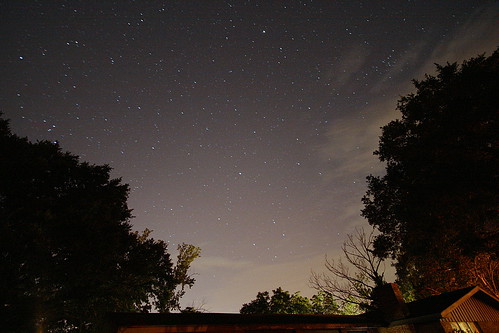
So by now it's after midnight, and as I'm experimenting with starfields and other through-the-eyepiece astrophotography attempts, I come to realize my hair is dripping wet. As are my lanterns, eyepiece case... Sky & Telescope is downright soggy. At some point, the dew monster snuck up on me. Time to call it a night. I packed up the camera and eyepieces and lanterns and hauled it all inside. I went back out, took a look at the faint light of the Milky Way above and the 20mm in the scope, and thought "What the heck? One starfield sweep then I'm going in." Would you believe that less than a minute later I'd stumbled across M11, the "Wild Duck Cluster," completely by accident? One of the best views of the night as well. I went to bed very happy.

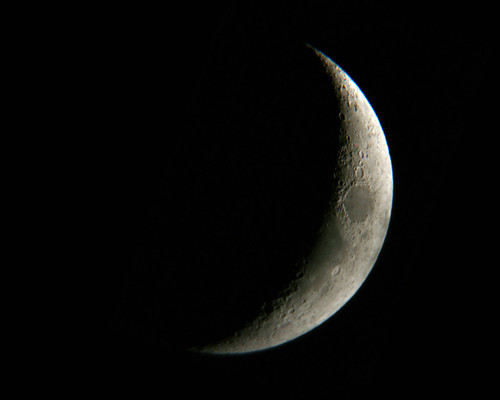
The following night, I set up for a while back home in New Braunfels. Light pollution in my immediate skies is worse than in Columbus, due to the close proximity of San Antonio to the southwest, New Braunfels to my immediate north and a honking big street lamp less than 20 yards from my front door. Even so, I was able to get a decent shot of the crescent moon:

StackedMoon_web


The following Tuesday, I got a decent look at M13 before humidity and high clouds drove me indoors.

As far as the optics went, I was very happy with the performance. The stars were very sharp, with only slight coma near the edges of the field--certainly a vast improvement over seagulls I remember seeing some of the final times I took the scope out before it sat unused for a decade. I guess collimation has that effect, eh? The one thing I really leaned is that it's difficult to focus the dSLR camera when it's attached to the telescope, simply because many of the objects being observed are so dim and fuzzy that it's well-nigh impossible to tell with the camera's tiny eyepiece when you've actually got them wholly in focus. But other than that, it was great. Before I pass final judgment on the Maroon Barsoom, I'd like to get it to a star party where there are other scopes with which to compare it, but in my opinion, I don't think it's too far short of its optimal performance when fresh from the factory.

Certainly the tracking motor works now, which is more than it ever did before.

Wednesday, July 9, 2008

Way down telescope way pt. 3

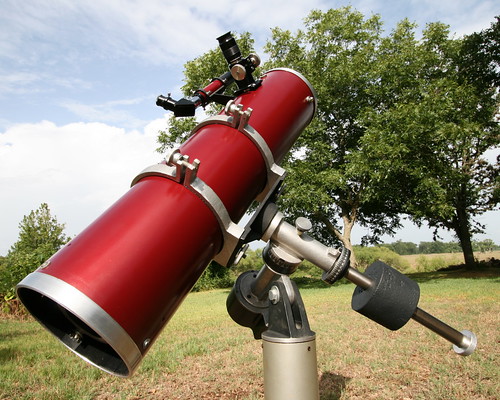
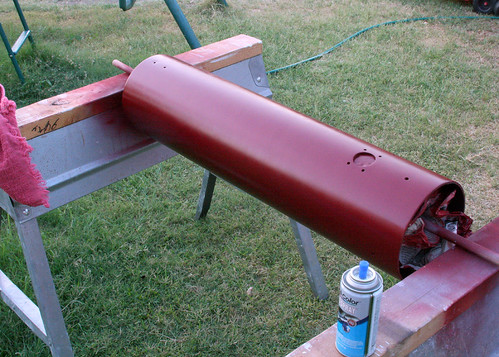
When last we spoke, I'd succeeded in taking my Meade 645 completely apart, sanding it down and applying a coat of primer. After letting it dry/cure/rest for a couple of days, I began to apply the final color paint on top of the primer--Duplicolor Claret Red Metallic:
Scope-ClearCoat


Pretty, no? I applied two light coats then set it aside to dry, with the intention of sanding lightly the next day and applying two more light coats. Then the winds came. For well more than two weeks, it was far too windy to spray paint, so I turned my attention to the telescope mount and tracking motor.
GEM


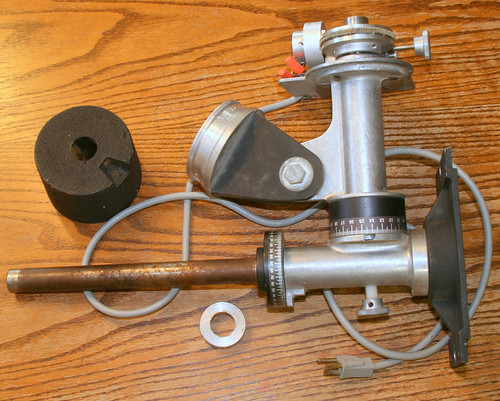
I cracked open the old motor drive to see if I could figure out a way to make it functional again. I bought the telescope used from Texas Nautical in '83, with the drive clearly described as "not working." I remember that clearly, because as a 13-year-old about to spend more money than he ever had in his life, I simply didn't care. It was more telescope than I'd dreamed of, and I didn't really understand the value of a tracking drive. So I bought it in non-functioning condition. Later, out of curiosity, I plugged the motor in. It came on with a clockwork whirr. Neat, I thought. Maybe it works after all. So I set it up on the front porch one weekend morning and let it run to see if it would track--or rather, move on its own. Six hours later I unplugged it in disappointment. It hadn't budged. That was maybe 25 years ago, and I hadn't plugged it in since.

Thanks to the kindness of the online community, I've now got a scanned copy of the Meade user's manual for the 645, which I'd never had before. There's a nice diagram of the drive system included, as well as a drive troubleshooting section. I found this helpful, and decided to plug in the drive once again to see if I could diagnose the problem. The R.A. override knob has always worked, I should point out. The plug prongs were pretty mangled, so I worked them back into shape with a pair of pliers and plugged it in. The whirr returned. I adjusted the setting circles to 0 and marked the R.A. override knob as Meade suggested and sat back to wait.
WormGear


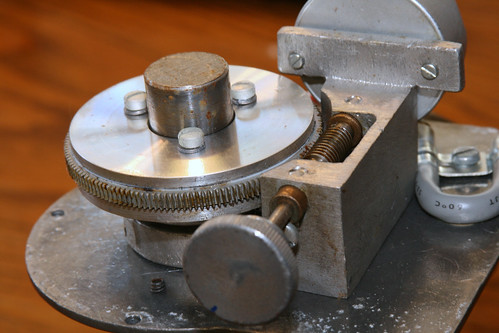
Danged if the thing didn't work. The R.A. override turned as supposed to, the motor whirred along and the tube moved. How accurately, I didn't know, since I bumped the tube a couple of times and had to start over and eventually it got too late to continue. But the crazy thing was working! The motor did change tone a couple of times, as if it was struggling, so I suspected the gears need to be re-lubed (after 25 years? You think so?).

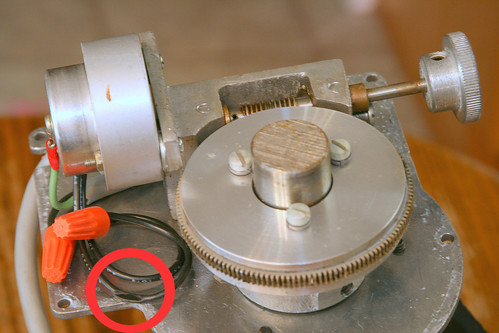
A few days later I returned to the motor. The cover had a bunch of dust and dead insects inside. Ugh. The worm gear was pretty gunky. What at one time was, I suspect, lubricant had turned over the decades into a thick sludge. Amazing that it'd turn at all. I set to work with a toothbrush purchased specifically for the job (I was afraid to use any degreasers other than detergent for fear of damaging the worm) and managed to get the worst of the nastiness out of there. Then, lo and behold, I just happened to notice one of the motor's wires crushed flat. It must've happened during the original assembly, when the cover was bolted over the motor.
WormGearSquish


Might that be what's caused the tracking motor to run/not run all these years? Since there was plenty of excess wire, it was simple work to snip away the bad section and re-splice. I don't know if that had anything to do with the motor's not running, but it didn't make any sense for me to not effect this repair. Having previously de-gunked the worm gear a respectable amount (not 100 percent clean, but most of what's left was just discoloration) I applied white lithium grease with teflon. Then I hand-cranked the RA adjustment knob until ungreased gears lined up with the worm and repeated. By the time I'd made the full 360, the tell-tale squeak accompanying my RA turning had faded almost completely. So far, so good.

Eventually, the insane winds that had been blowing non-stop for two weeks finally died down over, and I was able to get out and spray more layers of paint onto the 645. Spray and rotate, spray and rotate. Wait to dry, repeat. The next day sand, and repeat the process. Curse like a sailor when one can decides to start spitting for no reason when it's still 90 percent full. Curse curse curse. Let dry. Sand and sand again. Repeat paint application with a new can. Finally reach the point where I say to myself "That's probably enough paint." Apply clear coat. Let dry overnight, then sand with 1000 grit paper. Apply final coats.

At this point I want to make good on my promise to explain why I didn't apply enough primer. Turns out that 220 grit sandpaper was too rough. Or perhaps the 80 grit before that, which I used to strip away the old paint. Seems that the rough sanding left grooves in the tube that weren't entirely visible when I primed, but really stood out once metallic paint was applied. Light sanding and re-painting did little to remedy the situation, and I wasn't about to go through the time and expense of sanding everything back down and starting over. I'll live with it. Just remember kids: Primer is your friend!

When applying the final clear top coat, I vigorously cursed the gnats that come out of nowhere on a kamikaze mission. Then I fled into the house with still-tacky scope. The next day, I sanded with 2000 grit paper, wiping after ever stroke since wet sanding was not an option. The tube looked good, but oddly streaky in places from the sanding. I polished with Lemon Fresh Pledge. WOW! It looked better than good. Streaks had vanished, and the metallic paint really, really shone.

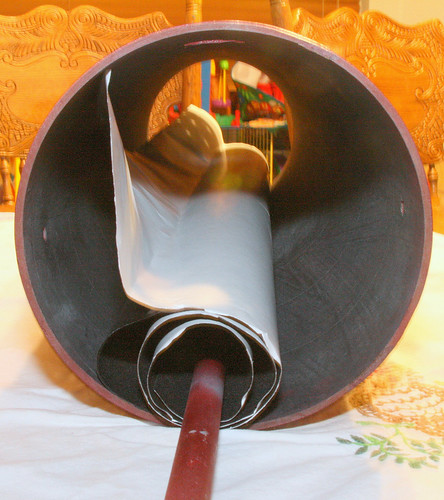
It was time to flock the tube's dull innards, so I got out my roll of Protostar flocking material (think adhesive velvet). Flocking, you see, is intended to cut down on light scatter and improve contrast during viewing. There's some debate over its effectiveness, but my scope needed something to improve the dull gray inside of the tube. The custom cut option Protostar offered came from a 30" wide roll, which was perfect for me, since my tube is exactly 30" long. I immediately discovered that rolled flocking material can attract lint, dust, cat hair and an ungodly number of bright white flecks of... stuff like nothing else. So I whipped out the sticky tape and spent the next hour trying to get it all picked off. I was mostly successful, but man, was that tedious. Then I clothes pinned the flocking material to the inside of the tube, marked it for a 1" overlap and trimmed off the excess (about 3" worth. I ordered extra to guard against coming up short). Then I rolled the material up on a thick wooden dowel, peeled back the wax paper backing, and began installing. Here's a before shot:
Scope-PreFlocked


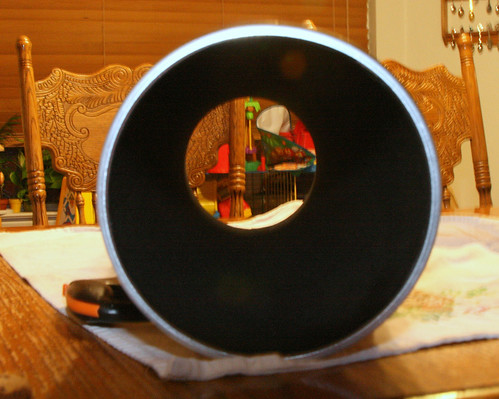
You'd think that since it sticks to the wax paper like nobody's business, it'd really hang onto the tube. Eh, not so much. At least not until you get about half of it laid down, at which point the paper is clogging up the tube so much you can't really reach anything. So the logical thing to do is tear away the paper, right? Just make sure when you do this, you don't allow the sticky side of the flocking material to come into contact with itself. In the immortal words of Elwood Blues, "Epoxy. Strong stuff." When I finally managed to separate it, somehow the adhesive had stripped from both sides of the affected patch. Where'd it go? Maybe I inadvertently created a dimensional rift. In any event, I finally got it all laid in, and despite my struggles, it looks pretty good. Here's the after shot:
Scope-Flocked


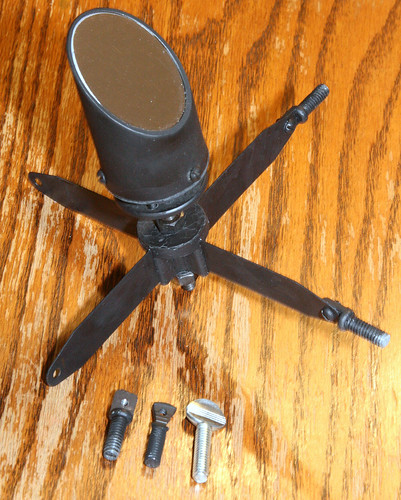
With the tube completed, I turned my attention to the spider. In the image below you can see the secondary mirror spider, along with three bolts. To the left is one of the original specialized aluminum bolts used to secure the spider to the optical tube. As I mentioned earlier, one of the bolts snapped on me a few years back, and I hadn't had any luck finding a replacement. So I made one of my own (center). I picked up some thumbscrews from a local hardware store and using a hack saw, a file and a 6x32 drill tap, cut the thumbscrew into a passable substitute. Then I primed it and sprayed everything matte black. I can't take all the credit, though--this guy restored a Meade 826 a few years ago and faced some of the exact same issues I'm dealing with. My secondary housing didn't appear to be in as bad of shape as his, but in a few years, I'll probably spring for a whole new spider vane/secondary rig. Probably a new secondary mirror as well, as mine is starting to show some streaks.
Thumbscrews


The spider fastener was the single biggest issue I had to deal with to get the scope usable again. And I'd triumphed!

The time came to put everything back together. The primary mirror went in easily, as did the spider. Suffice to say, it was wildly out of collimation. I had to wait a few days until the sight tube/cheshire collimation tube I ordered came in, and then I had Apollocon intervene, so collimation had to wait. In the meantime, I painted some black trim and installed the spotting scope and focuser. I took the two aluminum end rings, which had gotten pretty dull and dinged up, and wet sanded them with 2000 grit paper. That perked them up nicely. The felt lining the cradle rings had become hard and brittle, so I stripped this out and used a utility knife to chip away the petrified glue. Then I sanded with 400 grit paper to smooth the inner surface somewhat. I picked up adhesive felt sheets from Hobby Lobby and cut strips which I applied to the rings (although in hind sight the leftover flocking material probably would've done the job as good or better).

I returned the end rings on the scope and used pieces of flat cork to try and avoid having to glue them on. Well, the cork secured them on all right, but even the thinness of the "shim" was enough to distend the end ring. And, I feared it might eventually warp the tube as well. So I pulled both end rings off (no small feat--the cork held them on tight) and added a strip of that adhesive felt to each ring. This proved to work much better. The rings slide on more smoothly, but still maintain a firm grip without any distortion. It may get loose later on with use and age, but I can always add more strips of felt along the interior of the ring.

I reattached the mount to the pier, and set the OTA in the cradle rings. Then I added the counterweight. And I plugged it in. After four hours, a quick setting circle check showed movement of.... four hours. Obviously, that's not a test for precision accuracy, but after having this scope with no tracking whatsoever for 25+ years, the prospects of having a working drive leaves me positively giddy.

Oh, I also re-painted the black motor cover.

For collimation, I took the whole thing onto the back patio and set to work. Wow. This thing was waaaaay outta wack. The secondary mount in particular wasn't playing nice, so I had to take it completely out to work on it. The adjustment screws wouldn't turn, and it took a bit of coaxing before they'd cooperate. The secondary mirror looked as if it'd come slightly dislodged, but the ancient housing was corroded and brittle so that I couldn't get it apart to address that issue. The mirror wasn't loose, just slightly out of position. And on closer examination, the secondary mirror was in somewhat lesser condition than my original evaluation. The whole secondary/spider shebang will definitely be due for replacement eventually, but I can coax a little more mileage out of them yet.

Using the sight tube I got the secondary mirror positioned and aligned, then the cheshire made the primary collimation a snap. I was very happy with how that went. There's still a slight discrepancy in the collimation when looking through the sight tube--the two innermost circles are somewhat off-center in regards to each other, an effect I ascribe to the secondary mirror being slightly out of position, forcing the secondary mount to hold a steeper angle than ideal in order to compensate, thus showing a larger silhouette than ideal. In any event, I couldn't do anything about it at that point, and judged it wouldn't have a dramatic impact on my initial viewing anyway.

Holy moly... the scope, she is done! For reference, her is one of the few images I have of it pre-restoration:
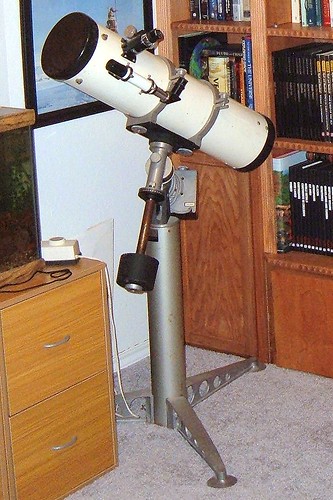
Meade-Before


And the finished product. Behold the Maroon Barsoom:

IMG_8160


And the wide-angle view:

IMG_8185


And an infrared view of your humble telescope restorer along with the fruits of his labor, in glorious false-color, just to shake things up a bit:
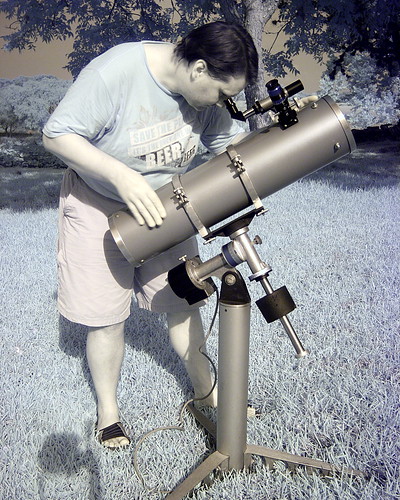
IMG_8217


Join us next time for the obligatory "first light" report!

Friday, July 4, 2008

MEMORY: 17

First
Previous


Flavius’ footsteps echoed eerily in the deathly silence of the hall. Barely a dozen liveried staff milled in confusion along the perimeter of the oblong chamber, with a like number of guards spaced at even intervals, cuayabs held unobtrusively. The balcony boxes, halfway up the vaulted ceiling, remained empty.

At the far end of the audience hall, seated upon ornate thrones on a raised marble dias polished so brightly it hurt the eyes to look at, were the Tricentennial Emperor and Empress.

His skin was darker than the majority of his subjects, almost rust-like, yet his silvery hair grew full and flowing from his head down into mutton chops framing his face. He informal dress of ivory-colored shirt and pants with blue and gold embroidery spiraling around his limbs and torso. He wore a black leather belt studded with gemstones around his waist and an amorphous fan-like ornament of fluid colors hovered above his shoulders right behind his head in lieu of a crown, creating the impression of a divine halo. He looked just a touch past thirty to Flavius’ eyes.

The Empress was wearing an ephemeral gown, of course--this one a relatively understated mixture of creamy yellow and aquamarine, with pinpoint traceries of light flicking across the fabric in a constant dance. Behind her throne, to the side, stood her ever-present handmaiden, Papantzin, her hair pulled back in an elaborate knot of braided coils run through with a large golden pin. The corner of the Empress’ mouth ticked up as Flavius’ eyes met hers. Papantzin remained stoic.

Flavius stopped in the center of the hall, hand prominently gripping Memory’s hilt, and looked the gathering over. “Nae much of a turnout for us, eh Parric?” Flavius whispered as his partner slithered up beside him. “Looks like we must’ve caught them more unawares than we thought. Ken we can take ‘em?”

“Probabling,” answered Parric, “but I’m rathering not.”

“Well, I’m rathering that bastard dinnae kill me again, so in light of that, I’m going to shove Memory up his-- hang on, he’s talking.”

The Tricentennial Emperor stood, spreading his arms wide. “We are honored, good Parric, by your presence among us. We see so few T'ul-us Tzan cross into our cosms, and we are all diminished by your parting.”

Parric dipped his head and antennae in acknowledgement. “It is my pleasuring to again experience Your Imperial Majesty’s legendary hospitaliting.”

“And Flavius MacDuff, of Clan MacDuff--”

Flavius tensed.

“--if I may be permitted to dispense with formality for the moment, it is good to see you,” the Emperor said. “You’re looking quite well. Doesn’t he look well, Malinche?”

“Indeed he does, dear Camargo,” the Empress answered with practiced disinterest, although her eyes watched him intently. “A veritable picture of health.”

Wide-eyed, Flavius glanced to Parric. “Ya daft bastard. Ya brought us to the wrong damned cosm, dinnae ya?”

“Don’t be stupiding. You’re rathering them attacking us instead?” Parric snapped his beak at Flavius. “And don’t forgetting the imperial protocol.”

Befuddled, Flavius racked his brain and it came to him in an abrupt flash from Memory: never address the emperor or empress by name, never compare yourself to them, never initiate physical contact... That last one, Flavius thought, was rife with all manner of pitfalls.

Emperor Camargo stepped down from the dias and strode over, clasping his hands to Flavius’ shoulders. “It really is good to see you again, although I must confess I’m quite surprised to see you so soon.” He glanced at Parric. “And you, Parric, your departure was rather abrupt as well.”

“Under the circumstancings, I’m not having much other choicings.”

“Yes, yes, I suppose not. Regrettable business, that,” Emperor Camargo said, drifting into a bleak reverie. As quickly as he’d drifted away, he snapped back. “But the sword worked, eh? Such a marvelous sword, with the power to raise the dead.”

“Not to contradict Yer Imperial Majesty, but the sword dinnae bring me back to life,” Flavius explained, finding the the conversation increasingly surreal. “It just passed on to me the memories of the other Flavius what died.”

“Semantics,” Emperor Camargo said, waving his hand in dismissal. “Although, in this case the semantics work in your favor. Death sentences are not negated by resurrection, my friend. Were you actually he, then your life would remain forfeit. Happily, that’s not the case.”

“Happily,” agreed Flavius.

Emperor Camargo pulled Flavius’ head closer to his and spoke softly. “The knowledge of what your sword can do was the only thing that made the whole sordid affair bearable, dear Flavius. Apart from your unfortunate transgression with the Empress, you and Parric have proven yourselves more loyal than many of our copil-blooded nobles. I’ll admit a great weight of dread lifted from my shoulders when the Empress Malinche informed me that you shed your sword long before she discarded the layers of her gown.”

Unbidden, the memory of her nude, six-breasted glory blazed in Flavius’s mind. Flavius glanced to her throne. Empress Malinche raised a provocative eyebrow, then flicked her tongue across a fingertip. A strand of gleaming silver hair slipped over her face. Flavius swallowed. “Er, right. Why is that?”

Emperor Camargo laughed free and easily, as if Flavius had made a witty joke a the expense or the courtiers. “Because lesser sentients are not worthy of such visions. Had your sword preserved any, shall we say, compromised memories of the Empress, your life would be just as forfeit as your predecessor’s.” He smiled. “Fortunately, we don’t have to worry about that.”

Flavius forced a smile, not daring to look in the Empress’ direction. “Lucky me.”

Continued

Wednesday, July 2, 2008

Mind Meld

SF Signal has a wonderful forum they call Mind Meld. A provocative SFFnal question is posed for SF writers and other people to contribute answers. Most recently there was this question:

What current avenue of scientific inquiry do you believe people should be paying attention to, and why?

This was pondered by Kathleen Ann Goonan, Nancy Kress, Mike Brotherton, Nina Munteanu, Jennifer Ouellette, Kay Kenyon and myself. Our answers are at http://www.sfsignal.com/archives/006823.html.

Tuesday, July 1, 2008

More Apollocon!

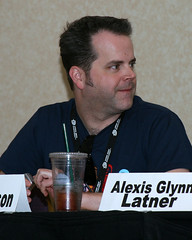
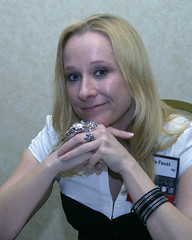
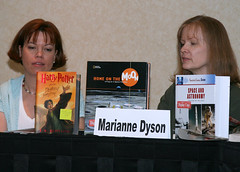
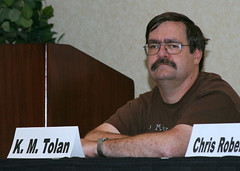
You didn't think I was finished posting images, did you?

apollo08_32apollo08_31


apollo08_33apollo08_36


apollo08_34apollo08_35


apollo08_37apollo08_41


Apollo08_38apollo08_39


apollo08_40apollo08_46


Okay, about the plane image below... Saturday afternoon, around 5:30 or so, I stepped out to the parking lot to put some stuff up in my car, and was met a serious thundering rumble. The con hotel is right in the flight path of Houston Intercontinental, so jets flying overhead isn't anything new. But this cargo jet took "overhead" a wee bit too literally. The shot was taken with my 28-135mm lens at the 28mm setting. No zoom at all. This plane cleared our hotel by maybe 100 feet, tops. Ditto for the buildings across the street. Another con-goer in the parking lot looked at me, then we both turned and scanned the immediate skyline for signs of smoke and/or fire from the expected crash. Seriously, the plane looked to be struggling. When nothing immediate happened, the guy wondered aloud if we should call 9-1-1. I assume they made it to wherever they were going safely, because I saw nothing about a devastating crash on the news, but boy, that wasn't a pleasant sight.

apollo08_42apollo08_43


apollo08_44apollo08_47


apollo08_45apollo08_48


These last two are my favorites. For obvious reasons.

apollo08_50apollo08_51