Wednesday, February 11, 2009

Frozen sperm of the stars and other poodled celebrities


Today's NYT had an intriguing article about the latest technology for the breeding of champion dogs:

Frozen Sperm Keeps Dogs' Championship Bloodlines Alive

Every time Tim Brazier leads his dog Yes into the ring, he can’t help thinking of Snapper, another champion black standard poodle.

“It’s a trip down memory lane,” said Brazier, who won the nonsporting group with Yes, or Ch. Randenn Tristar Affirmation, at the Westminster Kennel Club Dog Show on Monday.

Yes, a daughter of Snapper, or Ch. Eaton Affirmed, shares her father’s sashay as well as his fluid movement and balance.

“And the little personal quirks, too, like cocking her head to the side, like he always did,” Brazier said.

Like father, like daughter, with a twist: Snapper died in 1990, 13 years before Yes was born. She was conceived using 25-year-old frozen sperm from Snapper, who sired more than 100 champions in his lifetime.


Which made me wonder how long it is before this technology is applied to humans. Consider, for example, the possibilities for the infertile members of the superclass to pay for the privilege of breeding their own new legal offspring using the harvested genetic material of dead celebrities. A more wholesome family variation on James Ellroy's meme from L.A. Confidential, involving a silver age high-end prostitution ring staffed by women who are dead-ringers for famous screen goddesses. Imagine a well-born little tot running around the house, with the adults whispering about Marilyn, or Brando, or Heath Ledger. Best in show? Surely a killer app for the propulsion of new genetic technologies, and a novel way to accelerate the de-evolutionary in-breeding of the very rich.


Personally, I think I could go for having my own little pet Charlton Heston, a square-jawed pre-teen who would have a different dystopian outfit for every day of the week — Taylor from Planet of the Apes, Neville from The Omega Man, the airline pilot from Airport 1975, the reporter from Soylent Green, the architect from Earthquake, the NRA President from Bowling for Columbine, maybe Moses on Saturdays. That would so kick that poodle's ass.

Tuesday, February 10, 2009

SFWA announces inaugural Solstice Award recipients

SFWA announces inaugural Solstice Award recipients

Kate Wilhelm, Martin H. Greenberg and the late Algis Budrys are recipients of the inaugural Solstice Award, presented by the Science Fiction & Fantasy Writers of America.

SFWA President Russell Davis made the announcement Feb. 10. The recipients will be honored during the Nebula Award Weekend® in Los Angeles, Calif., April 24-26.

Created in 2008, the SFWA Solstice Award may be given at the discretion of the president with the majority approval of the SFWA Board of Directors. No more than three awards may be given in a fiscal year. The Solstice Award may be given to any person, living or deceased, with the exception of an individual who has already received either a Damon Knight Memorial Grand Master Award or named Author Emeritus, who has had a significant impact on the science fiction or fantasy landscape, and is particularly intended for those who have consistently made a major, positive difference within the speculative fiction field.

Kate Wilhelm’s writings span a wide range of genres and media. With her husband, the late Damon Knight, Wilhelm helped establish the Clarion Writer’s Workshop and the Milford Writer’s Conference, providing invaluable assistance to many writers over the years. Wilhelm continues to host monthly workshops, as well as teach at other events.

“As a new writer many years ago I was met with a generosity of advice, help, and encouragement that I've never forgotten,” Wilhelm said. “I assumed wrongly that it was general to all writing groups. It isn't. It is a unique spirit within the speculative fiction field for which all members can take pride. I am honored by this award, and thank those who have granted it, but with the awareness that at long last that generous sharing of knowledge and experience by the community as a whole is being recognized. Thank you very much.”

Martin H. Greenberg published his first anthology in 1974, and since then has gone on to shepherd hundreds of anthologies of both new and reprint material as president of Tekno Books. Greenberg’s anthology projects have long provided a valuable outlet for short fiction, an importance that is only enhanced as the periodical market continues to contract.

“It’s a great honor to receive this award,” Greenberg said. “Short fiction is close to my heart but this recognition also belongs to my professional colleagues, the editors and writers that I’ve been privileged to work with over the last 30 years.”

Known to many fans and friends as A.J., Algis Budrys wrote, reviewed and edited a wide array of science fiction beginning with his first sale in 1952 until his death in 2008 at the age of 77. Budrys’ career took him behind the editorial desk at Gnome Press, Galaxy, Regency Books and Playboy Press. He was the long-time coordinating judge for the L. Ron Hubbard's Writers of The Future competition, organizing workshops for the participants and offering advice and assistance to countless aspiring authors.

“A.J. felt strongly about helping and encouraging new writers,” said his widow, Edna Budrys. “In a workshop he would critique a story in a way that showed what was wrong, but never in a cruel way. He did it with kindness, and never diminished the person. He enjoyed helping aspiring writers improve and become successful.”

The Solstice Award is not reserved to members of SFWA, nor just to writers, but is intended as a broad spectrum award to recognize a wide variety of individuals.

“The creation of the Solstice Award is, I think, a great opportunity for SFWA to be able to recognize the many valuable people that have made the entire field of speculative fiction what it is today, and who have contributed to a mindset of paying forward,” said SFWA President Russell Davis. “Our first recipients, Algis Budrys, Martin H. Greenberg and Kate Wilhelm exemplify the spirit of this new award.

“Algis Budrys had an amazing impact on the field as a writer, editor and reviewer, but more than that, he was a mentor to many, many young writers who have gone on to have noted careers of their own,” he said. “As a noted anthologist, Martin H. Greenberg has launched untold numbers of writers on their career and no one has done more to keep the anthology market alive. And Kate Wilhelm, whose career has spanned many years and who is intimately tied to SFWA’s very beginnings, helped launch both the Clarion and the Milford writer’s workshops--and continues to offer workshops to this day. I am very excited about being able to recognize all three of these individuals at this year’s Nebula Awards banquet and believe they represent the very best of what the Solstice Award is truly about.”

The 2009 Nebula Awards® Weekend will be held in Los Angeles, Calif., April 24-26. Harry Harrison will be honored as the next Damon Knight Grand Master, while M.J. Engh will be honored as Author Emerita. Singer/songwriter/author Janis Ian will be on hand to serve as toastmistress. Victoria Strauss will also be presented with the SFWA Service Award.

About SFWA

Founded in 1965 by the late Damon Knight, Science Fiction and Fantasy Writers of America brings together the most successful and daring writers of speculative fiction throughout the world.

Since its inception, SFWA® has grown in numbers and influence until it is now widely recognized as one of the most effective non-profit writers' organizations in existence, boasting a membership of approximately 1,500 science fiction and fantasy writers as well as artists, editors and allied professionals. Each year the organization presents the prestigious Nebula Awards® for the year’s best literary and dramatic works of speculative fiction.

-30-

Contextualizing those zombies


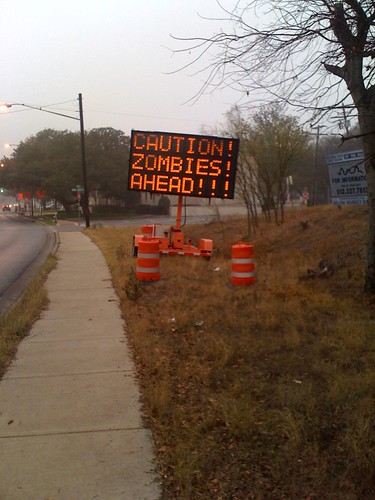
As noted, my post of the zombie construction sign hack has gone persistently viral, with daily Google alerts regarding new publications around the planet of one or more of our photos of the Austin mod alerting drivers to the Nazi zombie attack and the imperative to run for cold climates. (My son was even asked about one of my photo credits by some of his schoolmates.)

Which is somewhat ironic, since I am not that big a fan of the zombie sub-genre. For example, when I stop at my local comic book store and find racks of Marvel Zombies, my interest is repelled. Not just because the idea of Captain America as a zombie is the height of shark-jumping.


My view is that the zombiefication of the world is kind of stating the obvious. That is because I believe that the increasingly ubiquitous idea of everyday zombies is a psychologically accurate expression of our state of contemporary alienation — a variation on the same truths revealed through our better post-apocalyptic narratives. I touched on this topic in an essay I recently wrote that wrestles with, among other things, the role of dystopian zombies in science fiction as avatars of our estrangement from our fellow man in advanced capitalist society:

"The fuller social implications [of post-apocalyptic cozy catastrophe narratives] are revealed more explicitly, if with less authorial self-awareness, in Richard Matheson’s I Am Legend, a story with such pop memetic potency that it has been filmed three times in four decades. The novel opens with the physician protagonist settling down at dusk in the comfort of his barricaded townhome in plague-ridden Los Angeles:

'He sat in the living room, trying to read. He’d made himself a whisky and soda at his small bar and he held the cold glass as he read a physiology text. From the speaker over the hallway door, the music of Schönberg was playing loudly.

'Not loudly enough, though. He still heard them outside, their murmuring and their walkings about and their cries, their snarling and fighting among themselves. Once in a while a rock or brick thudded off the house. Sometimes a dog barked.

'And they were all there for the same thing.

'Robert Neville closed his eyes a moment and held his lips in a tight line. Then he opened his eyes and lit another cigarette, letting the smoke go deep into his lungs.

'He wished he’d had time to soundproof the house, It wouldn’t be so bad if it weren’t that he’d had to listen to them. Even after five months, it got on his nerves.'

"As Neville stares into his microscope searching for a cure to the mysterious virus that has rendered him alone, he reveals the extent to which his cozy driving tour of an apparently deserted Los Angeles is a depiction of real-world estrangement. Neville is *not* the last man Earth. He’s just the last upper-middle class professional white guy. A man who experiences his world largely through the medium of his own alienation, spends his days in the solitary performance of his professional chores, finds himself unable to form authentic emotional connections with the world around him, his comfortable suburban home a prison that protects him from the world of the real outside. As Neville drives around scavenging for commodities, he is surrounded by other humans, but they are dead to him other than as tribal predators or lewd objects of sexual desire. Like the protagonists of George Romero’s Dawn of the Dead, locked in a giant shopping mall that has been overtaken by zombies! (Perhaps you know the feeling?)"


I think this postulate probably has the best chance of explaining how it was that Cormac McCarthy's publication of the world's first literary realist zombie novel became an Oprah selection and a Viggo Mortenson major motion picture. File under nonfiction?

For the fuller discussion of these topics (including the aforementioned essay, "Feeling very estranged: science fiction and society in the aftermath of the twentieth century"), you can spend your spring break with yours truly and many bigger brains (including Mark Dery, Bruce Sterling, Christopher Priest, M. John Harrison, and Linda Nagata) March 16-20 at the Festival de Mexico in Mexico City, where we will put forth our essays and other thoughts on the important topic of Parallel Worlds: The Impact and Influence of Science Fiction on Contemporary Culture. The zombie-fighting Mezcal is on me.

Monday, February 9, 2009

NASA gets the YouTube treatment

Remember back last summer when a news blip made the rounds about how a significant number of engineers at NASA were so dissatisfied with the designs of the official launch system they were working on that, in their spare time and at their own expense, they designed their own renegade version and offered it to NASA as a superior product? And that NASA middle-managers promptly turned them down, since getting to the moon ain't exactly rocket science... Oh, wait. Yes it is!

Did you ever wonder what kind of culture can be so steeped in technology, yet so hidebound that it dismisses innovation from the very people hired to make such wonders manifest? Wonder no more. Astronaut Andrew Thomas has, with the assistance of numerous poorly-paid non-thespians, produced (in the tradition of all YouTube greatness) a shoestring video that gleefully bites the hand that feeds, well, a bloated, hidebound bureaucracy well-deserving of such scathing satire. NASA admins do get credit for allowing this to be posted on YouTube, but will this lead to any real change at NASA? I'm not holding my breath.

Sunday, February 8, 2009

Lukas Foss


Lukas Foss died last week. He probably wasn't much of a household name. Foss spent years as the conductor of the Buffalo Symphony Orhestra, where he championed and recorded a lot of 20th century music. I suspect a lot of composers' only commercial recordings--many for Naxos--were done by Foss. He himself was a composer of note. Like a lot of his contemporaries, his early work was very out there in terms of tonality or the lack thereof. As time went on, Foss apparently embraced more mainstream style, even writing an opera based on Twain's The Jumping Frog of Calaveras County.

Personally, I knew him from one piece. Years ago, and I have no idea why I bought it, I had a cassette (that's how long ago it was) of his Baroque Variations (1967). This was a clever little thing, very 60s, that consisted of three movements, each based on a classic composer of the period. So the first movement was "On a Handel Larghetto," the second "on a Scarlatti Sonata," and the third "On a Bach Prelude 'Phorion'."

Baroque Variations is the sort of mid-century classical that feels old in newness, if that makes any sense. It sounds very time specific. Like a lot of science fiction, you could probably guess its creation date within a year or two. Foss took the scores of each one of these small classical works and sort of played with them. For instance, with the Handel, he went through and simply erased some of the notes. Writing that sounds ridiculous, but the result is that the music, which would normally gather a narrative drive isn't allowed to do so. It has a weird start and stop to it, the music seems to drift in and out. In the liner notes (remember those?), Foss said simply: "I composed the holes."

The movement derived from the Bach is just outrageous. Again, the familiar underlying music is there, but it jitters in and out of the foreground, loud then soft, while all around it are out of place snaps and bangs of percussion instruments, an organ providing bottom at the end. The liner notes quote a New Yorker review of the original performance: "The thing reminded me of Marcel Duchamp's celebrated gesture of painting a mustache on Leonardo's 'Mona Lisa'. Shortly after that, Mr. Duchamp stopped creating art altogether and devoted himself to chess. A similar move by Mr. Foss might benefit the future of the art of music."

That's the sort of review you dream of getting. All I know is that I found Baroque Variations compelling. To the point that I still had the cassette years after I no longer had a cassette player and would think about it now and then hoping that it might come out on CD. As far as I can tell, it never did. About a month ago, I was thinking about the music, went on eBay and bought an old copy of the record. Baroque Variations is side 2. Side 1 and no doubt the big draw at the time was John Cage's Concerto for Prepared Piano and Orchestra. I got the record a day or so before reading that Foss had died.

You have no doubt been looking for a link to Baroque Variations or some of Foss' music. Sorry, I tried but I couldn't find any online. And I don't have one of those newfangled space age USB turntables that would let me create an audio clip. But to give you a taste of a similarly Duchampian piece of the era, here's a link for some of John Cage's 4'33''


Friday, February 6, 2009

Holy moly! A year already?

I just noticed, much to my astonishment, that Jan. 14 marked the one-year anniversary of Memory, my experiment in serialized online storytelling. If you'll harken back to the original rules, you'll see my goal was to produce a chapter/installment each week of roughly 1,000 words. I would not plot ahead. I had no idea how long it would be when I started, and honestly, I still don't have a clear guesstimate on that point. I missed the weekly posting goal by a pretty miserable margin--I'm up to roughly 33,000 words whereas it should be topping 52,000 by this point. But I haven't cheated by going back and doing rewrites and I generally meet my 1,000-word-per-chapter goal, if not surpass it.

For those of you who missed it, we're also a week shy of the anniversary of my first (and thus far only) interview with one of the two leads in the story, Flavius MacDuff. The interview didn't go quite as I'd expected, which puts it on footing quite similar to Memory itself. Enjoy.

MEMORY: 33

First
Previous


Papantzin slapped the flat of the blade away. Her kick to the chest sent Flavius sprawling. Immediately she turned back to Anacaona, a reed-thin stiletto glinting wickedly in her hand.

Anacaona scrambled away, stumbling over the corner of the bed. She fell hard onto the small pile of her clothes on the floor.

“Damn ya for losing focus, ya git,” Flavius gasped from the floor where he’d fallen. He still held Memory--thank goodness--but his chest burned like fire where she’d kicked him and it felt as if all his ribs were pulling loose as he tried to get up. “She’s nae just some stuck-up handmaiden. Ach! Damn, but she kicks like a mule!”

Papantzin moved quickly and fluidly to Anacaona. She bent over the fallen Sajal, stiletto poised for the killing stroke--

A burst of green flashed, flinging Papantzin away.

Anacaona sat up, a miniature cuayab glowing in her hand.

“What the hell is that?” Flavius managed, glancing over at Papantzin, who lay moaning--and smoking--in the middle of the floor. Empress Malinche stood frozen in place, disbelief and outrage battling for supremacy on her face.

“Palm cuayab. Nobility of Sajal rank and higher are entitled to carry one for personal protection. What? I keep it in my belt pouch,” Anacaona said, staring down at Papantzin with loathing. “They’re not powerful enough to more than stun. Unfortunately.”

Papantzin grunted and propped herself up on her elbows. Flavius quickly directed the sharp tip of Memory menacingly above her chest.

“Ah! That’ll be far enough, I’m thinking,” he said. “I’m nae squeamish about bloodying a lass, or even ya, Papantzin, but I’ll be letting ya live out of respect for my deep, meaningful relationship with yer Empress. We had some good times, didn’t we Malinche?”

The Empress’ disbelief and outrage had compromised to express themselves via a disapproving scowl. “This joke has lost all humor. Sajal, you will help Papantzin up and then accompany her to your suite where she will administer atonement. Flavius will accompany me to the Imperial wing.”

“I ken yer having a wholly different conversation than the rest of us,” Flavius said, staring at the Empress in exasperation. “Right then. Anacaona, whatever’s in the wardrobe, fit it in my pack there. Hand me my sporran, too, when ya get a chance. Hurry now, lass, be quick about it.”

“Have you made up your mind, then?” Anacaona asked as she stuffed Flavius’ few possessions into the much-abused pack. “About my traveling otherwhere with you?”

“Dinnae be a git. Of course yer coming with me. On one condition-- I have to have yer solemn promise yer going to let me sleep at least a week before we finish our business.”

“Yes! Yes!”

“And lass, much as it pains me to say this, ya’d better put yer clothes back on. The Nexus of All Realities is nae place to be flouncing around starkers.”

The room shook suddenly, an unnerving lurch just strong enough to throw Flavius off-balance.

Papantzin reacted, rolling to the side as Memory wavered. She came up thrusting her stiletto. Flavius pivoted, dodging the blade. His momentum carried Memory around, catching Papantzin’s knuckles. She cried out. Blood flew across the room, streaking Anacaona’s breasts scarlet. The stiletto clattered to the floor, along with splattering drops of blood.

“You moved as quickly as she did,” Anacaona said, eyes wide. “Your skill in disarming her--”

“Skill, hell. I was aiming to lop off her goddamned head!” Flavius kicked the bloody stiletto to Anacaona while keeping Memory trained on Papantzin. Anacaona snatched it up. Flavius tried staring Papantzin down with a murderous glare, but she returned it with equal ferocity as she cradled her bloody hand. Finally, he gave up. “Anacaona, that shake we just felt--that something happens often around here?”

She shook her head. “I’ve never felt anything like it.”

“Yer Imperial Majesty...?”

“The Palace of Un-pic Ja’ab has the most advanced inertial dampers in forty cosms,” Empress Malinche said proudly. “It does not shake.”

“Then just what--” Flavius jabbed Memory at the Empress for emphasis, “--do ya call that belly-knotting jitter what came through a moment ago and made the room go all wobbly, eh?”

The door to the room opened. A squad of Eternal Militiamen stood outside in the hall.

“Your Imperial Majesty, a situation has...” the commander trailed off, dumbstruck by the scene before him. The sounds of alarms drifted in from the hall.

Flavius looked at the Militiamen, then at Memory, pointed directly at the Empress. He closed his eyes. “Bugger me,” he muttered under his breath. Quickly he directed Memory away from the Empress, back toward Papantzin.

“Lads, it’s nae what it looks like,” he said, forcing a smile. “I was just having a chat with Her Imperial Majesty, that’s all. It was Papantzin I was having a wee row with.”

The commander’s eyes, if possible, got even wider at the sight of Papantzin’s blood everywhere.

“Damnit man, I ken what yer thinking, and it’s nae like that. She tried to kill me first. Ask Sajal Acaona--” For the first time, Flavius noticed the blood streaking her naked body. “Oh, Goddamn it all to hell. I’m nae getting out of here without a fight, am I?”

Continued