Sunday, October 5, 2008

Texas grit?


How can you not admire the unique survival kit strategy of this Texan, discovered by the Manhattan anthropologists at America's paper of record:

Michael Clow, a 53-year-old handyman, said he swam to a neighbor’s house after his cinder-block home broke to pieces around him. Struggling in water far above his head, Mr. Clow floated on a cooler in which he had stuffed two kittens, some cigarettes and a stash of beer.

I just hope he didn't eat the kittens while he was drinking Lone Star and smoking Pall Malls in the ruins of his post-deluge neighborhood.

And what's up with the unicorn pennant hanging from the line behind Mr. Clow?

Friday, October 3, 2008

MEMORY: 25

First
Previous


Flavius coughed, waving the smoke away. “Aye. That I noticed.”

“Indulge me, Flavius. I am curious,” Emperor Camargo said. “Were you wise enough to heed my advice, would you depart the same way you arrived?”

Flavius took a cautious sip of ja’na winic. Even without a mouthful of troesken, it imparted a sharp sting that wasn’t entirely pleasant. “To be honest with yer Imperial Majesty, I’ve nae given it much thought. The gap we arrived though, it were a three-day hike through yer mountains there.” He prodded the troesken suspiciously, then speared one of the roving berry-like things. It emitted a puff of gas, deflating. “With nae much to eat along the way.”

“Three days’ hike? Most interesting. I was under the impression--mistaken, obviously--that every Nexial gap within a 100 kaa radius had been collected and anchored inside the palace. My security director’s explanation should be quite... entertaining.”

Flavius’ skin prickled. No matter how tenuous his position was, he wouldn’t change places with the security director for anything.

He stared at his plate, the entree growing more revolting to him by the moment. His stomach churned with the exotic fare he’d already put down. Flavius looked up at Emperor Camargo, a man who’d killed him once already and could well stage an encore on a whim. Flavius’ eyes roamed across the crowded dining hall, finding Parric’s phantom near the musicians, pointedly ignoring a courtier--an Ajaw probably--babbling away at the conjoined tables. Farther back among the dining crowd, Flavius saw several peq herding drifting tables away from Empress Malinche’s field of vision, so she could keep an unobstructed eye on Flavius.

A feeling of abandonment and exposure settled over him. Alone among a crowd that regarded him as little more than an amusing animal, vulnerability did not sit well. He and Parric had come to the Eternal Dominion in order to catch their breaths and plan their next move. It was pretty clear--to Flavius at least--that Camargo wasn’t behind the moironteau attacks, but this mysterious Crafter Not-of-Onimik skewed the situation in ways he didn’t fully understand. Too many unknowns had intruded. The Eternal Dominion was no longer a haven of even dubious safety, if it ever had been. Damned Imperial court intrigues threatened to doom Flavius even if the moironteau never reared their ugly footheads again. Chaotic Tradefare may be a cutthroat morass of opportunistic betrayal, but at least the dangers there were familiar ones.

“Yer right,” Flavius said suddenly, pushing his plate and drink away. “Yer Imperial Majesty is absolutely right.”

Emperor Camargo barely concealed his surprise, then narrowed his eyes at Flavius. “About what, friend Flavius? Some of my predecessors have argued for infallibility in every Imperial thought, word and deed, so specific examples would help my studied evaluation of such claims.”

“Why, the bit about the leaving, of course,” Flavius said. “Yer Imperial hospitality’s been grand, but yer right that I dinnae belong here. Even yer food, fine stuff that it is, no doubt, is too much for my simple tastes. So, aye, I’m leaving.”

“And when do you plan to depart?”

“Immediately, if nae sooner.” Flavius stood, wobbled a moment, then bowed politely. His head swam more than he’d expected. “May we meet again in better times. And by better times, I mean with fewer bodies trying to put me in an early grave.”

With that, Flavius turned and briskly wound his way through the drifting tables, trying not to stumble too noticeably. Emperor Camargo’s laughter rose up behind him abruptly, following Flavius through the hall. A hush fell as conversation trailed off and the musicians put down their instruments. Even the aerial waiters caught themselves in mid-air, holding to their thread and watching the curious events below. All eyes followed Flavius as he made for the door.

“All right now, just make it to the door without anyone cutting ya down from behind and yer home free,” Flavius muttered to himself under his breath. He felt the heat of a hundred sets of eyes on him. He didn’t have to look at Empress Malinche to know she wouldn’t be as amused as Emperor Camargo.

Flavius reached the great double doors, pushed one open and stepped through. Once safely in the hall, he exhaled. He hadn’t realized he’d been holding his breath.

“Is the distinguished guest in need of facilities?” the doorman asked. “I can have a peq guide you.”

“Nae, lad. I’ve had my fill, ya could say. I’m just away to my bed.”

“Before the ninth course?” The doorman raised his eyebrows, but quickly regained composure. He gestured to a peq slouched in an alcove across the hall. “Of course, sir. This peq will see you to your room and address any need you may have.”

“Our pleasure is to but serve,” the peq said in acknowledgement, plodding off in the direction of Flavius’ room.

As they walked down the hall, Flavius tried and failed to identify the peq as the one who’d waited on him before. Peq had a startling sameness about them, and the drink fogging his head didn’t help in telling them apart.

Flavius noticed a slight limp in the peq’s hind legs when it mounted the stairs. A knot formed in his stomach. “Say lad... er, that spondl served in the dining room earlier, you weren’t... I mean--”

”They grow back,” answered the peq simply. “Your room, sir.”
“Thanks, lad,” Flavius said, opening the door. “I’d have nae found it on my own.”

“I will be out here in case sir needs anything,” the peq said. “Our pleasure--”

“Is to serve. Aye, I got that one the first time around. Well, g’night.”

Flavius closed the door quickly, shielding himself from the madness of the Eternal Dominion. The room threatened to begin spinning, but Flavius stilled it to a persistent jitter through force of will. He stood in the dark, starlight filtering in through the window. He shut his eyes, drained and exhausted, but not as hungry as he’d been before, at least. Forcing himself to concentrate, he weigh whether he should grab what sleep he could and depart in the morning or find Parric now and flee as quickly as possible.

The room seemed to breath about him.

Flavius’ eyes snapped open. It wasn’t the room breathing. Someone was there with him.

“All right, whoever ya are, show yerself.” Flavius gripped Memory, half-drawing the sword. “I’m in nae mood for games.”

She stepped from the spherical bath alcove tentatively, head down, submissive. Starlight silhouetted her six bare breasts.

This was not the assassin he’d expected. “Wha...? Who are ya, and what’re ya doing slinking around my room all starkers?”

“You don’t..? I-- I’m Anacaona. We sat together at dinner,” she answered in a wavering voice. “We discussed... ah, we discussed...”

“Anacaona?” Drink-tinged recollections came to Flavius from Memory. His weariness abruptly fled. “Oh! That Anacaona! Sorry, lass, but it’s been a bit of a night for me.” Flavius thought for a moment. “But wasn’t I supposed to go to yer room?”

She didn’t raise her head. “W-When you said you’d have me on your terms, I understood that as an ultimatum. So I came directly here to await you. I thought that your desire. I apologize if I am in error. It is not my wish to offend--”

Flavius stopped her, slipping his finger under her chin to lift her face. Fear mingled with excitement in her eyes. And something else, something furtive, like a thief caught in the royal treasury. For a noble of the Imperial court, Anacaona’s condescending arrogance was in surprisingly short supply. Flavius bent forward and kissed her lips, gently at first, but then with urgency.

“Then you’ll have me?” Tears of joy welled in her eyes. “Thank you. Oh, thank you.”

“A sweet bonny lass like yerself has nae need to beg.” Flavius slid his hands across her body. He pulled off his shirt, then drew her back to him, cupping each breast in turn. He was delighted to find her navel perfectly centered between the third pair.

He led her to the bed, shedding his kilt and unbuckling his swordbelt. An image of Empress Malinche flashed through his mind, of himself casting aside his sword an earlier time. He reconsidered, then, refastening the belt. “If ya dinnae mind, though, I ken I’ll be keeping my Memory with me.”

Continued

Thursday, October 2, 2008

Fast Forward 2: Paul Cornell's "Catherine Drewe"


At Pyr Books, editor Lou Anders has just posted online in its entirety the opening story from the just-released Fast Forward 2, Paul Cornell's "Catherine Drewe," a fine dish of smart pulp full of tasty Anglophilic anachronisms. Here's Lou's pitch:

"Catherine Drewe" by two-time Hugo nominee Paul Cornell is a tale of a Bond-like character in an alternate history where the Great Game never ended and the British Empire - along with the other world powers - extends its reach throughout the solar system.

Paul says of the character, "I like to think I'm writing in the tradition of Ian Fleming's Bond novels (not the movies) but I'm trying to stay away from pastiche, and instead hope to explore the same debates about masculinity and Britishness he did, while perhaps coming to different conclusions."


Cornell does a very nice job of using all of his alt history space adventure baubles to bring into greater relief the warm dream of a damp green English Home, as in this nicely painted early transitional scene that rings true to anyone who has lived in Oxford:

Hamilton made his apologies to his host, and that night drove to Oxford in his motor carriage, a Morgan Sixty-Six. The purr of the electrical motor made him happy. Precision workings. Small mechanisms making the big ones tick over.

It was a clear run up St. Giles, but glancing at his watch, Hamilton knew he wasn’t going to make it in time for the start of the service. He tore down the Banbury Road, and slowed down at the last moment to make the turn into Parks, enjoying the spectacle of the Pitt Rivers, lit up with moving displays for some special exhibition. The Porters, in all their multitudes, ran out of their lodge as he cut the engine and sailed into the quad, but the sight of the Fourth Dragoons badge had them doffing their caps and applauding. After a few words of greeting had been exchanged, Loftus, the head porter, came out and swore at Hamilton in her usual friendly fashion, and had her people boost the carriage onto the gravel just beyond the lodge.


Cornell also has a wonderful gift for drawing kinetic action with words on paper, as in this wonderful scene:

Hamilton detected something urgent in her voice, something he’d heard in the moments before other situations had got rough. This was no setback, no sighing pause.

He crumpled his cover into the darkness of his mind.

He slammed his palm against the wall beside her head.

The bodyguard moved—

But she put up a hand and he stopped.

He let out his Irish accent. “You’ve got a problem, Miss Drewe,” he said.

She considered that for a moment.

He smelt the edge of the ceramic knife as it split molecules an inch from his eye.

He flathanded the wrist of her knife hand into the wall, his other hand catching the gun she’d pulled at his stomach, his finger squashing hers into firing it point-blank into the bodyguard. His face exploded and he fell and Hamilton ripped aside the weapon and threw it.

There was a shout from behind.

Hamilton grabbed the Webley Collapsar 2 mm handgun from the folded dimensions in his chest, spun into firing stance, and blasted a miniature black hole into the skull of a Russian officer, sending the man’s brains flying into another universe.

He spun back to catch Drewe pulling another device from her boot.

He grabbed her wrist.

He knew intuitively how to snap her neck from this posture.

In moments, the gunfire would bring many soldiers running. Killing the overseer had compromised Hamilton’s mission but slightly. It was still something that a Russian assassin might do, to give his cover credibility. He had completed half his mission now.

But why had she pulled that, instead of something to kill him with?

He looked into her eyes.

“Do what you were going to do,” said Hamilton.

He let go.

Drewe threw the device at the overseer’s body, grabbed Hamilton, and heaved him with her through the rock wall.


Check it out. And then go buy yourself a copy!


Update: SF Signal now has the full text of Lou's introduction to the book available online.

Wednesday, October 1, 2008

The 21st century Coast Guard?


Like you needed another reason to love the Somali pirate story, which appeared amidst the dire tales of imminent global financial meltdown and Sarah Palin's bizarro tales of Putin's ethereal invasion of our Thulian mindspace. Hijacking a Ukrainian ship loaded with heavy weapons, inciting angered pursuit by both the American and Russian navies, these guys are like the trickster court jesters of our apocalyptic days.

The Somali pirates are coastal denizens of what is probably the world's biggest temporary autonomous zone. Not exactly a pirate utopia. In fact, they claim they are not even pirates. Rather, they are a sea posse, a bunch of local dudes who claim they are just protecting their own coastline from illegal fisherman and shippers and trash dumpers in a lawless country where the official state coastal patrols ended a long time ago.

"We come together like Chelsea or Arsenal," explains one of the Somalis. They even have an official spokesman. No, Harry Shearer did not make this up.


Q. & A. With a Pirate: “We Just Want the Money”
By JEFFREY GETTLEMAN

Sugule Ali, the spokesman for the Somali pirates holding hostage the Faina, a Ukrainian freighter loaded with weapons, spoke to me by satellite telephone today from the bridge of the seized ship. In the holds of the Faina, which the pirates seized on Thursday, are 33 Russian-built battle tanks and crates of grenade launchers, anti-aircraft guns, ammunition and other explosives. American officials fear that the weapons could fall into the hands of radical Islamist insurgents who are battling Somalia’s weak government. My questions were translated into Somali, and Mr. Ali’s responses into English, by a translator employed by The New York Times.

Q. Tell us how you discovered the weapons on board.
A. As soon as we get on a ship, we normally do what is called a control. We search everything. That’s how we found the weapons. Tanks, anti-aircraft, artillery. That’s all we will say right now.

Q. Were you surprised?
A. No, we weren’t surprised. We know everything goes through the sea. We see people who dump waste in our waters. We see people who illegally fish in our waters. We see people doing all sorts of things in our waters.

Q. Are you going to sell the weapons to insurgents?
A. No. We don’t want these weapons to go to anyone in Somalia. Somalia has suffered from many years of destruction because of all these weapons. We don’t want that suffering and chaos to continue. We are not going to offload the weapons. We just want the money.

Q. How much?
A. $20 million, in cash. We don’t use any other system than cash.

Q. Will you negotiate?
A. That’s deal making. Common sense says human beings can make deals.

Q. Right now, the American Navy has you surrounded. Are you scared?
A. No, we’re not scared. We are prepared. We are not afraid because we know you only die once.

Q. Will you kill the hostages if attacked?
A. Killing is not in our plans. We don’t want to do anything more than the hijacking.

Q. What will you do with the money?
A. We will protect ourselves from hunger.

Q. That’s a lot of money to protect yourselves from hunger.
A. Yes, because we have a lot of men and it will be divided amongst all of us.

Q. [There are 20 crew members, most of them Ukrainian, being held hostage.] How are you interacting with the hostages? Eating with them? Playing cards?
A. We interact with each other in an honorable manner. We are all human beings. We talk to one another, and because we are in the same place, we eat together.

Q. What if you were told you could leave peacefully, without arrest, though without any ransom money. Would you do it?
A. [With a laugh] We’re not afraid of arrest or death or any of these things. For us, hunger is our enemy.

Q. Have the pirates been misunderstood?
A. We don’t consider ourselves sea bandits [”sea bandit” is one way Somalis translate the English word pirate]. We consider sea bandits those who illegally fish in our seas and dump waste in our seas and carry weapons in our seas. We are simply patrolling our seas. Think of us like a coast guard.

Q. Why did you want to become a pirate?
A. We are patrolling our seas. This is a normal thing for people to do in their regions.

Q. Isn’t what you are doing a crime? Holding people at gunpoint?
A. If you hold hostage innocent people, that’s a crime. If you hold hostage people who are doing illegal activities, like waste dumping or fishing, that is not a crime.

Q. What has this Ukrainian ship done that was a crime?
A. To go through our waters carrying all these weapons without permission.

Q. What is the name of your group? How many ships have you hijacked before?
A. I won’t say how many ships we have hijacked. I won’t talk about that. Our name is the Central Region Coast Guard.

For more insight, see Gettleman's excellent little video report from the scene.

We can only hope that the crisis will reach its climax tomorrow night, in time for bizarro Palin and blabbermouth Biden to hash out the surrealities of our new century in cathode ray technicolor.

For more on old world pirate utopias, check out Peter Lamborn Wilson's amazing work on the subject.

For a very amusing speculative fictional take on the Somali pirates and their pop cultural intersection with Johnny Depps' Disney pirates, check out Terry Bisson's "Pirates of the Somali Coast," collected in the Hartwell and Cramer Year's Best SF 13.

Friday, September 26, 2008

Eight years later

Consider whether this bit of now-vintage speculative satire isn't a little too close for comfort to what actually happened.


Catching up with GYWO on the bailout:

Thursday, September 25, 2008

Turning reality up to eleven

Getting ready to lock down the hatch to your bunker in anticipation of the coming societal meltdown forecasted last night by our fearful leader? Looking for some good reading material to take with you? Well, yesterday's mail brought me copies of two different, amazing new science fiction anthologies that include new stories by yours truly, along with a whole bunch of amazing stories by my betters.

Fast Forward 2
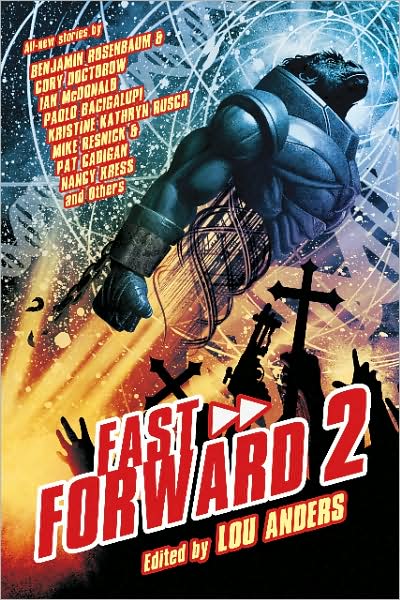


Fast Forward 2 from Pyr Books is the latest installment from the guy who is shaping up to be 21st century SF's master anthologist and most innovative editor, the incomparable Lou Anders, as previously noted, the only editor in science fiction who can actually see the future. With his Fast Forward anthology series, Lou has set out to revive the "literature of ideas" promise of earlier periods in the genre, to meet the challenge incisively articulated in the book's epigrammatic quote from Paul McAuley (who also has a story in book):


Science fiction is the holy fool of literature. It can say what it likes and get away with an examination of truly radical and subversive ideas because no one takes it seriously. When it's at its best, we're generally in trouble. Science fiction flourished during the social and economic upheavals of the 1930s, during the Cold War, and during the Iron Age of the 1980s. It should be flourishing now, damn it, but too many people who used to hang out with it have wandered off into some kind of fluffy make-believe world or other. Real science fiction doesn't make stuff up. It turns reality up to eleven. It takes stuff from contemporary weather—stuff no one else has bothered or dared to question—and uses it to make an end run on reality. It not only shows us what could happen if things carry on the way they are, but it pushes what's going on to the extremes of absurdity. That's not its job: that's its nature. And what's happened to science fiction lately, it isn't natural. It's pale and lank and kind of out of focus. It needs to straighten up and fly right. It needs to reconnect with the world's weather, and get medieval on reality's ass.

My story, "The Sun Also Explodes," tries to meet that challenge by exploring what happens when conceptual artists start to play with genetic material as a new medium. Lou's invitation to come up with something for the anthology arrived shortly after I had read Freeman Dyson's mind-blowing essay in the New York Review of Books about "Our Biotech Future," and the imminent explosion of garage geneticists spurring on a new wave of cross-species evolution. It also involves prosthetic limbs, disabled veterans of our global war, the things the very rich to to stave off boredom, next generation professional athletes, weird sexual intrigue, and a tree that grows Prozac.

To give you an idea of the quality of Lou's selections, five of the stories in David Hartwell and Kathryn Cramer's outstanding Year's Best SF 13 came from Fast Forward 1. So go get yourself a copy!


Spicy Slipstream Stories
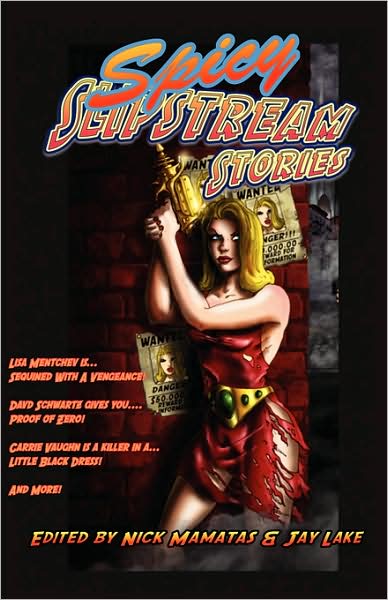


Spicy Slipstream Stories is the genius product of the twisted minds of authors Nick Mamatas and Jay Lake: to see what an invitation to combine the literate fabulism of slipstream with the technicolor plotting of the spicy pulps would produce (see our previous post on the anthology for a complete recap of what remain the most wonderfully insane guidelines for submissions ever written). Through the persistence of the editors and the vision of the folks at Lethe Press, after some false starts the anthology is now on the streets, and what a rare and wondrous thing it is.

My spicy slipstream story, "Wild Tchoupitoulas," explores the science fictional power chord Brian Aldiss calls the "cozy catastrophe," in the context of an alternate post-deluge New Orleans under lingering clouds of Walker Percy malaise and comic book wonder. It is totally, 100% nuts. So why don't you go buy one?