Showing posts sorted by relevance for query "invisible literature". Sort by date Show all posts

Monday, September 28, 2009

Review: The Complete Stories of J.G. Ballard


“I first met Jane Ciracylides during the Recess, that world slump of boredom, lethargy and high summer which carried us all so blissfully trhough ten unforgettable years, and I suppose that may have had a lot to do with what went on between us.”

So begins the first short story published by J.G. Ballard, “Prima Belladonna,” from Science Fantasy in 1956. It is also the opening of The Complete Stories of J.G. Ballard, finally out in the U.S. from Norton eight years after its publication in the U.K. The only addition appears to be the short personal introduction by Martin Amis, presumably designed to give genteel permission for establishment literary readers in the U.S. to read science fictions.

The canonization of Ballard as a writer who transcended his genre roots reached its apex upon the author’s death earier this year, and the past two weeks' rush of reviews (e.g., Jonathan Lethem in the Times, Michael Dirda in the Post) is the second ripple of the honorific obituaries from all all the papers that had largely forgotten Ballard’s work since Empire of the Sun. The English recognition of Ballard’s literary achievement never seems to have made it fully across the Atlantic. So perhaps the appearance of this definitive collection in an increasingly Ballardian 21st century America of abandoned suburbs, kinky astronauts and serial killers of the week is the perfect opportunity for a reclamation of Ballard by science fiction.

In contrast to Ballard’s more recent works (at least as they are marketed by publishers), every one of the 98 stories in this collection is a work of science fiction. (Granted, a science fiction that is being knowingly repurposed by an outsider who discovered the pulps as a young adult and found in them a perfect medium for underground literary surrealism.) Ballard’s contemporary establishment reputation is built largely on the works that made it socially acceptable to read him: the putatively mainstream novels that followed Empire of the Sun, explorations of contemporary bourgeois Europe like Cocaine Nights, Super-Cannes, Millennium People, Kingdom Come, and the semi-autobiographical Kindness of Women. While he is a seminal influence for many pioneering sf authors of the last 30 years, I think most of the current generation of sf readers, writers and editors, carrying on with a linear evolution of pulp sf and fantasy, don’t really know what to make of Ballard — he’s the Ballard of Crash and The Atrocity Exhibition, an outlier in the New Wave (already generally treated as a kind of dope-fueled footnote to generic history) who really is doing something other than science fiction. Fair enough, I suppose — I'm not holding my breath for the Syfy Channel adaptation of “Why I Want to Fuck Ronald Reagan.” But in a genre replete with self-referential manifestos, surely there remains no more cogent call to action for the real potential of sf than Ballard’s 1974 introduction to the French edition of Crash — all the more prescient when read from the perspective of the cyberpunk reality of the 21st century:


The marriage of reason and nightmare which has dominated the 20th century has given birth to an ever more ambiguous world. Across the communications landscape move the specters of sinister technologies and the dreams that money can buy. Thermonuclear weapons systems and soft drink commercials coexist in an overlit realm ruled by advertising and pseudo-events, science and pornography. Over our lives preside the great twin leitmotifs of the 20th century—sex and paranoia. Despite McLuhan’s delight in high-speed information mosaics we are still reminded of Freud’s profound pessimism in Civilization and its Discontents. Voyeurism, self-disgust, the infantile basis of our dreams and longings—these diseases of the psyche have now culminated in the most terrifying casualty of the century: the death of affect.

The demise of feeling and emotion has paved the way for all our most real and tender pleasures—in the excitements of pain and mutilation; in sex as the perfect arena, like a culture bed of sterile pus, for all the veronicas of our own perversions; in our moral freedom to pursue our own psychopathology as a game; and in our apparently limitless powers for conceptualization—what our children have to fear is not the cars on the highways of tomorrow but our own pleasure in calculating the most elegant parameters of their deaths.

To document the uneasy pleasures of living within this glaucous paradise has become the role of science fiction. I firmly believe that science fiction, far from being an unimportant minor offshoot, in fact represents the main literary tradition of the 20th century…

The main “fact” of the 20th century is the concept of unlimited possibility. This predicate of science and technology enshrines the notion of a moratorium on the past—the irrelevancy and even death of the past—and the limitless alternatives available to the present. What links the first flight of the Wright brothers to the invention of the Pill is the social and sexual philosophy of the ejector seat.


After establishing this premise, Ballard gently observes the failure of most sf to realize its potential in this regard, and his own approach to the task at hand:

…[W]hen I first turned to science fiction, I was convinced that the future was a better key to the present than the past. At the time, however, I was dissatisfied with science fiction’s obsession with its two principal themes—outer space and the far future. As much for embleamtic purposes as any theoretical or programmatic ones, I christened the new terrain I wished to explore inner space, that psychological domain (manifest, for example, in surrealist painting) where the inner world of the mind and the outer world of reality meet and fuse.

Primarily, I wanted to write a fiction about the present day. To do this in the context of the late 1950s, in a world where the call sign of Sputnik I could be heard on one’s radio like the advance beacon of a new universe, required completely different techniques from those available to the 19th century novelist. In fact, I believe that if it were possible to scrap the whole of existing literature, and be forced to begin without any knowledge of the past, all writers would find themselves inevitably producing something very close to science fiction.

Science and technology multiply around us. To an increasing extent they dictate the languages in which we speak and think. Either we use those languages, or we remain mute.

Yet, by an ironic paradox, modern science fiction becmae the first casualty of the changing world it anticipated and helped to create. The future envisaged by the science fiction of the 1940s and 1950s is already our past. Its dominant images, not merely of the first Moon flights and inerplanetary voyages, but of our changing social and political relationships in a world governed by technology, now resemble huge pieces of discarded stage scenery. For me, this could be seen most touchingly in the film 2001: A Space Odyssey, which signified the end of the herioc period of modern science fiction—its lovingly imagined panoramas and costumes, its huge set pieces, reminded me of Gone With the Wind, a scientific pageant that became a kind of historical romance in reverse, a sealed world into which the hard light of contemporary reality was never allowed to penetrate.


…We have annexed the future into our own present, as merely one of those manifold alternative open to us. Options multiply around us, we live in an almost infantile world where any demand, any possibility, whether for lilfestyles, travel, sexual roles and identities, can be satisfied instantly.

…Increasingly [the] roles [of fiction and reality] are reversed. We live in a world ruled by fictions of every kind—mass merchandising, advertising, politics conducted as a branch of advertising, the instant translation of science and technology into popular imagery, the increasing blurring and intermingling of identitieswithin the realm of consumer goods, the preempting of any free or original imaginative response to experience by the television screen. We live inside an enormous novel. For the writer in particular it is less and less necessary for him to invent the fictional content of his novel. The fiction is already there. The writer’s task is to invent the reality.


I quote the essay at such length because I think it is the missing introduction to the Complete Stories, providing literary context that is barely touched in Ballard’s 2001 introduction to the collection, and entirely missing from Amis’ comments. The pieces collected in this volume are Ballard’s achievement of the mission he set out for himself, more so than his novels. Indeed, Ballard’s best novels really want to be short stories, if not pure conceptual abstracts — the ultimate form for the "literature of ideas." The most acclaimed long works like Crash, The Atrocity Exhibition, Concrete Island, High Rise, are conceptual pieces for whom novel length exposition undermines the raw cogency of the premise, and one wonders if Ballard would have written them as such if market conditions had permitted.


Many of the stories that fulfill this Borgesian potential for narrative condensation do so through Ballard’s masterful appropriation of the tropes of “invisible literature” – clinical notes (“Notes Toward a Mental Breakdown”), research abstracts (“Why I Want to Fuck Ronald Reagan”), pataphysical sports reportage (“The Assassination of John Fitzgerald Kennedy Considered as a Downhill Motor Race”), television transcripts (“Theatre of War”), surveillance transcripts (“The 60 Minute Zoom”), postcards (“Having a Wonderful Time”), exploration logs (“Report on an Unidentified Space Station”), astrological entries (“Zodiac 2000”), biographical indexes (“The Index”), and answers to unknown police interrogation questions (“Answers to a Questionnaire”). Ballard figures out how to mimic the densest academic turge with a Calvino-esque lightness that transforms interoffice memoranda into the richest prose poems, achieving an effect both gravely profound and chortlingly funny. Even more beautiful are the experiments where Ballard’s narratives are more putatively accessible and linear, but subverted by the skilled application of surrealistic logic to produce sublime short epics of the subconcious like “The Drowned Giant.”

The collected stories also reveal qualities that Ballard and the critics don’t really acknowledge — Ballard’s achievement of the modernist agenda more successfully than his mainstream peers. Many of the stories are powerful dramas of the self that transport the interior stage from the bourgeois domicile to the more authentic science fictional settings of the present —abandoned motels and overgrown space launch facilities; alienated resorts occupied by the ennui-drunk elan of the leisure class; zones of transit and disaster where all sense of time and social context is obliterated; and extreme scenarios of social stress that peel back the veneer of civilized behavior to reveal primal instincts laid bare, mutated by their technologically mediated context. In stories like “The Dead Astronaut,” “My Dream of Flying to Wake Island,” “Low-Flying Aircraft,” “The 60 Minute Zoom,” “One Afternoon at Utah Beach,” “Motel Architecture,” “Memories of the Space Age,” “Myths of the Neat Future,” “The Man Who Walked on the Moon,” and the Vermilion Sands pieces, Ballard pioneered the art of using science fictional scenario-building — treating setting and technological McGuffins as tools to transform fictive narrative into socio-psychological laboratory — to better depict the emotional reality of what it feels like to live in the present.

Ballard’s ouevre has throughly infiltrated the intellectual superstructure of contemporary cyberculture, as evidenced in omnivorous weblogs like Geoff Manaugh's BLDG BLOG that filter an aspect of the world like architectural space through a Ballardian prism, or Simon Sellars' Ballardian, which annotates the power of Ballard’s philosophical point of view to understand topics as diverse as Michael Jackson’s plastic surgery, airport terminal design, or the pixellated ultraviolence of autogeddon video games. But his literary influence is more elusive, perhaps because Ballard’s singular voice is so outside the bounds of both mainstream literature and science fiction. As Bruce Sterling remarked when I interviewed him for Ballardian, Ballard borrowed from visual art and conceptual art in a way that I think may be less inimitable than Bruce assumes:

How do you think it is that Ballard transcended the genre in terms of critical acceptance?

Well, mostly because he really knows what he’s talking about. Ballard can write a movie review that I would dare any other science-fiction writer to do. Science-fiction writers can’t write about popular culture, even high culture, without trotting out their own self-importance. Which is sort of humiliating. Ballard never does that. He’s said things that are very affirmative about science fiction, like “it’s the only true literature of the twentieth century,” “Earth is the only alien planet,” and other wise things. Ballard’s the kind of guy – the kind of science-fiction writer – who can put on a performance in a pop art gallery that would cause a riot! If you took most science-fiction writers and dropped them in a pop-art gallery, they’d be saying things like “I didn’t get it about Picasso”, or “I kind of like Bridget Riley op art. Is that her real name, Bridget Riley?” They wouldn’t grab the bit between their teeth and push the world of artistic expression to a place that caused people to freak out.


One can only hope that the U.S. publication of The Complete Stories will bring fresh consideration and fresh readers to Ballard’s work, encourage more “literary” writers to borrow from the sf toolkit, and cause more sf writers to throw out the Clarion handbook in favor of trying to really bite into the copper wire of the science fictional landscape inside and outside our heads. The 21st century could use a few more riots started in art galleries by rogue science fictionalists.


The Complete Stories of J.G. Ballard (Norton, $35.00)

Previously in this space: "Invisible Literature for the Age of Celebrity" (or, "The Assassination Inquest of Diana, Princess of Wales Considered as an Unintentionally Ballardian Remix of the Warren Commission Report").

(Vintage covers courtesy of Rick McGrath's amazing Terminal Collection.)

Friday, December 15, 2006

Invisible Literature for the Age of Celebrity

The Assassination Inquest of Diana, Princess of Wales Considered as an Unintentionally Ballardian Remix of the Warren Commission Report


In 1966, J.G. Ballard authored one of his most famous experimental works, "The Assassination of John Fitzgerald Kennedy Considered as a Downhill Motor Race" (itself a remix of Alfred Jarry's "The Crucifixion Considered as an Uphill Bicycle Race").

"Oswald was the starter."

Ballard has frequently described the Warren Commission Report as one of the great avant-garde works of the century, an iconic masterpiece of "invisible literature" unintentionally transforming chapters on bullet trajectories and custody chains of cardboard boxes into simultaneously rich and minimalist prose poetry that charted the cartographic nodes of mass consciousness at the dawn of the 1960s. The text was clearly a primary source not only for the aforementioned short, but for the entirety of his masterful exploration of the intersection of sex, violence, technology and media in The Atrocity Exhibition.

''The latent sexual content of the automobile crash. Numerous studies have been conducted to assess the latent sexual appeal of public figures who have achieved subsequent notoriety as auto-crash fatalities, e.g. James Dean, Jayne Mansfield, Albert Camus. Simulated newsreels of politicians, film stars and TV celebrities were shown to panels of (a) suburban housewives, (b) terminal paretics, (c) filling station personnel. Sequences showing auto-crash victims brought about a marked acceleration of pulse and respiratory rates. Many volunteers became convinced that the fatalities were still living, and later used one or another of the crash victims as a private focus of arousal during intercourse with the domestic partner.''


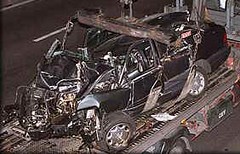
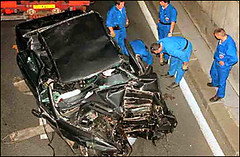
So, one can't help but imagine the smiles in Shepperton reading this week's sequel, "The Report of the Operation Paget inquiry into the allegation of conspiracy to murder Diana, Princess of Wales and Emad El-Din Mohamed Abdel Moneim Fayed." Eight-hundred-plus pages of pure clinical Ballardian detail remixed with Spectacular Baudrillardian celebrity media fireworks. If reading the Iraq Study Group's recipe book for imminent apocalypse has got you down, download this puppy, pull up a chair by the crackling fire, drop the needle on Herb Alpert's Mexican Road Race, turn to page 143, and consider this program book for the ultimate Formula One of the Zeitgeist:

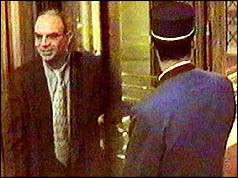
"The following paparazzi or press agents were identified as being present at the Ritz Hotel at the time that the Princess of Wales and Dodi Al Fayed left via rue Cambon:

Present in rue Cambon (rear entrance)

• Jacques Langevin (grey Volkswagen Golf)

• Alain Guizard (grey/blue Peugeot 205)

• David Odekerken (Mitsubishi Pajero)

• Fabrice Chassery (black Peugeot 205)

• Serge Benhamou (green Honda scooter)

Present in Place Vendôme (front entrance)

• Laslo Veres (black Piaggio Scooter)

• Serge Arnal and Christian Martinez (black Fiat Uno)

• Romuald Rat and Stéphane Darmon (blue Honda 650 motorcycle)

• Nikola Arsov (white BMW R100 GS motorcycle)

• Pierre Suu and Jerko Tomic (red BMW 750 motorcycle)

• Pierre Hounsfield (black Volkswagen Golf)

• Stéphane Cardinale (white Citroen AX)

• Dominique Dieppois (white Renault Super 5)

• Colm Pierce (no vehicle)"

Not enough? How about this:

- The testimony of Madame Myriah, the holistic healer that traveled with the Dark Dauphin on his yacht "Jonikal" and examined the Princess.

- Earnest consideration by Lord Stevens of Kirkwhelpington and his fellow inquisitioners of the potential that HRH Prince Philip is a looming gangster mastermind, his Upper Class Twit public persona masking a sinister Machiavelli ordering hits from his green country sanctum.

- The inquest's sophisticated computer sims of the crash (if that isn't the ultimate Grand Theft Auto add-on module, I don't know what is).

- Henri Paul's previously unnoted life as an aviator, his failed career as a private eye, comprehensive inventories of his apartment, and a novel length anatomical exposition on the forensic toxicology of his post-mortem anatomy.

- Deadpan evaluations of conspiracy theories involving MI5, MI6, Mossad, CIA, NSA, the Freemasons, the Scientologists and the Royal Mafia.

- Voyeuristic views from every surveillance camera in Paris.

- Unintentionally fetishistic dissections of the black Mercedes.

- Oliver Stone film clip glimpses of the Princess's contorted post-crash body position and cryptic last words.

In sum, a perfect pathology report on the end of the twentieth century.


In Los Angeles, they learned the lessons of Diana's death long ago, the Peugeots having paved the way for a new extreme paparazzi of the privacy-free 21st century. Last year, the NY Times reported on the increasing trend of celebrity photographers literally chasing down movie stars in cars in an effort to get more intense, emotional, real-life action shots:

***Routinely now, law enforcement officials said, paparazzi use several vehicles to ''box in'' a celebrity's car; try to force stars off the road; chase them at high speed as they do nothing more than run errands, often with their children in tow; and recklessly put pedestrians, other drivers and even themselves at risk.

... The photographers have long been a fixture in Los Angeles, on red carpets and outside fashionable restaurants and nightclubs, and there has always been a kind of symbiosis between them and celebrities, and particularly celebrity publicists. But veteran stars, publicists and entertainment lawyers say that certain photographers, and the publications they sell to, began increasing the pressure several years ago and seem to have changed the rules of the game -- transforming Los Angeles, even more than New York or other hot spots, from a somewhat safe haven into a hostile environment.

''They weren't always as invasive,'' [Halle] Berry said. ''There was some healthy respect about it -- they kept a certain distance from you. You weren't chased at high speeds through the streets where you endangered other lives and other innocent people who really don't know what the heck is going on.''

[Cameron] Diaz said screeching tires and honking horns had become a kind of personal soundtrack for her whenever she ran errands -- typically with three or more paparazzi cars in pursuit. ''People used to ask me how I could live in Los Angeles, and I'd say it's the best place, everybody's so jaded,'' said Ms. Diaz, who appeared in her first movie in 1994.

''That's how it used to be: I could go to the dry cleaners or to grocery stores. In the last few years, it's gotten to the point where you literally cannot walk outside your front gate without being literally attacked.''


Ms. Diaz recalled walking in the street with Mr. Timberlake and a friend and his dog about two years ago, when a photographer in a Toyota 4Runner roared up from behind them, knocking the friend to the ground, then shot pictures of her and Mr. Timberlake coming to the friend's aid. ''We're so used to not having any rights, we didn't think we should call 911,'' she said.

Photographs of the incident wound up in the next US Weekly with a caption saying, ''Cameron and Justin race to help a friend'' after the friend's dog was nearly hit by a car.

Janice Min, the editor of Us Weekly...acknowledged that the market for photos of stars' unguarded moments might have eroded Los Angeles's status as a safe haven. ''But anyone who's a celebrity in this day and age knows this is part of what being a celebrity is, for better or worse,'' she said. ''Its a 24-7 job.''

Still, stars say the risky behavior is becoming untenable. The actress Reese Witherspoon said in an interview that her car was sideswiped a few weeks ago when she tried to leave her gym and was hemmed in by photographers. ''After last month, I feel the boundaries are slipping,'' she said. ''One tried to ram the back left of my car. That had never happened before.''***


These predatory photographers, and the magazine editors they feed, didn't need the researchers at Cal Tech to tell them that human beings have single neurons dedicated to each celebrity. The stars are our cathode ray Olympians, arrayed in neurological constellations across the drive-in movie screen on the back of our foreheads.

If the celebrities and their masters are the airhead tyrants of our collective consciousness, the paparazzi may be unwittingly evolving into a vanguard of culture jamming guerillas, telephoto Nikons as postmodern Kalashnikovs in an amped-up L.A. cell of the Billboard Liberation Front. Imagine if they acted with deliberate revolutionary intent, seeking to capture the most hideous possible images of movie stars, the pampered skin of their faces pulled back into horrifying contortions by disused tendons provoked out of their Botox slumber. Surely that would hack the Spectacle, at least for the fifteen minutes before it morphed into the new sexy commoditized cool.

In the meantime, we wait for the secret boxes of evidence collected by Operation Paget to trickle out into the Internet-of-Things via eBay.

Thursday, August 7, 2008

The Kappa Fatwa


You knew all along that the mysterious anthrax attacks on The National Enquirer, the U.S. Senate, and leading broadcasters that made you afraid to open your mail in the days after 9/11 were the home-grown product of some media-addled American mind acting out from some obscure private workspace. This one is so made-for-TV ready, it even includes these nutty limericks that you can't help but imagine Bruce Dern singing with his crazy eyes in the denouement of some ABC special movie presentation:

I'm a little dream-self, short and stout.
I'm the other half of Bruce - when he lets me out.
When I get all steamed up, I don't pout.
I push Bruce aside, them I'm Free to run about!

Hickory dickory Doc - Doc Bruce ran up the clock.
But something then happened in very strange rhythm.
His other self went and exchanged places with him.
So now, please guess who
Is conversing with you.
Hickory dickory Doc!

Bruce and this other guy, sitting by some trees,
Exchanging personalities.
It's like having two in one.
Actually it's rather fun!"


Most amazingly, though, is the revelation that much of the trigger was the scientist's lifelong obsession with the sorority Kappa Kappa Gamma, which he believed had issued a fatwa against him.

Dr. Ivins provided CW-4 one of his alternate e-mail addresses as goldenphoenix111@hotmail.com. A search of the internet for postings under goldenphoenix111 identified the following posting dated February 20,2007, on a website at www.abovetopesecret.com:

"Wildswan, you are quite right about what you said about KKG. If people look hard enough and dig hard enough, have friends, relatives, perhaps financial resources, etc., then they can pretty much find out about whatever GLO they want. Kappas are noted for being lovely, highly intelligent campus leaders. Unfortunately, they labeled me as an enemy decades ago, and I can only abide by their "Fatwah" on me. I like individual Kappas enormously, and love being around them. I never choose an enemy, but they've been after me since the 1960s, and REALLY after me since the late 1970s. At one time in my life, I knew more about KKG than any non-Kappa that had ever lived. Unfortunately I've forgotten a lot. I've read the history of KKG that was written several decades ago about its founding. Question for you: Did your chapter use the combined service, or did you separate your services into the "RedRoom and WhiteRoom"? did you use special blue or white blindfolds? You can reach me at goldenphoenixlll@hotmail.com ... as a phoenix rises from its ashes ..."

This posting is significant in that in his own words, Dr. Ivins defines the depths of his obsession and knowledge in the sorority KKG. Additionally, as previously described above, the letters used in the 2001 anthrax mailings were mailed from a blue collection box located at 10 Nassau Street, Princeton, New Jersey. The sorority, KKG, has an office at 20 Nassau Street, Princeton, New Jersey, located on the same side of the street and 60 feet to the right from the blue collection box.


How many other dream warriors do you suppose are out there, cruising the frontage roads, swiping their building access cards, playing back the cut-up narratives of their televisually informed lives against the insides of their foreheads? Fortunately, not so many of them have access to weapons of mass destruction.

For the full story, check out this masterpiece of invisible literature: the affidavit of the joint FBI-Postal Inspector Task Force in support of its application for a search warrant. Revealing, among other things, that if you are going to send letter bombs, you should not use envelopes swiped from the stationery supply closet at your day job:

Envelopes used in the anthrax attacks

In the 2001 anthrax attacks, four envelopes were recovered. The four envelopes were all 6 3/4 inch federal eagle envelopes. The "federal eagle" designation is derived from the postage frank in the upper right-hand comer on the envelope which consists of the image of an eagle perched on a bar bearing the initials "USA." Underneath the lettering is the number "34," which denotes the postage value of 346. The eagle, lettering, and denomination are referred to as the indicia. The eagle and the bar are stamped in blue ink, while the denomination is stamped in grey ink. Approximately 45 million Federal eagle 6 3/4" envelopes were manufactured by Westvaco Corporation (now known as MeadWestvaco Corporation) of Williamsburg,
Pennsylvania, between December 6,2000 and March 2002. These Federal eagle 6 3/4" envelopes were manufactured exclusively for and sold solely by the U.S. Postal Service between January 8, 2001 and June 2002.

Subsequent to the attacks, an effort was made to collect all such envelopes for possible forensic examination, including the identification of defects that occur during the envelope manufacturing process. As a result of this collection, envelopes with printing defects identical to printing defects identified on the envelopes utilized in the anthrax attacks during the fall of 2001 were collected fiom the Fairfax Main post office in Fairfax, Virginia and the Cumberland and Elkton post offices in Maryland. The Fairfax Main, Cumberland, Maryland, and Elkton, Maryland post offices are supplied by the Dulles Stamp Distribution Office (SDO), located in Dulles, Virginia. The Dulles SDO distributed "federal eagle" envelopes to post offices throughout Maryland and Virginia. Given that the printing defects identified on the envelopes used in the attacks are transient, thereby being present on only a small population of the federal eagle envelopes produced, and that envelopes with identical printing defects to those identified on the envelopes used in the attacks were recovered fiom post offices serviced by the Dulles SDO, it is reasonable to conclude that the federal eagle envelopes utilized in the attacks were purchased from a post office in Maryland or Virginia.

Of the sixteen domestic government, commercial, and university laboratories that had virulent RMR- 1029 Ames strain Bacillus anthracis material in their inventory prior to the attacks, only one lab was located in Maryland or Virginia, where the relevant federal eagle envelopes were distributed and sold by the U.S. Postal Service: the USAMRID facility at Fort
Detrick, MD.


Casting call: the dogged postal inspector who, against all odds, tracks his man over a period of eight years, swabbing mailboxes, tracing envelope manufacturing, and interviewing befuddled Kappas.

Wednesday, January 24, 2007

Veep me


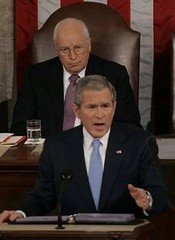
The Dark Buddha sits resplendent behind the Party Chimp, taciturn and knowing in his lush purple tie, spun of colors so rich they burn up the cathode rays, clandestinely mesmerizing the audience.

Occasionally the corners of his mouth will dimple ever so slightly, as the pacemaker tickles the ripe scarlet flesh under his sternum.

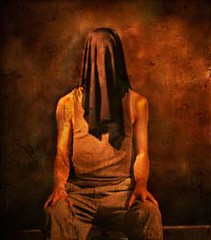
24 hours earlier, on 24, our hero the crypto-Canadian Brat Packer turned meta-G-Man and real-time utilitarian, meets his brother for the first time in six-plus years. They exchange small talk in the foyer, meeting the wife and the boy, before retiring to the home office, where Jack rips an electrical cord from a lamp, ties his brother to a chair, and proceeds to commence the torture. Close-up on on a contorted face consumed by a gaping maw of mouth sucking on a cellophane bag wrapped around his head: the housewife's waterboard. Cut to black.

On the teleprompter, the über pledge captain reads from the fever dream of another Houstonian.

"We defended the city as best we could. The arrows of the Comanches came in clouds. The war clubs of the Comanches clattered on the soft, yellow pavements. There were earthworks along the Boulevard Mark Clark and the hedges had been laced with sparkling wire. People were trying to understand. I spoke to Sylvia. 'Do you think this is a good life?' The table held apples, books, long-playing records. She looked up. 'No.'

"Patrols of paras and volunteers with armbands guarded the tall, flat buildings. We interrogated the captured Comanche. Two of us forced his head back while another poured water into his nostrils. His body jerked, he choked and wept. Not believing a hurried, careless and exaggerated report of the number of casualties in the outer districts where trees, lamps, swans had been reduced to clear fields of wire we issued entrenching tools to those who seemed trustworthy and turned the heavy-weapons companies so that we could not be surprised from that direction. And I sat there getting drunker and drunker and more in love and more in love. We talked."

-- Donald Barthelme, "The Indian Uprising"

At the after-parties, red cocktails flow and the bards recite rhymeless epics of invisible literature as the loyal secretaries perform their best Lynndie England impressions for the crowd. Several garner those gratuitous standing ovations for which the gathered chambers are known.

Thursday, October 4, 2007

Management Secrets of KUBARK


In the "why am I not surprised?" department, comes this off the front page of today's NYT:

Secret U.S. Endorsement of Severe Interrogations
By Scott Shane, David Johnston and James Risen
Published: October 4, 2007

WASHINGTON, Oct. 3 — When the Justice Department publicly declared torture “abhorrent” in a legal opinion in December 2004, the Bush administration appeared to have abandoned its assertion of nearly unlimited presidential authority to order brutal interrogations.

But soon after Alberto R. Gonzales’s arrival as attorney general in February 2005, the Justice Department issued another opinion, this one in secret. It was a very different document, according to officials briefed on it, an expansive endorsement of the harshest interrogation techniques ever used by the Central Intelligence Agency.

The new opinion, the officials said, for the first time provided explicit authorization to barrage terror suspects with a combination of painful physical and psychological tactics, including head-slapping, simulated drowning and frigid temperatures.

***

I look forward to the appearance of the original document in glorious PDF. If you haven't read them, the previously released (and apparently kinder gentler) memos are masterpieces of invisible literature for the new century.


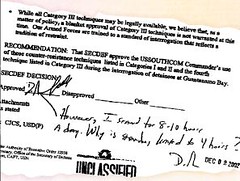
My favorite highlight when I first read this was Rummy's hand-written annotation of his approval in the winter of 2002 of new "Counter-Resistance Techniques": "Approved -- However, I stand 8-10 hours a day. Why is standing limited to 4 hours? D.R." Nothing like a little dry wit, SECDEF style, to lighten up those lawyer memos.

Now, if you really want to go deep in on this stuff, you need to read the KUBARK Manual of Counterintelligence Interrogation, which may qualify as the Necronomicon of the Episcopal Inquistion. Written in 1963, declassified in 1997, reportedly still used as a core source by the illuminated. My personal favorite on this menu:


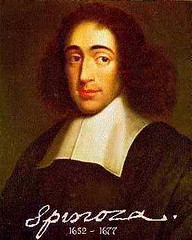
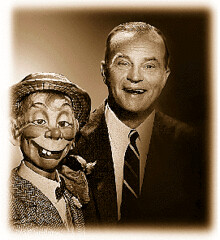
'Spinoza and Mortimer Snerd

'If there is reason to suspect that a withholding source possesses useful counterintelligence information but has not had access to the upper reaches of the target organizations, the policy and command level, continued questioning about lofty topics that the source knows nothing about may pave the way for the extraction of information at lower levels. The interrogatee is asked about KGB policy, for example: the relation of the service to its government, its liaison arrangements, etc., etc. His complaints that he knows nothing of such matters are met by flat insistence that he does know, he would have to know, that even the most stupid men in his position know. Communist interrogators who used this tactic against American POW's coupled it with punishment for "don't know" responses -- typically by forcing the prisoner to stand at attention until he gave some positive response. After the process had been continued long enough, the source was asked a question to which he did know the answer. Numbers of Americans have mentioned "...the tremendous feeling of relief you get when he finally asks you something you can answer." One said, "I know it seems strange now, but I was positively grateful to them when they switched to a topic I knew something about."'


New book pitch: A pop management tome for neighborhood chains and airport racks -- a book applying CIA interrogation and psychological warfare techniques to everyday white collar office environments. "Management Secrets of KUBARK."

Sunday, April 27, 2008

Blogging Sidewise


Wow. Courtesy of John Scalzi, I see that Prof. Nevins' amazing May 17, 2007 post here, "An Alternate History of Chinese Science Fiction," aka "The Humble Scrawl of Kuo Pao Kun, Mandarin," has been nominated for a Sidewise Award in the category of Best Short-Form Alternate History in 2007. The winners will be announced in August at Worldcon.


I think this is a first for a blog post to be considered alongside conventional narrative works Congratulations to Jess for taking invisible literature to the next level!

Tuesday, April 21, 2009

The Memos from Room 101


I've read the memos. I previously read all the amazing Mark Danner pieces in the New York Review of Books (and the book compiling the first phase of his work), the result of immense investigative effort that has essentially forced the release of the memos. Without a doubt the most hard-boiled invisible literature I have ever read.

My favorite part of the memos is where the DOJ lawyers evaluate the legality of a plan wherein the interrogators and the pet psychologists, having deduced that Abu Zubaydah has an intense fear of insects, put Zubaydah in a box with a caterpillar that they have convinced him is a poisonous mystery bug. How about that: Orwell's scene from 1984, in which Winston's fear of rats is exploited by the device that puts the hungry rodents next to his face, lives on and is reenacted by actual torturers!

I've also read Cheney's counter-p.r. campaign interviews, arguing that if the government is going to release classified GWOT memos, it should also release the ones showing what they learned and what they prevented. Seems like a reasonable point, and the more of this stuff that becomes public, the better.

(By the way, thanks to whoever in the Obama White House figured out how to keep the cyborg veep in the press every day. I was starting to miss him.)

I have read the reports of Obama's nervous head-patting speech to the C.I.A. employees yesterday.

This thing is really building toward some kind of public war crimes trial of the dark events of the GWOT. At what point do the aggrieved dark practitioners unleash their tradecraft against their own state, playing out some bizarre Kiefer Sutherland version of consensus reality?

And what happens if we actually do get attacked? Maybe the torture trials will provide the perfect venue for the next global guerilla warporn intervention.

What will make a better postmodern Law & Order hack: the torture trials of our own intelligence agents and Chicago school-on-steroids Federalist Society lawyers, or the Kafkaesque saga of the surviving Somali pirate from the Maersk Alabama/Captain Richard Phillips lifeboat affair (the one who didn't get tagged by the SEAL snipers), Abduhl Wali-i-Musi, who just showed up in Manhattan for his trial? Maybe he can get interviewed by Anderson Cooper, and take Anderson hostage live on CNN. That would rock.

Wednesday, June 24, 2009

When Björk attacks


Courtesy of Ballardian's Simon Sellars, an amazing collection of the world's best celebrity versus paparazzi smackdowns via Oz's thevine.com.au. See THX-1138 bald Britney smash the windows of an SUV with her umbrella! See Matthew McConaughey and his Malibu surfer posse going all Jets and Sharks on the photogs! Feel the unleashed Njalster tantrum fury of Björk! This is your reality.


If that's not enough, try this speculative version of celebrity culture jamming in my story R.P.M., courtesy of the fine fellas over at Futurismic, in which near-future revolutionaries take paparazzi tactics to the next level by creating intentional accidents with movie stars and dutifully documenting the results:

Seven long seconds across the yellow line, four overpowered bald tires balanced on the edge of totally out of control.

KKKKKKEEEERRRRUUUUUUUUUUNCHH.

The windshield fills with white as the Monte Carlo punctures the left drivers’ side door and rear quarter panel. Elegant forms of sheet metal assembled with attentive precision by North America’s most diligent factory robots krush, crumpled like the aluminum foil of the Gods. The busted hymen of new car virginity rended in an act of loving violation.

“To free the world, we must rape the Spectacle,” says Avineri in the Prison Blog.

Tinted windows shatter and blow, exposing Jessica as she screams, the secret sphincters of her facial muscles contorting her pampered dermis into a horrifying rictus a hundred times over, once for each of the dilating shutters excitedly popping off in her face—our half-dozen cameras and those of the true paparazzi excitedly seizing upon the sudden scene.

The best of our photos and video clips will be posted on one of 0z0’s myriad websites that bounce from host to host as the cybercrime brigades hound the ISPs. The straight paparazzi images will end up in checkout counters and dinnertime television broadcasts. Percy usually manages to sell a few of our choicest illegally procured spots to the same outlets, financing our future efforts with the fruits of our transgression. The best of the celebrity accident photos will go for a few thousand bucks; clean video can reap five figures.

“Our home invasions are legitimate, virtual, and totally commercial,” says 0z0 in his manifesto-in-progress. “We merely insert a slow-burning virus into the mediascape to hasten its self-immolation. No one makes you watch, right?”


See also: Invisible Literature for the Age of Celebrity: The Assassination Inquest of Diana, Princess of Wales Considered as an Unintentionally Ballardian Remix of the Warren Commission Report.

Friday, February 23, 2007

The Warporn Eucharist

The February 19 issue of The New Yorker has a great article by Jane Mayer on the impact of the television War on Terror fantasy "24" on real-world public policy. Jack Bauer's imaginary L.A.-based domestic covert ops wing of the CIA, it turns out, is housed on the ground floor of a refurbished pencil factory in the San Fernando Valley, where America's enemies are interrogated every Monday night for the entertainment of prime time zombies like yours truly. The article notes that American TV now feeds us one hundred instances of torture a year, versus four before 9/11.


"The show's villains usually inflict the most gruesome tortures: their victims are hung on hooks, like carcasses in a butcher shop; poked with smoking-hot scalpels; or abraded with sanding machines. In many episodes, however, heroic American officials act as tormentors, even though torture is illegal under U.S. law. In one episode, a fictional President commands a member of his Secret Service to torture a suspected traitor: his national-security adviser. The victim is jolted with defibrillator paddles while his feet are submerged on a tub filled with water. As the voltage is turned up, the President, who is depicted as a scrupulous leader, watches the suspect suffer on a video feed. The viewer, who knows that the adviser is guilty and is harboring secrets, becomes complicit in hoping that the torture works. A few minutes before the suspect gives in, the President utters the show's credo, 'Everyone breaks eventually.'"


The article catalogues Agent Bauer's menu of techniques for immediate revelation, from brutish stab wounds to mock live video executions of a prisoner's family members. It then recounts the efforts of actual military interrogators to persuade the producers and writers to imbue the show with a more realistic portrayal of government agents conducting their interrogations in accordance with the law, citing their concerns that 24's representations of intelligence collection are distorting the public's view of reality, and influencing public opinion in an unhealthy way. Quoting a December 2006 report of the Intelligence Science Board:

"Prime-time television increasingly offers up plot lines involving the incineration of metropolitan Los Angeles by an atomic weapon or its depopulation by an aerosol nerve toxin. The characters do not have time to reflect upon, much less to utilize, what real professionals know to be the 'science and art' of 'educing information.' They want results. Now. The public thinks the same way. They want, and rightly expect, precisely the same kind of 'protection' that only a skilled intelligence professional can provide. Unfortunately, they have no idea how such a person is supposed to act in 'real life.'"


Recall a prior generation of L.A.-based Watchmen enduring a stressed out Zeitgeist: the Jack Webb police procedurals Dragnet and Adam-12, in which lonely sentinels of law and order exhaustedly administered Miranda due process to murderers, car thieves, pill popping moms, and spoiled Bourgeois hippies. Alas, Jack Bauer's lineage is more Bud White than Joe Friday – Judge Dredd with a Blackberry.


The intriguing allure of this brutalist cultural thread is compounded when Mayer name-checks some of the Washington notables who are big fans of 24: Karl Rove, Tony Snow, Laura Ingraham, Clarence Thomas, ex-Justice Department torture analyst John Yoo, Mary Cheney, Lynne Cheney ("an extreme '24' fan"), and Homeland Security Secretary Michael Chertoff. Justice Thomas' wife Virginia organized a Heritage Foundation symposium on the show, at which Secretary Chertoff praised the ethical credibility of the show's real-time bet-the-world utilitarianism: "Frankly, it reflects real life."


9/11 happened to a culture that had long before obliterated the barriers between consensus reality and the narrative delusions of technicolor media dreams. Consider the disturbing number of lawyers practicing today who were lured by "what's your movie" aspirations to realize their own inner Arnie Becker and Ally McBeal. Is it any surprise that our neoconservative sentinels and their dark dauphines enjoy spending their down time inside an action movie funhouse mirror of their day jobs? Celebrating situational nihilism as the dutiful resignation of the protective pater familias (the unappreciated Vietnam Vet meme never dies). How long before they start making cameo appearances? Or one of the taciturn mutual fund commercial terror-fighters gets recruited to head some bogus White House task force?

Skeptical that a pulp action TV serial could have a bona fide impact on public policy and its practitioners? Consider this intriguing lecture held last night at the University of Texas' Harry Ransom Center:

"Daniel Posnansky, retired faculty member of Harvard University, presents the Carl and Lily Pforzheimer Lecture "Arthur Conan Doyle on America: British-American Foreign Policy in the New Millennium" on Thursday, February 22, at 7 p.m. at the Harry Ransom Center.

"Posnansky will discuss the ways in which Arthur Conan Doyle and Sherlock Holmes influenced American foreign policy for decades after Doyle’s death, and continue to do so. He will bring samples of original materials from his personal collection, including letters of Harry S. Truman and Franklin D. Roosevelt, that quote Holmes and discuss his strategies for pressing foreign concerns."


Any preference for Chertoff channeling Bauer versus FDR channeling Holmes?

Of course, Jack Bauer's raw and unlawful interrogation techniques are tame compared to the thinly disguised warporn at your local cineplex and Blockbuster outlet. Every few weeks brings a new torture-based shock thriller to amuse America's teens. Saw I-III, in which abductees are compelled to maim themselves to survive. Hostel, which envisions an underground torture club of paying tormentors and kidnapped victims in some corner of Slovakia that didn't make the latest "Let's Go." Turistas, The Descent, etc....these are not your brother's Reservoir Dogs.


When a colleague at the day job last fall said her weekend plans as a suburban mom included hosting her daughter's 12th birthday party at a showing of Saw III, my incredulity was compounded by further investigations at the parental film guide Kids-in-Mind.com. Dig the accidentally Ballardian, clinical catalog of the film's suburban Abu Ghraib, invisible literature for an age of terror:

VIOLENCE/GORE 10 - A man is screwed into an apparatus that we are told will twist his limbs: We see screws through his hands and feet and a metal ring around his head, the machinery begins to twist (we hear popping and cracking and tearing and see blood spurting), the man screams in agony, each limbs is twisted, and we see bones protruding through the twisted skin; then his head is twisted and we see the stretched skin on his neck and we hear a loud crunch when his neck breaks.

► We see a man with chains attached to him by rings that pierce his skin, his lip and Achilles tendons: we see him pull the rings out one by one, while he screams and blood flows, and he tries to reach for a bomb to de-activate it, but it explodes leaving him in pieces.

► An explosive device is detonated and blows a woman's head off (we see the blood and matter that remains above her shoulders).

► A man uses what looks like a toilet tank cover and pounds it down on his foot repeatedly crushing his ankle and foot (the man screams with every blow and we hear cracking and popping); he then snaps the ankle bone (we see the bone pushing through the skin and the foot is very bloody) in order to be able to slip out of a shackle that holds him attached to a pipe.

► A man uses a power saw to cut another man's throat (blood spurts and we see the man gag and spurt). A man shoots a woman in the throat (blood spurts and pours), she falls to the floor, and she gags and dies. A man is shot in the side of the head (we see part of his head and face blown off and blood spurts from the additional resulting neck wound).

► A woman wakes up from being unconscious, with a heavy metal ring around her neck, and an apparatus attached to her ribs (we see bloody hooks attached to her sides and blood drips on the floor); she reaches into a container of acid to retrieve a key that will free her (her hand is eaten away by the acid and the liquid turns bloody), her time runs out and the apparatus that she is attached to rips her rib cage apart (we see her fall limp and see bloody tissue flapping around).

► A medical procedure is performed on a man's head and we see the entire procedure: the scalp is cut and folded back, the skull is drilled into, a saw is used to cut a piece out (blood sprays on the surgeon's face) and the brain is exposed (we hear squishing, cracking, the whirring of a saw and drill and there is a lot of blood).

► A man with a very bloody foot wound drags himself through a dark hallway (we see his foot flopping around), he beats a woman with a metal pipe, she kicks him in the bad foot and he falls to the floor, he bites her on the leg, punches her and slams her head into a wall (we see her bloody head and face), and she spits in his face, kicks him and leaves.

► In a flashback to a sequence from the first "Saw" a woman locked into a head apparatus must cut a key out of a man's stomach in order to save herself, and she does so.

► A man injects himself with a drug that reduces his heart rate, his head is covered with blood and he lies down in a pool of blood on the floor (presumably it is animal blood, not his own).

► A nude woman hangs from her hands, which are chained to a metal frame, and she is sprayed with water periodically; the room she is in is a large freezer, and she is eventually completely encased in ice.

► A woman shoots a woman in the back, blood sprays on a plastic sheet, and she falls into a man's arms (we see blood on her clothes).

► A woman wraps a plastic bag around a man's head, he flails trying to get away, and he hits his head on a toilet (we hear the crack and see blood in the bag); he flails for a little bit longer and then falls dead.

► Armed police break into a room and are shocked by what they find: We see a room with very bloody body parts strewn around and bits of internal organs and tissue on the floor. A man shines a flashlight around a dark room and sees a dead man lying next to a severed foot (the man has blood on his face and the foot is covered with blood).

► A woman squeezes the blade of a saw and cuts her hand (we see blood pouring onto the floor and on her hand). A woman cuts herself on the leg with a large knife (we hear squishing and see old scars from previous cuts). A man struggles to reach a key, his cheek becomes frozen to a bar and when he pulls away from the bar the skin tears off (he screams and we see a bloody patch).

► A young boy is brought into an emergency room on a stretcher and has a bloody head wound and a bloody wound on his side (ER staff examine and stabilize him).

► A woman places an explosive collar around another woman's neck and explains what she needs to do to be set free. A woman locked in a locker room is attacked by someone wearing a pig mask, and she wakes up tied into a chair and struggles to get free.

► A man is chained around the neck to the bottom of a large vat, many decayed pig carcasses with wriggling maggots are dropped into a crusher, they are liquefied, the man in the vat is sprayed with the liquid and it begins to fill up (he is freed before he drowns). A man finds himself trapped inside a wooden crate, and he pounds on the crate until it falls from its perch and breaks apart on the floor below (he ends up with a bloody gash on his head).

► A woman attacks a man and incapacitates him (we see her knock him to the floor, then straddle him and we see him unconscious later). A woman shoots her gun through a closet door, reaches in to find something and is grabbed from behind and incapacitated.

► We see several disjointed sequences of a boy dying after having been struck by a car (there's no blood, and he is lying motionless on the pavement).

►  A man lying on the floor and chained to a pipe in a dark room struggles to reach a gun and then a flashlight. We see a young girl locked in a room.

► A woman with a knife threatens another woman. We hear a man screaming that he is going to kill someone. A man yells at a woman and she appears frightened. A husband and wife argue.

► We hear that a man has an inoperable brain tumor. A man finds a tricycle and a doll lying on the floor in a dark hallway and he remembers his son's fatal accident.

► A man has a seizure; he vomits, begins to thrash violently and spits blood. A man vomits (we see goo and hear him gag).

Roll over, Walt Disney. Time to turn on CNN for the latest beheading video. The news is a snuff film, and so is the matinee.

Postulate: When your nation is unleashing mayhem with remote control bombs on the other side of the planet and gurgling waterboards in the windowless buildings where no one can hear you scream, even though the resulting real-world carnage never appears on your dinnertime news feed or coffeetime front page, you know it's out there. It lurks in your subconscious, and needs to be processed. Pop culture provides a sugar-coated safety valve. Acted out in a waking dream, one where your filmic alter egos are both the victims and the perpetrators. In the gated cortex of the American mind, the motion lights flicker on after midnight, illuminating the lurking predators 'R us. Grab some buttered popcorn and a 48 ounce Diet Coke.


When the mainstream media mainlines warporn, one wonders what kinds of deeper moral crises this already-savage century is incubating in the minds of the world's adolescents. The imminent rise of the next generation will tell us whether this dark carnival of cathode ray mayhem is a prefatory Dionysian revel of 'obscene enjoyment,' or a more grounded ethical percolation designed to perform cultural C.P.R. on exhausted Christian aspirations for utopian love.

Wednesday, December 31, 2008

The men who fell to Earth


Looking for some invisible literature to enjoy over the long weekend? A clinically rigorous, heartless prose dissecting some weird corner of reality, perfect antidote to whatever piles of literary ink on paper you found under your tree? You are in luck: NASA has just released the Columbia Crew Survival Investigation Report, 400 pages of the most detailed description of astronautical death imaginable (except, maybe, for the unredacted version of what was released to the public). As if the opening credits of The Six Million Dollar Man ("She's breaking up!") were rewritten in the style of The Atrocity Exhibition. Even better, it's a *speculative* narrative, extrapolating from the insane quantities of evidence each of the "events of lethal potential" that may have been the point at which one or more of the astronauts died:

1. Depressurization of the crew module as the orbiter began breakup, when most of the astronauts had their helmet visors up and some did not have their gloves on. The report suggests the entire crew was killed or rendered unconscious at this point, but it also reads like they want that to be the case because the idea of death at any of the subsequent points is so horrific.

2. Exposure "to a dynamic rotating load environment with nonconformal helmets and a lack of upper body restraint" — heads being slammed against the insides of helmets that were not padded for such purposes, and torsos being whiplashed without shoulder belts, as the crew module windmilled through the high atmosphere.

3. The seats being torn from the module, and the crew members being torn loose from the seats.

4. "[E]xposure to near vacuum, aerodynamic accelerations, and cold temperatures" somewhere above 63,000 feet.

5. Ground impact.

The express purpose of the report is to aid future spacecraft designers and accident investigators, while the obvious unspoken purpose is to support a desired view that no astronaut experienced prolonged suffering. The methodology is the application of the most advanced air crash investigative techniques to support a detailed timeline, a comprehensive "vehicle failure assessment," and a thorough if sanitized review of each aspect of the "occupant protection" — seats, restraints, shuttle suits, helmets, training, etc. The level of detail is seriously mind-boggling, with detailed charts and analyses of each individual piece of shuttle material recovered, astronaut suit fragment, frayed seat restraint, and maps of debris distribution from Plano to Nacogdoches.


Some representative excerpts:

3.4.2 Injury classifications
3.4.2.1 Exposure to high altitude
[REDACTED.] Given the level of tissue damage, the crew could not have regained consciousness even with re-pressurization. Survival was possible, but not likely, even with immediate and extensive medical intervention at this point. Although respiration would cease after depressurization, circulatory functions can exist for a short period of time.

[REDACTED.]

Finding. Tissue samples revealed evidence of ebullism.

Conclusion L1-3. The crew was exposed to a pressure altitude above 63,500 feet, indicating that the cabin depressurization event occurred above this altitude.

[REDACTED.]

Finding. The depressurization event occurred prior to the loss of circulatory function.

There is very limited data on human exposure to space-equivalent vacuum. [REDACTED.] Although the Soyuz 11 cabin depressurization was relatively slow (reportedly taking more than 3.5 minutes to depressurize to 0 psi), it was stated that the depressurization was fatal to the crew in roughly 30 seconds.12 Because the exact scenario cannot be positively identified, no conclusions with respect to the rate or timing of cabin depressurization can be made from the medical findings.
[REDACTED.]

Depressurization events in aviation have led to extensive studies on “time of useful consciousness (TUC).” TUC is generally based on the remaining amount of O2 in the tissues that is permitting brain functions to continue. Various factors affect the TUC (i.e., exertion, depressurization rate, pre-exposure O2 partial pressure, G-loads, adrenaline loading, etc.). Since the shuttle cabin uses air, the pre-exposure O2 partial pressure was only 21% O2 (the normal for sea-level). Based on debris and structural evidence, the most likely time for the initiation of cabin depressurization was at orbiter breakup (CE) at GMT 14:00:18.

Based on video evidence, the depressurization was complete no later than GMT 14:00:59 (figure 3.4-15), and likely much earlier (see Section 2.3). This corresponded to an altitude range of 181,000 feet to approximately 140,000 feet. Traditional aviation TUC would correlate a rapid depressurization at these altitudes to a TUC of 12 seconds. This would have been enough time for the crew to close their visors and initiate O2 flow, and yet they did not (see Section 3.2).

However, additional research discussed in Joint Aerospace Physiology, Air Education and Training Command/Bureau of Medicine and Surgery shows that the physiological response to hypoxia during a rapid depressurization event at this extreme altitude (181,000 feet) would have reduced the conventional TUC interval by 50% (i.e., 12 seconds would have been reduced to 6 seconds). In addition to the depressurization effects, the physical exertion against the G-forces that the crew experienced at this time would further reduce the available metabolic O2 reserves and increase the CO2 partial pressure. Also, NASA research data indicate that de-conditioned crews have a reduced tolerance to G-loads. Further, anecdotal reports from accidental exposure to vacuum confirm much shorter periods of awareness as reported by survivors.


The 51-L Challenger accident investigation showed that the Challenger CM remained intact and the crew was able to take some immediate actions after vehicle breakup, although the accelerations experienced were much higher as a result of the aerodynamic loads (estimated at G to 21 G). The Challenger crew became incapacitated quickly and could not complete activation of all breathing air systems, leading to the conclusion that an incapacitating cabin depressurization occurred. By comparison, the Columbia crew experienced lower loads (~3.5 G) at the CE. The fact that none of the crew members lowered their visors strongly suggests that the crew was incapacitated after the CE by a rapid depressurization.

From this time forward, the crew members would have been unconscious, totally unaware of events, and unable to brace against the loads. With the configuration of the ACES (i.e., visors up and three crew members without gloves donned), the depressurization was an event of lethal potential. Had the ACES been configured with the visors down and locked, gloves on, and EOS activated, the depressurization event by itself probably would have been survivable.

Finding. No conclusion could be drawn as to the rate of cabin depressurization based on medical evidence.

Finding. None of the six crew members wearing helmets closed their visors.

Conclusion L1-5. The depressurization incapacitated the crew members so rapidly that they were not able to lower their helmet visors.

Recommendation L1-3/L5-1. Future spacecraft crew survival systems should not rely on manual activation to protect the crew.

Conclusion A8-1. Spacecraft accidents are rare, and each event adds critical knowledge and understanding to the database of experience.

Recommendation A8. As was executed with Columbia, spacecraft accident investigation plans must include provisions for debris and data preservation and security. All debris and data should be cataloged, stored, and preserved so they will be available for future investigations or studies.

3.4.2.2 Mechanical injuries
Mechanical injuries were isolated to the period of time at which they most likely occurred, based on engineering analyses of motions and accelerations.

Pre-Catastrophic Event
[REDACTED.]

Catastrophic Event to Crew Module Catastrophic Event

A very dynamic motion environment existed after the CE (GMT 14:00:18); this environment became more intense as the CMCE (the breakup of the forebody) approached at GMT 14:00:53. Figure 3.4-16 shows representative loads on the unconscious or deceased crew members based on aerodynamic modeling of the forebody dynamics post-CE. The black dashed lines showing human performance limits20 are for conscious crew members. Based on the conclusion that the rapid depressurization occurred at or close to the time of the orbiter forebody separation, the crew was unconscious or deceased and unable to brace against these loads.

For the first 15 to 20 seconds, the modeled loads would not cause serious injuries to a conscious crew member who was capable of active bracing. An unconscious or deceased crew member would have been more susceptible to injury.

The crew is normally restrained in the seats by a five-point harness system (figure 3.4-17). A lap belt secures the lower torso. A crotch strap prevents “submarining.”21 Two shoulder harnesses, which attach to an inertial reel via the inertial reel strap, secure the upper torso.

Engineering analysis of the STS-107 restraints indicates that most of the inertial reel straps were extended and did not lock or retract prior to failure of the straps. The inertial reels are normally unlocked to allow the crew to access displays and controls with a full range of motion. With the inertial reels unlocked, the crew members’ upper bodies were left unrestrained during the forebody dynamics. [REDACTED.]

Finding. One crew member appears to have been restrained only by the shoulder harness and crotch strap.

Recommendation L1-2. Future spacecraft and crew survival systems should be designed such that the equipment and procedures provided to protect the crew in emergency situations are compatible with nominal operations. Future spacecraft vehicles, equipment, and mission timelines should be designed such that a suited crew member can perform all operations without compromising the configuration of the survival suit during critical phases of flight.

[REDACTED.]

Figure 3.4-18 provides a demonstration of an integrated seat/suit/crew member in entry configuration.

[REDACTED.] Figure 3.4-19 shows an interior view of an intact, pristine ACES helmet demonstrating exposed hardware. [REDACTED.]
[REDACTED. Figure 3.4-20.]

Finding. Injuries were consistent with the crew’s upper bodies not being securely held to the seatbacks and with the evidence indicating that the inertial reel straps were extended at the time of failure.

Finding. Injuries were consistent with the crew’s upper bodies not being supported during the time of dynamic motion.

Conclusion L2-3. Lethal injuries resulted from inadequate upper body restraint and protection during rotational motion.

Recommendation L2-4/L3-4. Future spacecraft suits and seat restraints should use state-of-the-art technology in an integrated solution to minimize crew injury and maximize crew survival in off-nominal acceleration environments.

Recommendation L2-7. Design suit helmets with head protection as a functional requirement, not just as a portion of the pressure garment. Suits should incorporate conformal helmets with head and neck restraint devices, similar to helmet/head restraint techniques used in professional automobile racing.

Recommendation L2-8. The current shuttle inertial reels should be manually locked at the first sign of an off-nominal situation.

Recommendation L2-9. The use of inertial reels in future restraint systems should be evaluated to ensure that they are capable of protecting the crew during nominal and off-nominal situations without active crew intervention.

Crew Module Catastrophic Event

[REDACTED.] Engineering and ballistic analyses of the orbiter forebody failure indicate that the middeck separated prior to the flight deck. Crew members on the middeck separated along with the middeck accommodations rack, middeck lockers, sub-floor components, and Modular Auxiliary Data System/orbiter experiment data recorder – a scenario that is supported by debris plots (see Section 2.2). Based on structural design analysis, thermal damage, and position in the debris field, the flight deck “pod” and the CM aft bulkhead stayed intact for a longer time. The location of the recovered flight crew equipment, which is plotted in figure 3.4-21, supports the middeck departing prior to the flight deck.


[REDACTED.]

[REDACTED. Figure 3.4-22.]

[REDACTED.]

Finding. Crew members experienced traumatic injuries in areas corresponding to the seat restraint system.

Conclusion L3-4. The seat restraint system caused lethal-level injuries to the unconscious or deceased crew members when they separated from the seat.

Recommendation L2-4/L3-4. Future spacecraft suits and seat restraints should use state-of-the-art technology in an integrated solution to minimize crew injury and maximize crew survival in off-nominal acceleration environments.

Recommendation L3-1. Future vehicles should incorporate a design analysis for breakup to help guide design toward the most graceful degradation of the integrated vehicle systems and structure to maximize crew survival.


3.4.2.3 Thermal exposure
[REDACTED.]

Finding. No significant levels of carbon monoxide or cyanide (combustion by-products) were identified in any of the body fluids.

Finding. There was no evidence of thermal injury to the respiratory tracts.

Conclusion L1-4. The crew was not exposed to a cabin fire or thermal injury prior to depressurization, cessation of breathing, and loss of consciousness.

[REDACTED.]

[REDACTED. Figure 3.4-23.]

[REDACTED.]

The ambient absolute pressure condition at separation was approximately 0.03 psi.

3.4.3 Identified events with lethal potential

1. The first event with lethal potential was depressurization of the CM, which started at or shortly after orbiter breakup. Existing crew equipment protects for this type of lethal event, but operational practices and hardware limitations were such that the ACESs were not in a protective configuration. The current shuttle ACES relies on the crew to lower and lock the visor; therefore, complete protection from a depressurization event depends on a permissive environment. Design solutions that do not require crew action are achievable.

2. The second event with lethal potential was unconscious or deceased crew members exposed to a dynamic rotating load environment with nonconformal helmets and a lack of upper body restraint. Current shuttle seat and helmet design and operational practices did not protect the crew members from this lethal event. Complete strap-in with inertial reels locked would reduce the risk of injury/death; however, even in this configuration, the current seat-suit restraint system provides limited protection from dynamic G events (i.e., no lateral restraints, no control of extremity motion, and no head-neck support). Better restraint designs that include head-neck support (i.e., conformal helmets), extremity control, and spine support are achievable to reduce the risk of injury/death.

3. The third event with lethal potential was separation from the crew module and the seats with associated forces, material interactions, and thermal consequences. This event is the least understood due to limitations in current knowledge of mechanisms at this Mach number and altitude. Seat restraints played a role in the lethality of this event. Although the seat restraints (e.g., narrow width) played a significant role in the lethal mechanical injuries, there is currently no full range of equipment to protect for this event. The event was not survivable by any means currently known to the investigative team, with the exception of ensuring the integrity of the CM until the airspeed and altitude are within survival limits. This is not possible for the current space shuttle design; however, future vehicle designs incorporating a principle of “graceful degradation” and CM stabilization are possible.

4. The fourth event with lethal potential was exposure to near vacuum, aerodynamic accelerations, and cold temperatures. Although current crew survival equipment may be capable of protecting the crew, it is not certified to protect the crew above 100,000 feet. At the altitude and speeds at which the unconscious or deceased crew members departed from the CM, the environmental risks include lack of O2, low atmospheric pressure, high thermal loads as a result of deceleration from high Mach numbers, shock wave interactions, aerodynamic accelerations, and exposure to cold temperatures. Existing shuttle CEE is certified to protect up to 100,000 feet and 600 KEAS; however, the ACES is not designed to provide protection from high-temperature exposures. Anecdotal evidence from the survival of the pilot of an SR-71 mishap [Aviation Week & Space Technology, August 8, 2005, pp. 60–62] suggests that an intact, pressurized suit similar to the ACES can protect a crew member at an altitude of 78,000 feet and speeds of at least Mach 3 (~400 KEAS). More research is needed to close the survival gap. The only protection that is achievable is to ensure the integrity of the CM until the airspeed and altitude are within suit capability, which is currently not precisely determined.

5. The final event with lethal potential was ground impact. Existing shuttle CEE protects for ground impact with a parachute. However, the crew member must manually initiate the parachute opening sequence, or the parachute must be used in conjunction with the crew escape pole of the shuttle to initiate the parachute automatic opening sequence. Military and sport parachuting solutions exist for opening parachutes independent of crew action.

3.4.4 Synopsis of crew analysis
The crew was unaware of an impending survival situation prior to the LOC. At the time of LOC, the flight deck crew was probably troubleshooting the caution-and-warning messages that were associated with the FCS fault, left main landing gear talk-back, and tire pressure messages. One of the middeck crew members was likely attempting to become seated and restrained under the dynamic LOC conditions. Until the forebody separated from the orbiter vehicle, the crew was conscious and had not suffered serious injuries. Cause of death was unprotected exposure to high-altitude conditions and blunt trauma.

[REDACTED.]


If you're skeptical about the likelihood of being able to actually increase the chances of astronauts surviving the break-up of the spacecraft during re-entry, consider the following discussion, with particular reference to the SR-71 comparison:

3.2.2 Crew worn equipment configuration
Recovered videotape from Columbia revealed information related to the configuration of the crew worn survival equipment, including the helmets and the ACESs. The recovered middeck video shows the seat 5 crew member suited (except for the helmet and gloves) and the seat 1 and seat 6 crew members donning their suits. The middeck video, which does not include views of other flight deck crew members donning their suits, ends prior to the seat 7 crew member donning the ACES.

Recovered flight deck video shows the flight deck crew members suited with helmets and gloves on (except one crew member, who had not completed donning gloves by the end of the video). This video also shows the helmet and helmet neck rings in close proximity to the crew members’ chins. Because the helmets appeared to be restrained, investigators concluded that the crew members had the proper tension on the neck ring tie-down straps.

Although all crew members were wearing the main portion of the suit at the time of the accident, at some point the suits completely failed and separated. The SCSIIT investigated similar cases to understand the mechanism of suit failure.

3.2.3 Aircraft in-flight breakup case studies
The following civil aviation accidents provide examples of cases of passenger clothing being shed (body denuding) during in-flight breakups:

• Air India Flight 182 was flying at 31,000 feet over the Atlantic Ocean on June 23, 1985 when a terrorist bomb exploded in the baggage compartment. The Boeing 747 aircraft broke up in flight, and at least 21 of the 131 recovered bodies were denuded.

• Iran Air Flight 655 was mistakenly shot down by a U.S. Navy ship on July 3, 1988 while flying over the Persian Gulf. After missiles hit it, the Airbus A300 aircraft broke up in flight at an altitude of 13,500 feet. The denuded bodies of the passengers
were recovered from the Persian Gulf waters.

• Pan Am Flight 103 was blown up by a terrorist bomb over Lockerbie, Scotland on December 21, 1988. The bomb went off when the Boeing 747 aircraft was at roughly 31,000 feet and 313 knots airspeed; numerous passengers who had separated from the aircraft prior to ground impact were denuded.

• COPA Flight 201 broke up over the jungle in Panama on June 6, 1992. The Boeing 737 aircraft broke up at approximately 13,000 feet while in a high-speed dive (the pilots entered the dive because of a faulty attitude indication that was due to a wiring problem). Many of the passengers’ bodies were denuded.

These aviation accidents involved lower altitudes and slower speeds than those associated with the Columbia accident. However, a military accident more similar to the Columbia accident occurred on January 25, 1966 involving an SR-71 test flight. The pilot lost control of the aircraft, and the SR-71 broke up while flying at approximately Mach 3 at over 75,000 feet (~400 knots equivalent airspeed (KEAS)). The pilot survived, but the reconnaissance systems officer was killed. Points of similarity to the Columbia accident include:

• The SR-71 accident occurred at high speed and relatively high altitude.
• The SR-71 aircraft breakup dynamics resulted in a fatality.
• The SR-71 aircraft breakup dynamics included crew member separation from the vehicle.
• The seat restraint straps failed.
• The SR-71 pressure suit is very similar to the shuttle ACES in design and construction.
• The dynamic pressure at the Columbia CMCE was roughly 405 pounds per square foot (psf) and the dynamic pressure at SR-71 aircraft breakup was roughly 398 psf, a difference of less than 2%.

However, there are also notable differences between the two accidents. These include:

• The SR-71 pilot’s suit pressurized automatically (as designed) when the cockpit depressurized due to the aircraft breakup. The pilot attributed his survival to the pressurized suit, which protected him from the low-pressure/low-O2 environment as well as the aerodynamic forces (windblast) that he experienced when he separated from the aircraft. As discussed in the sections below, the Columbia suits did not pressurize because the crew members did not lower visors or activate the suit O2 system. Additionally, three crew members did not complete donning gloves, which is required for the suit to pressurize.
• While the Columbia crew members were exposed to a similar dynamic pressure environment as the SR-71 crew members, the thermal environment of the Columbia accident was much more severe than that experienced during the SR-71 breakup.
• Because of the altitude differences, the chemical environment (higher concentration of more reactive monatomic oxygen) of the Columbia accident differs from that of the SR-71 breakup.
• The Columbia suits did not remain intact, whereas the SR-71 pressure suits did remain intact.

Aerodynamic analysis indicates that the equivalent airspeed of the CM at the CMCE (GMT 14:00:53) was roughly 400 KEAS, and that it increased to 560 KEAS by the time of Total Dispersal (TD) (GMT 14:01:10). The ACES is designed to maintain structural integrity and pressure response capability when exposed to at least a 560-KEAS windblast. Since the suit is certified by NASA to meet this requirement based on its similarity to the pressure suit used by the U.S. Air Force, it was not subjected to windblast tests for certification. By contrast, the U.S. Air Force suit was tested in a certification program in 1990 during which it was exposed to a 600-KEAS windblast (the suit was worn by a manikin that was restrained in an ejection seat with the helmet visor down and locked). During the first test (suit not pressurized), the helmet sun shield separated from the helmet and a life preserver unit inflation tube separated from the life preserver unit. During the second test (the suit was pressurized to 2.99 psi), both shin pockets (survival gear storage pockets) were forced open. No other relevant anomalies were observed.

In the U.S. Air Force windblast test configuration, the helmet visors were lowered, which is notably different from the position of the Columbia visors. Debris evidence indicates that the Columbia helmet visors were up. With the helmet visor up, the helmet cavity presents a high drag configuration that could contribute to a mechanical failure of the suit/helmet interface, leading to suit disruption.

Standard materials testing data exist for the suit materials (GORE-TEX®, Nomex, nylon, etc.). However, the data are for tests conducted at “normal” environmental conditions (sea-level atmospheric temperature, pressure, and composition). Little laboratory test data exist on the performance of the materials in extreme environments. The lack of laboratory data presents an information gap regarding how the materials properties of the ACES are affected by exposure to the thermal and chemical environments at the altitudes and speeds experienced by Columbia. Although the more severe thermal and chemical environment of the Columbia accident may have weakened the suit materials, hastening suit disruption, the extent to which the thermal/chemical environment contributed to suit disruption cannot be determined from the debris and because the environment’s affects on suit materials is not understood.


Complete report (PDF).


Previous posts regarding invisible literature
, including "The Assassination Inquest of Diana, Princess of Wales Considered as an Unintentionally Ballardian Remix of the Warren Commission Report."