
Over at my Tumblr, my translation of a fascinating news story from La Jornada of Mexico about the role of American drone and electronic surveillance support in the capture of Los Zetas leader Z-40.
Friday, July 19, 2013
Monday, July 15, 2013
Kaiju Theater: Pacific Rim

Wednesday, July 3, 2013
Ciencia Ficción y Literatura en Oaxaca
See you this Friday night in Oaxaca, where I have the good fortune to join my friends and colleagues the Mexican writers Bef (Bernardo Fernández), Gerardo Sifuentes and Pepe Rojo for a talk about SF and literature at the Proveedora Escolar bookstore: "Libros para Todos."
The wonderful flyer for the event reminds me to ask: did they check Spock's papers? What about Kal El, Katar Hol, and J'onn J'onzz? Why are our American fantastic fictions so rife with illegal (space) aliens hiding in plain sight? Maybe we all secretly identify with the feeling of being a clandestine outsider at risk of discovery? With the notion that the idea of national origin is an illusory fiction? Or at least a socio-political construct deserving of rigorous interrogation? Are they going to deport Edward Snowden back to his home planet? Maybe he will meet us in Oaxaca?
Pretty good discussion of this issue in the context of Superman comics right here.
What does your Declaration of Independence look like?
Thursday, June 6, 2013
Welcome to the Electric Panopticon
Some thoughts and links regarding the revelations of domestic telephone surveillance here on my Tumblr.
Tuesday, May 28, 2013
The occult detective quilters of Gee's Bend.
Gee’s Bend. The fictional Gee’s Bend was created by “Elizabeth Keckley” and debuted in “The Witches of Boykin” (Colored Library of Sport, Story and Adventure, Sept. 25, 1886). “Elizabeth Keckley” was the pseudonym of an anonymous African-American writer. (The real Keckley (1818-1907) was a successful African-American seamstress and autobiographer). The women of Gee’s Bend appeared in around two dozen stories in three magazines from 1886 to 1891.
The real Gee’s Bend, otherwise known as Boykin, is an isolated, African-American majority community located in southern Alabama. The women of Gee’s Bend have become famous for their quilts, which have become known as outstanding examples of American outsider material art. Quilting in Gee’s Bend is a practice which dates back to slave times.
The fictional women of Gee’s Bend, who are informally led by Grace Butler, are a version of the Occult Detective character--those private investigators, usually gentlemen rather than professionals, who specialize in cases involving the supernatural. Unusually for Occult Detectives, the women of Gee’s Bend let the cases come to them rather than searching them out–Gee’s Bend and environs are, in the stories, haunted by many supernatural creatures.
The Gee’s Bend stories develop thematically over time. In their debut they are approached by a white Occult Detective, Dr. Eldon, who needs their help with a case. He has heard of the power of the women of Gee’s Bend, and how the abstract designs of their quilts, in the shapes of bars, and squares act as prisons for demons, haunts, and other evil spirits, and appeals to them for help. There is a possessed man who Eldon cannot exorcize a spirit from. It turns out that the possessed man is Eldon himself, and Grace Butler, her particular friend Barbary Robinson, and the other women of Gee’s Bend only succeed in the exorcism at the cost of Eldon’s life.
Other stories in the initial spate of Gee’s Bend stories include the ghosts of the haunted Alabama River, a Stagger Lee-like “Bad Colored Man,” a Ku Klux Klan-like group of night riders, a haunted house in the next town over, a corrupt preacher, and the three devilish Tenyson brothers.
As the stories progressed, however, certain themes became more pronounced. The interaction between the white world and Gee’s Bend disappeared and was replaced by the interaction between Society Montgomery and Society Atlanta. More typically dime novel villains, like the mad farmer Loulie Brisco, were replaced with more women-oriented antagonists: a femme fatale who was seducing husbands away from wives, misbehaving daughters gone astray, a demon of crowd hate, and a femme fatale hairstylist/poisoner in Atlanta (the closest the Gee’s Bend characters have to an arch-enemy). References to other fictional characters–“that man in New York” (Francis Worcester Doughty’s Old King Brady) and “that man over in London who came to visit” (Arthur Conan Doyle’s Sherlock Holmes)–disappeared. Gee’s Bend, the town, became a sort of character in its own right. The supporting cast of characters was expanded, and the plots became about more than the central mystery.
The Gee’s Bend stories are interesting on a number of levels, not least because of the mystery of the author’s identity. The Colored Library catered toward African-American readers and featured the work of African-American authors. (This was a rarity, and was only possible during the late 1880s and early 1890s, the peak period for dime novels and a time when publishers were trying out a variety of dime novels in an attempt to cash in on the craze). Presumably the author of the Gee’s Bend stories was African-American. Presumably she was a woman (another rarity among dime novels), based on the content of the stories. Presumably she was located in Atlanta or Montgomery or Birmingham–the stories show an awareness of both popular literature and Gee’s Bend, something a more rural or Northern author would not have had. And presumably she was politically active or at the least aware: she has Grace Butler voice a version of Sojourner Truth’s famous “Ain’t I A Woman” speech in the first Gee’s Bend story, but also is consciously developing an African-American alternative, and a female-oriented one at that, to the white, male detectives of popular literature, especially the dime novels.
Even more interesting is the way in which the themes of the series become predominant. The author creates a series very much by a woman for women. Gee’s Bend is a very homosocial atmosphere, all about mothers and daughters, with men in a secondary role, either as villains or husbands, who are either supportive and absent or bad and present. In a symbolic sense, the protagonists are symbolically female–communal, supportive, group-oriented, resolution-oriented–as opposed to the stereotypically male protagonists of most dime novels–individualistic, oriented toward conflict.
Likewise, Gee’s Bend is a series for African-Americans by African-Americans. During the initial series of stories the white world is presented as the alternative to Gee’s Bend, lesser but still present, just as white characters appear as antagonists or supporting character. But during the later stories the white world disappears altogether. Gee’s Bend becomes a kind of early African-American utopia, a community of freed slaves who have nothing to do with whites. The outsiders become the high class blacks of urban Montgomery, Birmingham, and Atlanta, rather than whites.
The Gee’s Bend stories are early examples of a number of characters and tropes: early Occult Detectives, following J.S. Le Fanu’s Doctor Hesselius (“Green Tea,” 1869) and preceding E. and H. Heron’s Flaxman Low (1898); early female detectives, following several in the dime novels in the early 1880s and preceding C.L. Pirkis’ Loveday Brooke (1893); early feminist characters, anticipating the New Woman literature of the 1890s and reacting to First-wave feminism of earlier in the century; and early American horror fiction, following Nathaniel Hawthorne and Fitz-James O’Brien but preceding the commercial authors of the 1890s.
It might be asked why the Gee’s Bend stories have been so thoroughly forgotten. In part this is because of the ephemeral nature of the dime novels–Old King Brady appeared in 830 stories, and who now remembers him? But the larger reason is that the Gee’s Bend stories were a reaction to the Booker T. Washington school of thought, of accommodation with the white world, so that the stories were not popular with Washington partisans–but were not nearly confrontational enough for the W.E.B. Du Bois supporters of the 1910s. As a black utopia Gee’s Bend was a unique creature, neither fish nor fowl enough for African-American political ideologues, and it is no surprise that the stories were completely forgotten, when they were not in disrepute, by the time of the Harlem Renaissance.
About that Chicken Ranch thing...
Friday, May 24, 2013
There’s a Zucker born every minute
[Pic: $200 million Tumblr wundrboy David Karp]
Tumblr Flickrs out just when it's getting good. Twitter evolves into a big media cacophony filled with commercial stalkers working it for an angle. Facebook works on cracking the human genome of product placement, helping the advertising bots infiltrate the few remaining social relationships that aren't just transactions in disguise. How is it that we are allowing our self-expression and our friendships to be harnessed as the wageless fuel of the new platforms of our commercial exploitation—as both workers and consumers—without any real resistance?
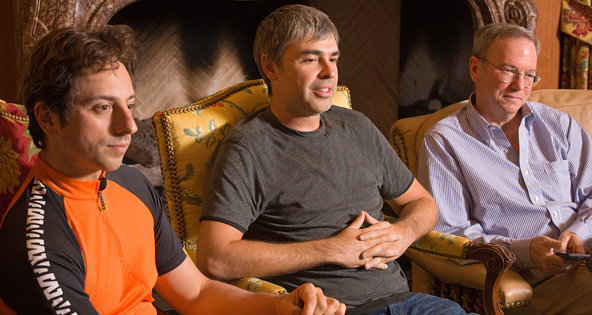
[Pic: Sergey and Larry and their adult supervision, sharing the wisdom their algorithms derived from your shopping habits.]
Contemporary American culture venerates the entrepreneurs who create the new corporate commons in which we now spend most of our work and leisure time—the mall inside our screens. The Founders who make it all the way to an exit—whether the kind of exit investment bankers talk about, where you get liquidity in your founder’s stock through an IPO or sale at some stratospheric valuation that defies rational valuation metrics, or the kind they talked about at Steve Jobs’ funeral—receive a kind of beatification into a peculiar category of neo-capitalist celebrity beyond reproach.
[Pic: The Founder, shortly before the moment of his canonization.]
Now matter how saintly the founders seem, the development of these new arenas of network life as for-profit ventures is inherently conflicted and corrupted. A “community” founded on the fiduciary duty to maximize the financial self-interest of its owners is not a community. It is a business that has tricked its labor force and suppliers into thinking they are its customers. Why does the future need to follow the robber baron model of organization? Do our new communities in the clouds really need to be structured as business corporations, which have the pyramidical governance structure of military warlord bands? Why can’t they be structured as cooperatives, in which the users are also the owners, and the governors? Or maybe an entirely new model founded on a socio-economic contract compatible with the operating system of the network and the diverse interests of its participants?
There appear to be a few folks trying to explore this idea, but none that’s really nailed it. We need to think about social media platforms as incipient polities instead of capitalist cults. As we digest the mass media supplication to David Karp’s personal redemption through the accumulation of $200 million of fuck you money selling this beautiful platform he built to the barons of Silicon Valley, we should be looking for alternative paradigms to the hypercapitalist founder cult. Rockefeller, Vanderbilt, Carnegie, Gates, Dell, Musk, Brin/Page aren’t the only models, no matter how much cool stuff they are funding with their fortunes. One place to start is the mostly abandoned thread that followed the thinking of people like Robert Owen.
[Pic: Robert Owen, 1854.]
The antebellum cooperatives were experiments in utopian socialism, and mostly ended up in the graveyards of other failed American utopias. But there are surviving models that seem very healthy—enterprises like REI, Amana (before it ultimately went corporate), and the housing coops of NYC. If the movements of the Arab Spring could overthrow their governments without charismatic leaders or figureheads, why can’t the online multitude experiment with collective ownership of the realms where we incubate our own 21st century identities? Surely it’s at least worth trying to develop some user-controlled alternatives, letting them compete with the corporates, and see how things play it.
[Pic: New Harmony, a real manifestation of an alternate Indiana.]
Or we could just resign ourselves to live in a world that looks like an endless wander through the corporate-branded hallways of LinkedIn—the kind of world where we all wear clothing with the logos of our corporate employers when we’re out with our families. Zo long, Zuckers!
Recommended reading: MacKenzie Wark in The Guardian, May 22: Who dares to dodge Google's information tax? In exchange for giving up our personal data, we get to watch each other's cat videos, while Google becomes the new state.


