Today would have been Robert A. Heinlein's 100th birthday, had he been as immortal as some of his characters.
It's no secret that, unlike some Heinlein fans I could name, I don't believe the man could do no wrong. He was too complex for that, and I strongly disagree with some of the things he said and wrote. I detest Farnham's Freehold and The Day After Tomorrow, was bored by I Will Fear No Evil and Time Enough For Love, and haven't even attempted to read The Number of the Beast or To Sail Beyond the Sunset (though I have recently been ploughing through his early attempt at a novel For Us, The Living, an intriguing if plotless diatribe written after his unsuccessful attempt to enter politics as a polyamorous nudist supporter of Upton Sinclair's EPIC. No, I'm not joking).
That said, if he'd written nothing but 'All You Zombies', 'The Unpleasant Profession of Jonathan Hoag', and 'The Man Who Traveled in Elephants', he would still (IMHO) be deserving of his Grand Master status. And as well as these gems, he also gave us 'The Long Watch', 'The Green Hills of Earth', 'The Man Who Sold the Moon', 'Requiem', Have Space Suit, Will Travel, Between Planets, Glory Road, and many other works that I've enjoyed reading and re-reading. While I'm no fan of Starship Troopers, I acknowledge its importance to the genre, if only for the "responses" and outright piss-takes it has inspired and which I have enjoyed.
His influence on the sf writing community has been immeasurable: to cite just one example, I am pleased and grateful his philosophy that the sf writers who he helped out in times of crisis (and there were many of them, some of whom disagreed fervently with his politics at the time), should not pay back these favours but "pay them forward", has been adopted by many others in the field.
Take him for all in all, the world would be a much poorer place had he never lived, and I can think of no higher praise for anyone.
Saturday, July 7, 2007


Thursday, July 5, 2007
Another Green World
There's a fun brain-popping (and compelling) bit of science nonfiction from Freeman Dyson in the July 19 issue of The New York Review of Books, titled "Our Biotech Future." Among his talking points:
- Biotech will blossom into something bright and beautiful once it undergoes a Small is Beautiful domestication similar to what the computer industry experienced from 1981-1999, and kids and hobbyists are practicing genetic experimentation in their playrooms. As an early telegraph of this trend, he suggests, see the recent appearance of brightly colored genetically modified tropical fish in pet stores.
- Linear Darwinian evolution, in which species progress and differentiate through time like the branches on the tree of life, is a kind of anomalous interlude. Most of Earth's biological history was a golden age of synthetic rather than reductionist biology, in which horizontal gene transfer was universal and separate species did not yet exist, and a similar period is now ascendant: "Life was then a community of cells of various kinds, sharing their genetic information so that clever chemical tricks invented by one creature could be inherited by all of them. Evolution was a communal affair, the whole community advancing in metabolic and reproductive efficiency as the genes of the most efficient cells were shared...And now, as Homo sapiens domesticates the new biotechnology, we are reviving the ancient pre-Darwinian practice of horizontal gene transfer, moving genes easily from microbes to plants and animals, blurring the boundaries between species. We are moving rapidly into the post-Darwinian era, when species other than our own will no longer exist, and the rules of Open Source sharing will be extended from the exchange of software to the exchange of genes. Then the evolution of life will once again be communal, as it was in the good old days before separate species and intellectual property were invented." Quoting microbial taxonomist Carl Woese (who sounds like he's been reading Rudy Rucker's gnarly blog):
-- "Imagine a child playing in a woodland stream, poking a stick into an eddy in the flowing current, thereby disrupting it. But the eddy quickly reforms. The child disperses it again. Again it reforms, and the fascinating game goes on. There you have it! Organisms are resilient patterns in a turbulent flow -- patterns in an energy flow...it is becoming increasingly clear that to understand living systems in any deep sense, we must come to see them not materialistically, as machines, but as stable, complex, dynamic organization."
- Green technology that results from these trends, such as silcon-based leafy plants that more efficiently photosynthesize to generate energy and grow edible parts, is the key to ending rural pverty and restoring equilbrium to the North-South balance of power.
A provocative synthesis of various ideas and a fun read. Not sure I buy the socio-economic optimism, but it's some crunchy food for thought.
- Biotech will blossom into something bright and beautiful once it undergoes a Small is Beautiful domestication similar to what the computer industry experienced from 1981-1999, and kids and hobbyists are practicing genetic experimentation in their playrooms. As an early telegraph of this trend, he suggests, see the recent appearance of brightly colored genetically modified tropical fish in pet stores.
- Linear Darwinian evolution, in which species progress and differentiate through time like the branches on the tree of life, is a kind of anomalous interlude. Most of Earth's biological history was a golden age of synthetic rather than reductionist biology, in which horizontal gene transfer was universal and separate species did not yet exist, and a similar period is now ascendant: "Life was then a community of cells of various kinds, sharing their genetic information so that clever chemical tricks invented by one creature could be inherited by all of them. Evolution was a communal affair, the whole community advancing in metabolic and reproductive efficiency as the genes of the most efficient cells were shared...And now, as Homo sapiens domesticates the new biotechnology, we are reviving the ancient pre-Darwinian practice of horizontal gene transfer, moving genes easily from microbes to plants and animals, blurring the boundaries between species. We are moving rapidly into the post-Darwinian era, when species other than our own will no longer exist, and the rules of Open Source sharing will be extended from the exchange of software to the exchange of genes. Then the evolution of life will once again be communal, as it was in the good old days before separate species and intellectual property were invented." Quoting microbial taxonomist Carl Woese (who sounds like he's been reading Rudy Rucker's gnarly blog):
-- "Imagine a child playing in a woodland stream, poking a stick into an eddy in the flowing current, thereby disrupting it. But the eddy quickly reforms. The child disperses it again. Again it reforms, and the fascinating game goes on. There you have it! Organisms are resilient patterns in a turbulent flow -- patterns in an energy flow...it is becoming increasingly clear that to understand living systems in any deep sense, we must come to see them not materialistically, as machines, but as stable, complex, dynamic organization."
- Green technology that results from these trends, such as silcon-based leafy plants that more efficiently photosynthesize to generate energy and grow edible parts, is the key to ending rural pverty and restoring equilbrium to the North-South balance of power.
A provocative synthesis of various ideas and a fun read. Not sure I buy the socio-economic optimism, but it's some crunchy food for thought.
Wednesday, July 4, 2007
Rocking SF power chords
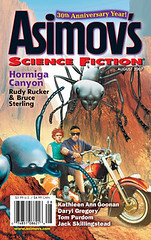
In the August 2007 issue of Asimov's, cyberpunk grandmasters Rudy Rucker and Bruce Sterling collaborate on a hilariously fun story that dollops out duelling SF power chords like the genre equivalent of a riff-off between Frank Zappa and Joe Walsh. "Hormiga Canyon": take one part Jan-Michael Vincent dirt biking across the post-apocalyptic desert in Damnation Alley (with a wonderfully incongruous strand of Renaissance Faire DIY chainmail), one classic cyber-trickster, mix them with the Mythbusters guys, then throw them into a gnarly southern California desert that discovers the Calabi-Yau lurking beneath the milieu of Carlos Castaneda and the Warner Bros. backlot of Them! Yes, it's a giant ant story.

"A colossal ant burst from a ticket of manzanita, bearing three fierce-looking natives. The riders were clutching the ant's insectile bristles like Mongols holding a horse's mane. They were deeply tanned men with filed teeth, floppy hair, and bizarre patterns painted on their faces. Original Californians.
"The Tongvans sprang at Jayson and Stefan; second later the boys were swathed in woven nets, wrapped up like pupas side by side.
"The largest Tongvan leaned over Stefan. He was a wiry, dignified gentleman just over five feet tall. He'd painted an intricate pattern of fern-like scrolls around his eyes and mouth. He had a deeply skeptical, highly judgmental look, very much like an overworked immigration officer at LAX."
Highly recommended -- the perfect smart silly summer matinee for your favorite sofa, a buttered popcorn path to the Nagual. Check it out. The first third of the story is up on the Asimov's site for your reading enjoyment.
Tuesday, July 3, 2007
Fred Saberhagen (1920-2007)
This just turned up in my in-box. Rotten, evil news that Fred Saberhagen has died. I knew he'd been fighting cancer for several years, but you always hope those afflicted are able to lick that nasty disease.
I first met Saberhagen back in 1991, when he was gracious enough to be my writer guest of honor at Aggiecon 22. And a more cooperative guest I couldn't have asked for. He was friendly and accomodating to all the fans and con workers there. Privately, myself and several other concom began affectionately referring to him as "Yoda" after seeing him sitting in various areas in the university's student center outside of the convention events, silently observing all the students going to and fro. Around midnight on Friday we found him sipping coffee in a mostly-empty food court. He had a serene, dignified air about him, just like a Jedi Master should have.
I'd encountered him occasionally at various conventions in the ensuing years, and he always had a kind word for me. Once I started publishing interviews, he was always on my short list of people who I wanted to sit down with some day. Alas, I waited too long, and that day will never come.
Fred Thomas Saberhagen passed away in his Albuquerque, New Mexico home on Friday, June 29, 2007. He was 77 years old.
Fred Saberhagen was the author of over 65 historical fiction, science fiction and fantasy novels, including such series at the Dracula and Berserker series. His first published story was "Volume Paa-Pyx" which appeared in the February 1961 issue of Galaxy, and his first published novel was The Golden People in 1964.
Before starting his writing career, Saberhagen served in the US Air Force, worked as a civilian electronics technician, and wrote and edited articles on science and technology for the Encyclopedia Britannica. He was born and raised in Chicago, but lived for many years in Albuquerque.
A memorial will be announced for later in the year. In lieu of flowers, donations may be made to any of the following: Doctors without Borders. Catholic Relief, SFWA Emergency Medical Fund, or John 23rd Catholic Church in Albuquerque. Saberhagen is survived by his wife, Joan Spicci.
I first met Saberhagen back in 1991, when he was gracious enough to be my writer guest of honor at Aggiecon 22. And a more cooperative guest I couldn't have asked for. He was friendly and accomodating to all the fans and con workers there. Privately, myself and several other concom began affectionately referring to him as "Yoda" after seeing him sitting in various areas in the university's student center outside of the convention events, silently observing all the students going to and fro. Around midnight on Friday we found him sipping coffee in a mostly-empty food court. He had a serene, dignified air about him, just like a Jedi Master should have.
I'd encountered him occasionally at various conventions in the ensuing years, and he always had a kind word for me. Once I started publishing interviews, he was always on my short list of people who I wanted to sit down with some day. Alas, I waited too long, and that day will never come.
Saturday, June 30, 2007
Auf Wiedersehen, Zwanzigste Jahrhundert

Last week German photographer Bernd Becher passed away. With his wife Hilla, he spent fifty years documenting the hidden beauties of the dying industrial landscapes of the West in incredibly beautiful black and white photographs. What a monumental achievement he made. If you've never experienced their work, you really should check out a tome (you know your coffee table *needs* a collection of rusting cooling towers sitting on top of it).
Friday, June 29, 2007
A Book at Last
Copies of Hurricane Moon have been shipped to bookstores. And to me. And it's wonderful to hold a copy of my novel in the form it was always meant to have. After years of being notes, sketches, Word documents, printouts with comments scribbled in all colors of ink; notebooks and binders with the MSS formatted and printed out for friends to read; the final draft boxed up to go to my agent in the mail; a digital MSS e-mailed to the editor and then sent to the publisher on CD's; the copy-edited manuscript, electronic galleys in PDF, and Xeroxed galleys, now finally, simply, it's a book.
The first three chapters are online at Pyr.
The first three chapters are online at Pyr.
Apollocon in the rear view mirror
Forgive my tardiness in posting these shots taken at last weekend's Apollocon in Houston. I'd claim that I was too busy to post them, but too many people out there know better: I'm simply lazy. One disappointment was the absence of the ever-entertaining Bill Crider, who had to cancel out because of the recent diagnosis of non-Hodgkin's lymphoma in his wife, Judy. We're all pulling for you, Judy.


I didn't arrive until Saturday morning at the convention, and had some time to kill before my first panel. So I ended up talking with Monkeybrain mastermind Chris Roberson about setting up a Wiki to deal with worldbuilding notes and the like for various writing projects, the fact that emails weren't getting through in regards to the upcoming Armadillocon Writer's Workshop and Interzone. After running through the various panels I was scheduled for that day and having absolutely nobody show up for my reading (except for Martha Wells. Instead of reading, we just BSed through my alotted time) I made it up to the various parties going on, and ran into John Moore.


Since the evening rapidly became a blur, I won't even try to figure which party individual photos were taken at. Suffice to say, it was either at the Fencon, Space Squid/RevolutionSF or Armadillocon soirees. I chatted with editor David Hartwell and physicist John Cramer. Hartwell told fascinating stories about his experiences with Phil Dick and James Tiptree, Jr. Cramer talked about quantum entanglement and retrocausality, and my head exploded. Staggering over to the next party, I encountered Chuck Siros and Lawrence Person livin' la vida sofa.


Hartwell gets some editorial pointers from Steve Wilson of Space Squid and RevolutionSF fame. And really, what SF convention would be complete without a roving band of drunken, singing pirates?


Above we have Tim Miller of Fencon fame. Sadly, Tim was not seen wearing his Tim the Enchanter headpiece this year. Also present was Elze Hamilton, best known for her photo documentation and blogging about various Texas conventions.

Sunday I finally caught up with Kim Kofmel, one of the prime movers-and-shakers behind Apollocon and an increasingly significant presence behind the scenes at Armadillocon as well. Since she was slowly going insane from putting out fires at the con, I was able to talk a little with Kathryn Cramer. I've read her blog off and on for years--even before it was a nexus of socio-political-geo-revolutionary controversy. She confessed that she didn't know what she was going to do with the blog, since it'd taken on such a bizarre life of its own and she now figured prominently in several conspiracy theories circling the globe. So instead we switched gears to lighter fare, and traded rants about how Creation Conventions have pretty much fouled the waters for every other genre convention in the world by setting really, really bad precedents in regard to guest relations, fan relations and overall greed. On that happy note, I bade my farewells and went home, shamed by all the brilliant writers I interacted with over the weekend and vowing to be more productive myself in the weeks and months ahead (don't you just love conventions?).
I didn't arrive until Saturday morning at the convention, and had some time to kill before my first panel. So I ended up talking with Monkeybrain mastermind Chris Roberson about setting up a Wiki to deal with worldbuilding notes and the like for various writing projects, the fact that emails weren't getting through in regards to the upcoming Armadillocon Writer's Workshop and Interzone. After running through the various panels I was scheduled for that day and having absolutely nobody show up for my reading (except for Martha Wells. Instead of reading, we just BSed through my alotted time) I made it up to the various parties going on, and ran into John Moore.
Since the evening rapidly became a blur, I won't even try to figure which party individual photos were taken at. Suffice to say, it was either at the Fencon, Space Squid/RevolutionSF or Armadillocon soirees. I chatted with editor David Hartwell and physicist John Cramer. Hartwell told fascinating stories about his experiences with Phil Dick and James Tiptree, Jr. Cramer talked about quantum entanglement and retrocausality, and my head exploded. Staggering over to the next party, I encountered Chuck Siros and Lawrence Person livin' la vida sofa.
Hartwell gets some editorial pointers from Steve Wilson of Space Squid and RevolutionSF fame. And really, what SF convention would be complete without a roving band of drunken, singing pirates?
Above we have Tim Miller of Fencon fame. Sadly, Tim was not seen wearing his Tim the Enchanter headpiece this year. Also present was Elze Hamilton, best known for her photo documentation and blogging about various Texas conventions.
Sunday I finally caught up with Kim Kofmel, one of the prime movers-and-shakers behind Apollocon and an increasingly significant presence behind the scenes at Armadillocon as well. Since she was slowly going insane from putting out fires at the con, I was able to talk a little with Kathryn Cramer. I've read her blog off and on for years--even before it was a nexus of socio-political-geo-revolutionary controversy. She confessed that she didn't know what she was going to do with the blog, since it'd taken on such a bizarre life of its own and she now figured prominently in several conspiracy theories circling the globe. So instead we switched gears to lighter fare, and traded rants about how Creation Conventions have pretty much fouled the waters for every other genre convention in the world by setting really, really bad precedents in regard to guest relations, fan relations and overall greed. On that happy note, I bade my farewells and went home, shamed by all the brilliant writers I interacted with over the weekend and vowing to be more productive myself in the weeks and months ahead (don't you just love conventions?).
Subscribe to:
Posts (Atom)