Sunday, November 30, 2008

Reviews and apocalyptic holiday reading recommendations


Friday's mail (snail and electronic) delivered two very nice new reviews of Lou Anders' Fast Forward 2.

The December 2008 issue of Locus has a new column by the unstoppable Gardner Dozois, "Gardnerspace," which opens with Gardner's conclusion that FF2 may be the best (by a "very slight edge") original anthology in a year of many stellar contenders, singling out stories by Benjamin Rosenbaum/Cory Doctorow, Nancy Kress, Jack Skillingstead, Paul Cornell, Paul McAuley, Karl Schroeder and Tobias Buckell, Kristine Kathryn Rusch, Kay Kenyon, and yours truly. An earlier version of this review appeared on the Asimov's message boards, and in the process of translation Gardner's kind note of my story has been adverbially upgraded from "cool" to "seriously cool" (that's right before the "almost too self-consciously cool, in fact" part, which gives me hope that I may yet succeed in my Quixotic effort to remake Arthur Fonzarelli as a pop Lacanian science fiction writer). Add that to the blurb list (or maybe better, "too cool for Gardner Dozois"?).

Friday's update of Strange Horizons includes a wonderful review by Alvaro Zinos-Amaro, in which he calls FF2 "that rare beast among anthologies of the imagination: one whose content actually provides a materialization of its own theoretical blueprint." He covers all of the stories along with some very insightful commentary about the editorial contribution and vision, and has this to say about my piece:

"The Sun Also Explodes" by Chris Nakashima-Brown is Fast Forward 2's most stylistically engaging outing, and perhaps also its most difficult to summarize. Living in Colonia, a legally independent "microstate," and pursuing a three-year fellowship paid for by the Virilian Investors Cultural Fund, the narrator finds himself entangled, emotionally and professionally, with bio-artist Elkin, a "genomic postmodernist." Nakashima-Brown brilliantly depicts the subtle inter-personal dynamics of the narrator with his friends and with Elkin, and enriches his mostly plot-less tale with thoughtful literary references (get out your Hemingway) and poetic descriptions ... Make no mistake, despite the literary veneer, the SF elements are everywhere, and this is an SF story at its core, not a modernist study in ennui transliterated to the idiom of SF. But Nakashima-Brown's SF "furniture" is not always brightly illuminated or center-stage. It is no less dazzling or mesmerizing for it, though.

Hey, they're flying off the Borgesian storerooms at Amazon for close to $10 a copy. Why not support your favorite science fiction small press and buy one for everyone on your list? If you need to mix it up, you can throw in a copy of Spicy Slipstream Stories for good measure.


If you are looking for the kind of media that generates this kind of weirdness, following is a holiday gift menu of some of things I have most enjoyed over the past year, just the kind of thing to cause awkward moments of disturbed bafflement by the tree:

The Architecture of Parking, by Simon Henley - A coffee table book filled with beautiful black and white photos of concrete parking structures, for those of you who can't wait for Geoff Manaugh's BLDGBLOG book.


The Hyena and Other Men, by Pieter Hugo - A coffee table book filled with photos of Nigerian dudes roaming the rough streets of Lagos with hyenas on leashes. I first saw one of these photos on the web some years back, and it just has some insanely potent 21st century juju going. I think these guys could handle The Ghost Who Walks just fine.

Terror and Consent, by Phillip Bobbitt - Though it has healthy dollops of warmed over neocon drool from this sometime advisor to Sarah Palin's running mate, this book has some very interesting surveys and explorations of the status of the nation state in the 21st century, and the emergence of the "market state," very interesting material to mix in the cerebral soup for anyone interested on extrapolating the coming century.

Year’s Best SF 13, edited by David Hartwell & Kathryn Cramer - A rare sf anthology filled with stories this weird reader wants to read, lots of politically (and geopolitically) charged speculative fictions for the age of the GWOT.

Angler: The Cheney Vice Presidency, by Barton Gellman - The last Dick Cheney book? See no one less than Dick Armey describe how his old friend personally lied to him about WMD, and how he wishes he could go back and prevent the Iraq war, as he believes he could have had he known the truth.

Buda’s Wagon: A Brief History of the Car Bomb, by Mike Davis - Did you know the first car bomb was a horse cart detonated on Wall Street by an anarchist in 1920? Mike Davis does, and he also knows the future. Talk about the street finds its own uses for things.

The Second Plane, by Martin Amis - I read the UK edition of this collection of Martin Amis essays about 9/11 and its aftermath, an interesting box of prisms through which to think about the period we are now leaving.

Biophilia, by Wena Poon - A wonderfully fun bit of technicolor prose from this gifted Singaporean now living in the US. Though (perhaps deservedly) Poon gets more attention for her literary short fiction, she has a knack for the eyeball kick that should not be wasted.

Rogue Male, by Geoffrey Household (New York Review of Books Classics edition, with an introduction Victoria Nelson) - I first read this wonderful short novel years ago, an amazing lean thriller about an English gentleman hunter who tries to shoot Hitler and must literally go to ground. The new introduction is worth the book itself, and the book is required reading for anyone who loves thrillers with natural settings — a kind of literary proto-Rambo. NYRB's publishing imprint is putting out tons of wonderful volumes like this, including many genre lost diamonds like Christopher Priest's The Inverted World (now on my to-read shelf) and John Wyndham's The Chrysalids.

Maps & Legends, by Michael Chabon - Essays by this year's Nebula winner, in which his embrace of all things skiffy and lending to our genre of his much-coveted literary gentility is fully expressed, in an insanely beautiful package from McSweeney's.

The Black Lizard Big Book of Pulps, edited by Otto Penzler - All the hardfisted pre-WWII fiction you can read while drunk on eggnog, found under my tree last year.

McMafia, by Misha Glenny - If you're dying to actually meet those Nigerian spammers, here's your chance in this excellent journalistic tour of the high crimes of the 21st century.

Drug Lord: The Life and Death of a Mexican Kingpin, by Terrence Poppa - Not a new book, but just picked up by me on a West Texas trip, an amazing story of life in the borderlands.

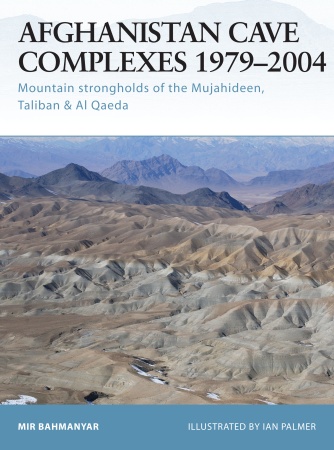
The Wars of the Barbary Pirates, by Gregory Fremony-Barnes (Osprey Essential Histories) - Osprey, the publisher that started out doing tomes designed to serve as reference works for military modellers and wargamers, has adapted its power chords for excellent plain-English histories and real-time arcana about the wars of the 21st century, all of which are wonderful writerly reference works. This one is the perfect sober companion to Peter Lamborn Wilson's Pirate Utopias. See also, US Marine in Iraq: Operation Iraqi Freedom, 2003 – Richard S. Lowry (Osprey Warrior); Special Forces Camps in Vietnam 1961-70 – Gordon L. Rottman (Osprey Fortress); and my all-time personal favorite, Afghanistan Cave Complexes 1979-2004: Mountain strongholds of the Mujahideen, Taliban & Al Qaeda (Osprey Fortress).


El Verdadero Pablo: Sangre, Traicion, y Muerte, by Astrid Legarda - Spanish language tabloid true crime about Pablo Escobar. Study in technicolor scarlet, Jack Bauer meets the telenovela.

The Brief Wondrous Life of Oscar Wao, by Junot Diaz - I know, last year's darling novel, but I just got around to it, and I have to say I have a soft spot for mainstream semi-autobiographical novels portraying the profundities of being an adolescent sf and D&D freak.

War and Film, by James Chapman - Found in the gift shop of the Art Institute of Chicago, a wonderful critical survey of the depiction of war in English-language cinema, in a beautiful small volume with perfectly presented black and white stills.

Food of the Gods: The Search for the Original Tree of Knowledge A Radical History of Plants, Drugs, and Human Evolution, by Terrence McKenna - Enjoying J.J. Abrams' new series Fringe? Enjoyed Altered States? Want to remember Robert Anton Wilson in a different way? I just found this 1992 book-length summation of the late Terrence McKenna's fascinating theories on magic fungi and human consciousness in a used bookstore in Marfa. Curl up by the fireside with this tome, your favorite Amazonian shaman, a dose of ayahuasca, and a vomit bucket, and see if you can't find your own "self-transforming machine elves."

Matters of Gravity: Special Effects and Supermen in the 20th Century, by Scott Bukatman - Wonderful collection I read this year by one of the finest theorists of sf.

Wiscon Chronicles 2, edited by L. Timmel Duchamp & Eileen Gunn - Worth the price just for Timmi Duchamp's amazing essay on sf convention panels and the "view from nowhere," this also includes a crazed essay by me about science fiction, revolution, and utopia.

The Color Purple (as rendered in black newspaper ink)

In Sunday's installment of The Phantom (which for decades preserved the old school tradition of separate, and sometimes conflicting, daily and Sunday storylines — the only thing better than a never-ending non-sequitur narrative that has been running since 1934 is *two* parallel versions featuring the same character, you know, the kind of thing that caused DC comics to kill off a bunch of characters just to try to tidy it up a little bit), a newly introduced character poses a question one of the Phantom's Bandar pygmy deputies should have asked a long time ago:


Note the Ghost Who Walks' Man Friday Guran leering at the interloper from the lower left hand corner of the above panel. Move in for a close-up. Wouldn't you be wearing a similarly self-loathing face if you had been living out your "existence" for 70-some years drawn as a chubby pygmy with a lampshade on his head, serving the arrogant whims of a white man in purple tights, gun belt and a bunch of giant skull bling? Not much of a surprise when you learn that part of the current Phantom's backstory was his youthful education in Mississippi.


To which you might say, hey, just be glad you're not one of the Phantom's vintage female characters, like these sisters trapped by African cannibals and then by Arab slavers in a vintage Sunday storyline that has been going on since sometime this past spring.


(One wonders if Falk, famous for his repeated use of a secret band of female air pirates who like to lounge in 1930s bikinis on their private atoll, hung out with Wonder Woman creator William Marston, who spent his life as the apex of a polyamorous triangle.)

What a weird experience to continue to wander through the technicolor pulp pre-WWII imagination of the Phantom's creator, Lee Falk, a kid from St. Louis who changed his own surname and concocted his own elaborate personal mythology when setting out to make his mark as a comics pro, styling himself as a world traveler who had studied with Eastern mystics when the farthest he'd been was Illinois. A bold lesson in inventing your own reality, and making the juvenile imaginary into a tangible simulation of the Real:

Falk died of heart failure in 1999. He lived the last years of his life in New York, in an apartment with a panoramic view of the New York skyline and Central Park; he spent his summers in a house on Cape Cod. He literally wrote his comic strips from 1934 to the last days of his life, when in hospital he tore off his oxygen mask to dictate his stories. However, his two characters, Mandrake and, in particular, The Phantom, are still active and popular, both in comic books (the newest addition to the Phantom coming from Moonstone Books) and comic strips.


Meanwhile, in the 21st century update of Upper Manhattan racial attitudes for the age of Obama department, the Sunday Times' glossy magazine cover story by one of its star journalists about her own experience hiring a surrogate to gestate her child features this astonishing photo of the reporter, her baby, and the baby's "nurse" (standing before some Hudson Valley miniature simulation of an antebellum plantation, I guess)...


...and if you flip the page, a photo of the barefoot working class surrogate that carried the reporter's child to term, lounging on her Appalachian porch:


The Phantom's pygmy personal assistants will be glad to see that the surrogate was allowed to keep her bow and arrow* with her on the porch.

According to the story, the gestational surrogate was located through a lawyer who places ads on diner placemats, total price $30,000-$60,000 (legal fees included, medical expenses not included).

And you thought The Handmaid's Tale was a dystopian fiction designed to prevent such a future from occurring. The difference is, the real-world variation is much more benevolent, governance by The New Mandarins of the Baby Boom, whose exercise of class and race power is okay because they are so rational and loving. And with such outstanding academic pedigrees.

Institutionally self-revelatory media pieces like these (the memoir pieces by big-time journalists are always a tell) provide rich subtextual insight into the old currents stirring beneath the utopian veneer of the current politico-cultural climate. Does the President-Elect realize that the portion of his constituency that's writing all the biggest checks love him the way they loved David Hampton? (You know, he goes to Harvard with the kids' friends, his father is Sidney Poitier?) That the 21st century remix of The Manchurian Candidate is not the Denzel Washington post-cyberpunk version, but rather a cathode ray stadium rally remake of Six Degrees of Separation for the consuming masses? Roll over, Richard Condon, tell George Orwell the news.

Can we arrange for the smart-assed gang kid from the Phantom's section of the comics page to wander uninvited into the Sunday Times Magazine? And when he's done there, spray some graffiti on the walls of the editorial page? Please? Maybe Huey**?


*Darn, inspection of the larger image in the print version reveals that the object in the lower-right-hand corner of the picture is not a toy bow and arrow, but a Swifter duster and a piece a pipe. Oh, well, I think the comparison of the photos still speaks for itself. Do the editors not realize what they are saying about themselves with this piece?

**Ten-year old radical from erstwhile daily strip (and now Adult Swim cartoon) Boondocks, who was frequently evicted from the comics page for being too uppity.

Wednesday, November 26, 2008

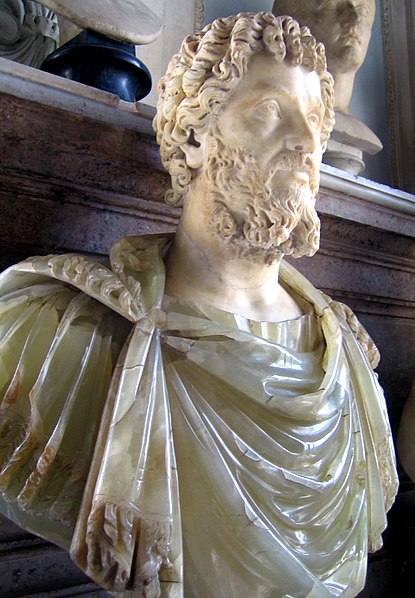
Baracchus Maximus?


At The Times Online, Cambridge classicist Mary Beard on the Roman Obama analog:

In the second century AD, Lucius Septimius Severus became the first ‘African-Roman’ emperor of Rome. Like Obama he was of mixed race -- his father from Libya, his mother of European descent. He too had an outspoken and determined wife, from Syria. And his first task on coming to the throne in 193 AD was to deal with a military disaster in Iraq (‘Parthia’ as it was then known). The success of his surge was commemorated in the great arch, which remains to this day one of the most impressive monuments in the Forum at Rome.

The two little children he took with him to the palace did not fare so well. In fact they grew up to be murderous thugs – even if the elder, Caracalla, did go on to initiate the most daring extension of civic rights in the whole of world history. Once he had got rid of his brother (nastily murdered on his mother’s lap), he gave full Roman citizenship, and the legal privileges and protection that went with it, to all the free male inhabitants of the empire.


Some ready-made precedent for an alternate future history? Flash forward to the Obama girls as a near-future Uday and Qusay? I would totally read that.


P.S. -- Wikipedia trivia on the death of Caracalla: "While travelling from Edessa to begin a war with Parthia [the territory subsequently known as Iraq], he was assassinated while urinating at a roadside near Harran on April 8, 217 by Julius Martialis, an officer in the imperial bodyguard."

Tuesday, November 25, 2008

Victor Six

When Mom went into Assisted Living, she gave me her car—a 2006 Chevrolet Impala, silver with leather seats. It was not the right car for me. But still a rather nice car. Odd, how catastrophe brings markedly mixed outcomes. Mom getting Alzheimer's was catastrophic for both of us. Yet the dark clouds turned out to have, if not sterling silver linings, at least glints of silver in the gloom.

The Alzheimer's has knocked out some of Mom's brain circuits. That's why she had to stop living alone. On the other hand, some of the affected circuitry seemed to control neurotic inhibitions, and maybe even self-absorption. In the past three years my mother has expressed more appreciation for my character, capability, and career than she expressed in the previous three decades. Then there was the end of our last phone call, a couple of days ago. She said, "Good night, Honey." Normal, right? Well, the norm for thirty years was an emotionally neutral, tentative signoff more appropriate for concluding a chat with a near stranger: "Good night...?" I treasure that unexpected, nice, normal "Good night, Honey."

And there's the silver Impala. It came in handy when I returned to Houston from Columbus, Georgia with most of what I inherited from Mom's house. The Impala effortlessly hauled a huge trove of childhood stuff plus heirlooms including furniture.

Six weeks later, I took the Impala on a 4,000-mile road trip out West, from Houston to Oklahoma then Colorado. For part of the trip I had a co-pilot. The car absorbed her luggage and mine and my plentiful emergency supplies with room to spare. One afternoon in Denver, I emptied out the car in order to transport pretty much all of the supplies for a publisher's party—Pyr's Brazil-themed bash at the World Science Fiction Convention, orchestrated by editor Lou Anders. Lou needed wheels to schlep the supplies to the party hotel. Enter the Impala. Into the Impala went lots of bottles of Brazilian booze, a hundred limes and other groceries, enough plastic cups and plates for a horde of partygoers, and several large boxes of Pyr-logo souvenir glasses shipped from New York. Booze and all was safely delivered to the party hotel in the capacious car previously belonging to my mother, the teetotaling Southern Baptist. After WorldCon my copilot and I drove on to Salt Lake City. When we unloaded our luggage, I found a lime skulking in the Impala's vast trunk. A couple of days later I took a long day trip out into the Uinta Basin, east of Salt Lake City, to do some novel research. Finally I returned to Texas via scenic routes in Utah and New Mexico. I had a safe, cool and comfortable ride day and night, rain and shine.

No way could I have made a trip like that in my 1996 Toyota Celica. And it was high time for me to move up to a more spacious car with newer safety features, even though I loved the Celi dearly. She was a sweet, fun-driving automobile that I named Sierra Tango—as in Celica ST, as distinct from the more souped-up but mechanically iffier Celica GT. At the tail end of September, I drove the Celica back to Georgia to handle more of my Mom's finances, and to sell the Celi to my third cousin.

That left me owning one car. The Impala. Unfortunately it still wasn't the right car for me. On top of that, with the potential failure of General Motors splashed all over the news, this did not seem like a good time to hang onto a GM car for too long. Much less a GM car purchased from and still under warranty from Bill Heard Chevrolet, which spectacularly went bankrupt just before I returned to Columbus in the Celica. Columbus was buzzing about it, since Bill Heard originated in Columbus and had rated as one of the top local points of entrepreneurial pride.

Returning to Houston via AirTran, I soon went shopping at the CarMax on the Gulf Freeway. After pleasant dealings with CarMax, including asking for delivery of a car from Austin because it was just the make, model and color I wanted, I bought that car. It's a 2005 Honda Accord. Yes, I dropped back a year—but despite being one year older than the Impala, the Accord drives much more nimbly and has fewer rattles. There are reasons why GM is not in the best of corporate shape. In any event, if you ask around for reliable, highly safe cars that have great fit and finish inside and hold value against depreciation, the brand names Toyota and Honda inevitably enter the conversation. Most other auto brand names exit stage right.

CarMax gave me a good trade-in price for the Impala. I'm sure its new owner will drive away happy. I certainly did. The Accord is exactly the right car for me. It's an elegantly styled coupe with an understated spoiler and a moon roof and it's the most wonderful, sparkle-saturated shade of blue. The sparkles in the high-tech paint reflect sunlight to keep the car cool. The interior is dark gray with leather and chrome accents. And there are more better storage arrangements than any car I've ever seen. These include a special little compartment above the rear view mirror for sunglasses; a lidded niche under the instrument panel for I don't know what, but I'm using it for tiny souvenirs of my travels with the Impala; and under the CD changer there is a compartment specifically sized for a stack of CD's. That's perfect, since I check out numerous CD's from the music collection at the Rice University Library.

I named my new car Victor Six. For one thing, it has a V-6 engine. For another thing, that's a way to declare victory over two years of problems. There was my mother's Alzheimer's with so many problematic repercussions. There was my first published novel being released into a bad time for the publishing industry and for science fiction sales. Hurricane Ike blew through Houston, and every place it didn't wreck outright it laded with negative energy. Now Hurricane Bad Economy is churning across the U.S. and world. None of these problems are over and done with. It's a good time to declare victory anyway. Victory can be at least as much frame of mind as fact on the ground.

Friday, November 21, 2008

Somali Pirates: The Risk Module


The fun-loving folks at the International Chamber of Commerce's Commercial Crime Services are maintaining a really sweet Google Earth based real-time map of global incidents of piracy, with map markers you can click through for more details about the specific incident. Some representative sample reports:

IMB Piracy Map 2008
Attack ID: 2008/239
Wed Nov 12 2008
Attack Type: ATTEMPTED
Vessel Type: TANKER
Location:GULF OF ADEN
Incident details: 12.11.2008: 1210 UTC: Posn: 12:33.6n – 045:10.6e, Gulf of Aden. Armed pirates in two speedboats chased a tanker underway. Tanker took evasive manoeuvres and escaped from the pirates.

Attack ID: 2008/195
Fri Sep 26 2008
Attack Type: HIJACKED
Vessel Type: CHEMICAL TANKER
Location: GULF OF ADEN
Incident details: 26.09.2008: 0920 UTC: Posn: 13:32N - 048:26E, Gulf of Aden. Armed pirates fired upon a chemical tanker underway. The tanker sent mayday messages via VHF channel. The pirates boarded and hijacked the tanker. Further details awaited.

Attack ID: 2008/095
Sun May 25 2008
Attack Type: HIJACKED
Vessel Type: GENERAL CARGO
Location: GULF OF ADEN
Incident details: 25.05.2008: 2235 LT: 13:13N-050:49E: Gulf of Aden. Pirates hijacked a general cargo ship 80 nm off the coast of Somalia. Nine crewmembers are held hostage onboard. At present the vessel is 2.5 nm from the coast. Further details awaited.


ICC Commercial Crime Services: Live Piracy Map 2008

Lem: The Opera

From Gazeta Wyborca, via the amazing polymathic Allen Varney, the discovery of Stanislaw Lem's secret dystopian opera:

Stanisław Lem's Unpublished Works Discovered

An uncompromising NKVD man named Utterly Inadvisabiladze, a brave Soviet spy Dementiy Dogsonov, who's lost his eye trying to spy on the imperialists through the keyhole, an ideological communist Avdotia Niedoganina, brilliant academician Michurenko (student of Lysurin), and above all Stalin - as always superhumanly intelligent and inhumanly smiling. These are the main characters of a satirical piece by Stanisław Lem, which the author himself for half a century thought missing.

Lem, who gained worldwide recognition for his SF novels, wrote it in the late 1940s, at the height of Stalinism, when people were being imprisoned or even executed for far lesser trespasses. Twenty years later, in the 1960s, writer Janusz Szpotański received a very special literary prize for his unpublished musical satire The Silent and the Honkers - three years in prison.

Lem's piece is similar in some aspects to the Szpotański lampoon. Written during his student times, it is a quasi-opera about the brilliant future of communism and Stalin's genius. Lem read it only for his closest friends - Roman Husarski and his future wife, Halina Burton, as well as, among others, writers Jan Józef Szczepański and Aleksander Ścibor-Rylski.


Among those admitted to his closest circle was medicine student Barbara Leśniak, who was later to become the writer's wife.

'The first time I heard this piece was when Staszek was still a bachelor, around 1949, I think', remembers Barbara Lem. 'He enacted all the characters himself, and he was best in the woman's role. He performed the piece for as long as Stalin lived - he obviously needed this kind of abreaction'.

Lem mentioned the missing piece in numerous interviews, including those given to Stanisław Bereś and Tomasz Fijałkowski. 'We've turned everything upside down here. I still hope it surfaces somewhere', Lem told Bereś.

Also the writer's secretary, Wojciech Zemek, for years searched for the piece. 'From time to time Mr Lem would ask me whether I'd already found it, and I'd reply regretfully that I hadn't', remembers Mr Zemek. 'And yet I held the folder containing it so many times in my hands!'

The folder, an old-style grey cardboard, ribbon-tied folder, was inscribed 'Botched crime story' and contained an unfinished Raymond Chandler-style crime novel that Lem started writing in the mid-1950s. It has now turned out he used that typescript to create a hiding place so perfect the text went missing for five decades - he simply slid the Stalin opera between the pages of the crime novel typescript.

'I always knew that every one of Lem's pieces has a second bottom - even a botched crime story can hide an opera about Stalin!', commented Mr Zemek.

Translated by Marcin Wawrzyńczak

Źródło: Gazeta Wyborcza

Thursday, November 20, 2008

There were giants in those days.

Newspaper columnists, I mean.

Once upon a time, only a few decades ago, there were newspaper columnists who produced something approaching art, columns which were lovingly crafted, where every word was given the attention of a poet, and which, though made for a disposable medium, were created to linger in the minds of the reader.

Now...oh, don't get me started. I'd rather focus on the past. The present is so much more grim. (Out of Town News, a landmark of my youth and many others' in Boston, is going to close. Harvard Square has lost its last, best link to its past). I would rather celebrate the past than contemplate what the future is likely to be like. (No, I'm not fearing it. Just hating it).

Let us consider, briefly, Murray Kempton. Great journalist. Pulitzer Prize winner. Author of Rebellions, Perversities, and Main Events, which is one of the best collections of essays I've ever read, made all the more impressive when you consider that he turned out some of them three times a week.

Newspaper columnists today are non-entities, mediocrities, sycophants, nattering nabobs of negativity, mean-spirited putzes in the shape of human beings, and shrieking ideologues. But once upon a time Kempton was around, and produced the following on a few days' notice:
-----
Woke up yesterday morning where there is not a chicken to crow for day and remembered that on September 27 next Bessie Smith will have been dead for fifty years.

She was killed a few miles from Clarksdale, Mississippi. The gods could not have selected a more appropriate place to close her epic, because Clarksdale is not very far from the railroad tracks where the Southern used to cross the Yellow Dog and where Miss Susie Johnson's Jockie Lee had gone.

September is a while away. But what fitter day for filing an advance notice of this special occasion could there be than July 4, which is sacred to the falling-short but undiscouragable pursuit of happiness that is most of what the works of Bessie Smith are about. Most but, as usual with great subjects, by no means all.

The rising sun ain't gonna set in the East no more
- "Hard Time Blues"


To distill a complexity into the sparest of direct statements and still preserve intact its paradox was among the subtler of Bessie's arts. We have no way to know the source of most of her lyrics; she must have picked up a good many in the carnivals and others were written for her by hands more practiced. But a lot of these words have to be her very own and they bring us the sense of being in the company of the last of the Anglo-Saxon poets. There are, as an instance, those lines in "Lost Your Head Blues" that have been authenticated as pure improvisation: "Once ain't for always and two ain't but twice." I have puzzled over them off and on through my conscious life and am yet to be sure precisely what they mean. All that I know with certainty is that they are entirely beautiful.

If I ever get my hands on a dollar again,
I'm gonna hold on to it till the eagle grin.
- "Nobody Knows You When You're Down And Out"


Or "My heart's on fire but my love is icy cold." No generation is long enough to produce more than one writer who can bring off this cadence so perfect that, when you think you remember it and look it up, you find that you were wrong because you had allowed some bit of dross - say, an adverb - from your own literary baggage to intrude and spoil the rhythm and taint the purity of the original. Those of us who learned to write from the blues are to be envied, and those of us who have since forgotten the lesson are to be pitied.

Thirty days in jail and I got to stay there so long.
- "Jailhouse Blues"


"Jailhouse Blues" was her first record and the first of hers I ever owned, which is to say that it was the one I have played most and thus the one I have loved most, because the record of Bessie's you have heard most often ends up the deepest in your heart.

I also saw and heard her once at the old Howard Theater in Baltimore in 1933, and was too overwhelmed for any coherent recollection. Witnesses to the apparitions of creatures from another world are seldom useful for details. I have only two memories. One is the shock of the recognition of how faintly even her records conveyed the immensity of her actual presence.

The other involves one of my companions, who was far from having conquered his baby fat and was indeed huge enough to be the most conspicuous figure in the house except of course Bessie herself. At one point she descended from higher things to "One-Hour Woman," one of the requisite dirty songs her grandeur somehow always kept from being quite disgusting, and then she noticed Freddy and, like giantess calling out to giant, she began singing that she had found in him her one-hour man.

He turned turkey red and fled the theater. Long afterward I ran into him and wondered as tactfully as I could if he remembered the afternoon we had gone to hear Bessie. He replied that he had and that, even though dozens of women had since bruised his heart, it was the supreme regret of his life that he had not held his ground and heard the whole set.

"Is it true," he asked, "that she sang `Muddy Water'?" I answered that she had and his sigh had resonances of sorrow and loss not unworthy of her own. We would still have no more used for her any name except the bare and stately "Bessie" than we would have spoken of Juno as Mrs. Jupiter. Goddesses do not have last names.

A while back I fell into one of those tiresome discussions where the other party says you take Julius Erving and I'll take Larry Bird and you take Sarah Vaughan and I'll take Ella Fitzgerald. There was no disposing of such nonsense except to observe that the years have taught me to be grateful for having them all, but I had to say that Sarah Vaughan is the greatest jazz singer I have ever heard. "What about Bessie Smith?" a bystander inquired. I could only answer that I had concluded that there could never have been a Bessie Smith; the molds where they stamp out human beings are just too small for stuff of those proportions.
-----