Tuesday, December 1, 2009

Tora Bora and the case of the disappearing necromancer


Remember the four months after September 11, 2001?

Afghanistan! The American response to the destruction of the World Trade Center and parts of the Pentagon played out like the action movie narrative it wanted to be, violent acts of Hestonian moral clarity acted out on an ideal soundstage: the rugged mountains of Afghanistan. Our "time to put on the war paint" revenge saga would appropriate a potpourri of fantastic precedents in which ramrod American paladins export frontier justice to the pre-medieval realm beyond the Khyber Pass—Rambo, Soldier of Fortune magazine, Robert E. Howard, Rudyard Kipling, High Noon. One almost expected the White House to assemble a special team of actual 1980s action movie heroes to be HALOed in as a kind of semiotic vanguard against the bad juju emanating from the mythic territories of Central Asia.


Prior to that, our primary experience of Afghanistan was its portrayal in adventure narratives or their news media analogs, from John Huston's The Man Who Would Be King to its 20th century Rocky Mountain döppelganger, John Milius' Red Dawn. The CNN narrative played to all that—remember the first time you saw a picture of some Special Ops soldier in massive beard and civiilian combat gear, riding a horse across the B-movie landscape of Armageddon? In that brief period of the immediate military response to 9/11, we were all complicit in writing history real-time as a postmodern Western, each of our soldiers some kind of Outside magazine update of the frontier scout, loner Hawkeye with a customized AK-47 and a little bit of Pashto.

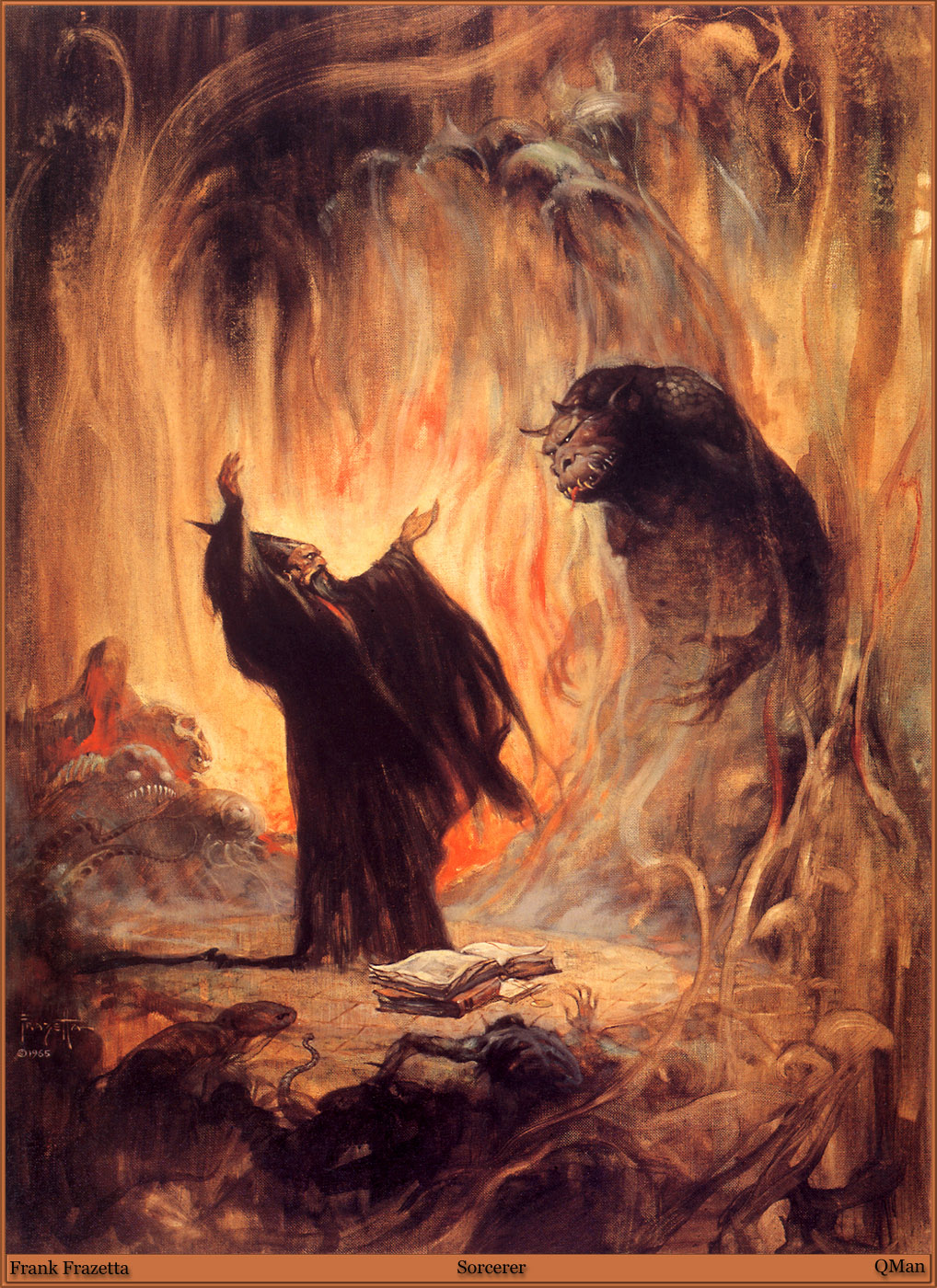
And the enemy was immediately personalized as an enigmatic other, a mysterious necromancer out of some 1970s Frank Frazetta painting, dark Gandalf crossed with Bond villain.


Concrete evidence of this narrative overlay of the dramatic events occurring in real life were all over the place, from the real-time action figures based on photos of our S.O.F. paladins to the insane USA Today-style graphics of Bin Laden's imagined mountain fortress, a work of news media fiction based on DC Comics cutaways of Kal El's Fortress of Solitude, a ready-made design for the G.I. Joe Spin Boldak Adventure Playset.
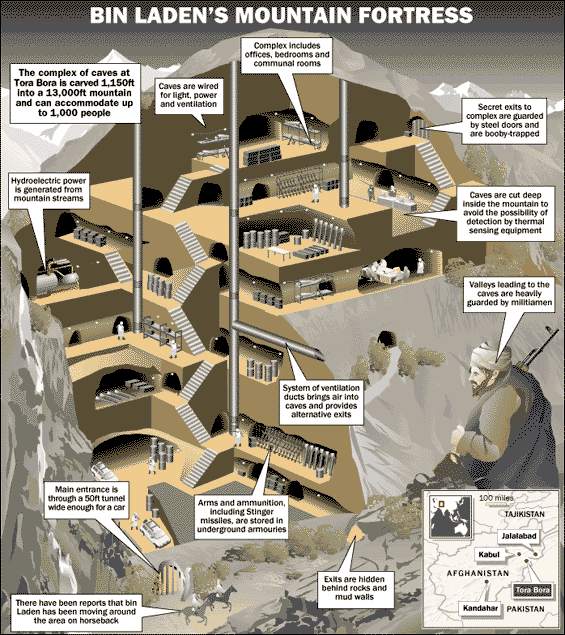


As detailed in this excellent piece by Edward Jay Epstein, the comic book secret headquarters meme fit so perfectly with the American master narrative, that what started as leftover lore from the 1980s became a government-certified part of consensus reality during the climatic run-up to the showdown at Tora Bora:

The story probably reached its high point on NBC's Meet The Press on December 2nd when Tim Russert, the host of the program, provided Secretary of Defense Donald Rumsfeld with the artist's rendering of bin Laden's fortress. The interview proceeded:

Russert: The Times of London did a graphic, which I want to put on the screen for you and our viewers. This is it. This is a fortress. This is a very much a complex, multi-tiered, bedrooms and offices on the top, as you can see, secret exits on the side and on the bottom, cut deep to avoid thermal detection so when our planes fly to try to determine if any human beings are in there, it's built so deeply down and embedded in the mountain and the rock it's hard to detect. And over here, valleys guarded, as you can see, by some Taliban soldiers. A ventilation system to allow people to breathe and to carry on. An arms and ammunition depot. And you can see here the exits leading into it and the entrances large enough to drive trucks and cars and even tanks. And it's own hydroelectric power to help keep lights on, even computer systems and telephone systems. It's a very sophisticated operation.

Rumsfeld: Oh, you bet. This is serious business. And there's not one of those. There are many of those. And they have been used very effectively. And I might add, Afghanistan is not the only country that has gone underground. Any number of countries have gone underground. The tunneling equipment that exists today is very powerful. It's dual use. It's available across the globe. And people have recognized the advantages of using underground protection for themselves.


The assault on Tora Bora was built up as the denouement of our real-world action movie. The big showdown in which Sgt. Fury and his Howling Commandoes would trudge through the snow and blast their way into the hydroelectric plant and the TV rooms and the 2000-room hotel and the submarine base and the Soviet wonder tanks and bring the bad guy back to be prosecuted by Sam Waterson.

Eight years later, we are still waiting for the final act. The picture went off-script and has never gone back. No wonder President Obama has been dithering, in a quandary about what to do. He's trying to figure out how to make the Afghan War fit back into the American narrative of how we roll, instead of being the Forever War. The unfulfilled search for this fantasy fortress, and the evil mastermind within, turned out to be the missing reel of our Zeitgeist. Such a massive delayed climax of our cultural self-conception that you can't blame the Alex Joneses of the world when they wonder whether Bin Laden actually exists, or is just an invention of our secret masters smoking cigars in the club rooms of the Bilderberg Group.


In this context, it is especially interesting to see the story of what really happened up there in December 2001 laid out by John Kerry's Senate Foreign Relations Committee staff in their new report. A partisan spin, no doubt, with patrician Kerry rehashing arguments he made to little effect in 2004, but a fascinating glimpse into what was on that missing reel of the post-9/11 history that could have been.

The report relies on recollections from an ex-Delta Force officer who goes under the pen name of (I kid you not) "Major Fury." Fury was apparently in charge of the 90 special ops troops who were at Tora Bora with the Afghan irregulars, and he vividly describes the scene of our soldiers listening in to the non-stop radio chatter among Bin Laden and his ~300 Qaeda manning the last stand, right up through the dropping of the first Daisy Cutter since Vietnam, when many of the men deep in those caves were vaporized.

The report continues with another classic Hollywood scene, the maverick CIA operative's futile efforts to get the brass to do the right thing (think Willem Dafoe in Clear and Present Danger) to accomplish the just mission:

Another confirmation came from the senior CIA paramilitary commander in Afghanistan at the time. Gary Berntsen was working at the CIA’s counterterrorist center in October 2001 when his boss summoned him to the front office and told him, ‘‘Gary, I want you killing the enemy immediately.’’ Berntsen left the next day for Afghanistan, where he assumed leadership of the CIA’s paramilitary operation against the Taliban and Al Qaeda. His primary target was bin Laden and he was confident that the Al Qaeda leader would make his last stand at Tora Bora. His suspicions were confirmed when he learned bin Laden’s voice had been intercepted there.

From the outset, Berntsen says he was skeptical about relying on Afghan militias ‘‘cobbled together at the last minute’’ to capture or kill the man who ordered the 9/11 attacks. ‘‘I’d made it clear in my reports that our Afghan allies were hardly anxious to get at al Qaeda in Tora Bora,’’ he wrote in his own book, Jawbreaker, which was published in late 2005. He also knew that the special operations troops and CIA operatives on the scene were not enough to stop bin Laden from escaping across the mountain passes. In thebook, Berntsen uses exclamation points to vent his fears that the most wanted man in the world was about to slip out of our grasp.

‘‘We needed U.S. soldiers on the ground!’’ he wrote. ‘‘I’d sent my request for 800 U.S. Army Rangers and was still waiting for a response. I repeated to anyone at headquarters who would listen: We need Rangers now! The opportunity to get bin Laden and his men is slipping away!!’’

At one point, Berntsen recalled an argument at a CIA guest house in Kabul with Maj. Gen. Dell Dailey, the commander of U.S. special operations forces in Afghanistan at the time. Berntsen said he renewed his demand that American troops be dispatched to Tora Bora immediately. Following orders from Franks at U.S. Central Command (CentCom) headquarters at MacDill Air Force Base in Tampa, Florida, Dailey refused to deploy U.S. troops, explaining that he feared alienating Afghan allies. ‘‘I don’t give a damn about offending our allies!’’ Berntsen shouted. ‘‘I only care about eliminating al Qaeda and delivering bin Laden’s head in a box!’’

Dailey said the military’s position was firm and Berntsen replied, ‘‘Screw that!’’


Stories by soldiers of secret battles that paint themselves as heroes require due skepticism, as do political "fact-finding" reports by legislators with a partisan promotional agenda. But notwithstanding the layers of spin, the report is pretty compelling in making the case from multiple sources that Bin Laden was really there in Tora Bora, and allowed to get away because the Pentagon didn't want to send in a large contingent of American troops to crowd out the Afghan allies or piss off the Pakistanis by blocking the back door to the Tribal Areas.

Thinking about it from the perspective of the end of the decade, one can't be blamed for wondering if letting Bin Laden go wasn't a necessary predicate to the initiation of the Iraq War. If we had captured Bin Laden, wouldn't that have sated the Furies possessing the American public, and deprived the Bushies of the narrative they constructed to justify that invasion? Alas, we'll never know. We're stuck instead with the Forever War, one whose opportunity for an ending came and went a long time ago.

Good luck inventing a victory condition for this one, Mr. President.

Friday, November 20, 2009

Guy de Bord's Wild Kingdom


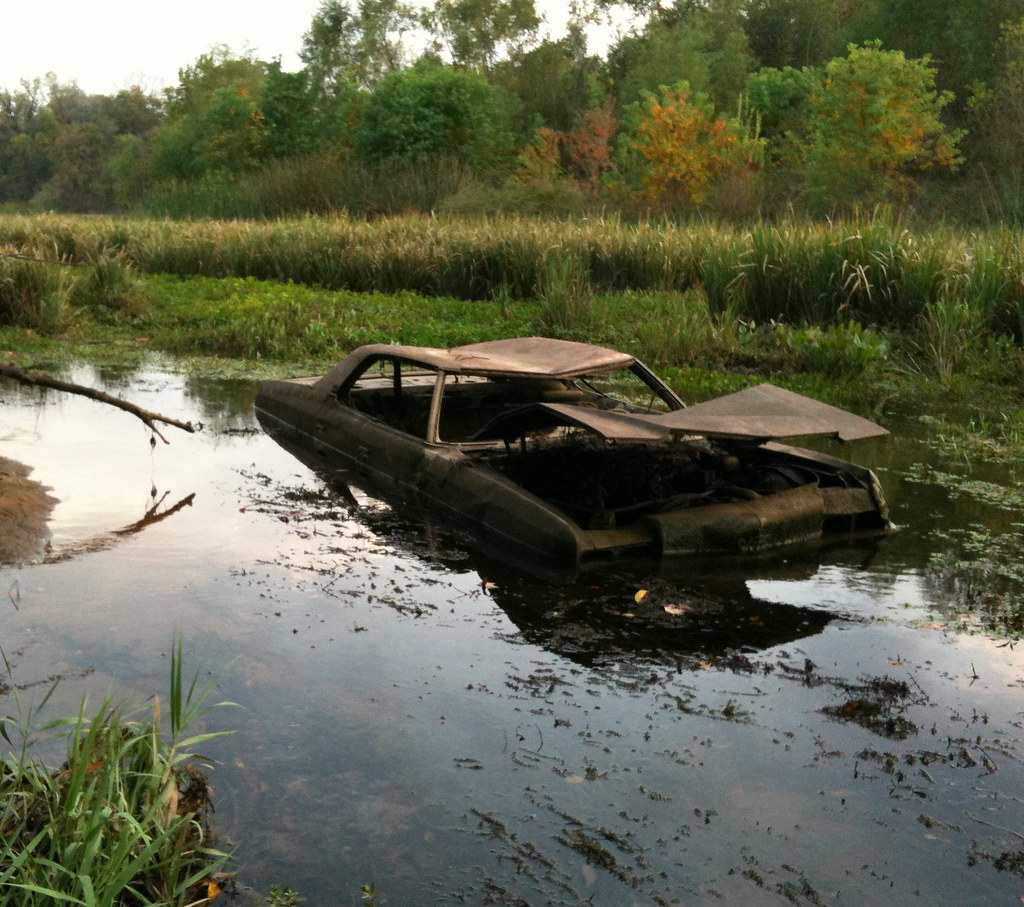
For some reason, whenever I walk in the woods, I find stuff like this. Which I am guessing is probably a 1967 Chevy Impala. Discovered as I emerged from tall marsh grass, flushing out a big heron who was rather annoyed I had interrupted his perch.

It was found in the floodplain of the Lower Colorado River, about halfway between downtown Austin and the airport. When the water is low, acres of land that don't exist on any map appear, filled with unexpected psychogeographical Easter eggs like this. All the flotsam of a city like Austin that gets carried out of yards and construction sites and streets and empty lots during big rains and the occasional flood, deposited downriver in the deep woods and marshes over the banks, back off the trail near the secret transient camps.


I have written here before about the sublime wonders of exploring the pockets of wild nature secreted within the interstices of the city. My latest walks and canoe trips through the strange territory of far East Austin have revealed more of the weird wonder that comes from penetrating these unexpected habitats of urban ospreys and coyotes, only to discover freshly decontextualized relics of civilization: abandoned Impalas, overgrown civil engineering bunkers, ruined bridges, empty pipelines, grounded buoys, technicolor Flash Gordon guns stowed in the tall grass in case of egret attack. This ancient river, running through a booming metropolis that still harbors its zones of urban negative space, relics of the phantom overlays of other, more mysterious land uses: military space (the former SAC base that was turned into the airport just 10 years ago), civil engineering space (the River Authority's concrete and steel nature controls), segregation space (the lasting impact of zoning-based race controls), migrant space (Austin's favelas-in-progress), industrial space. The perfect venue to really experience the Uncanny, as a perceptive architect friend suggested. An opportunity for a special type of dérive, one that requires snake boots.


What's more wondrous on a Sunday afternoon in autumn, the colors illuminated from within by the crisp filter of an incipient cold front: to discover a rare colony of road-building harvester ants in the right of way behind a dairy plant, or to discover an abandoned 1960s pickup embedded in the ground and aimed at the moon?

Last year I had a dream about a garden of Rebar. Who knew a year later I would be moving there?

Saturday, November 14, 2009

Genesis by Crumb

The following appeared, with no article or additional background information, in the Belief/Religion section of the Houston Chronicle:

"I used a lot of white-out, a lot of corrections when I tried to draw God."
-Illustrator Robert Crumb, describing his four years of work on The Book of Genesis, quoted by USA Today

Who what? Could Illustrator Robert Crumb be the famed underground comix artist who drew Fritz the Cat, which was adapted into an X-rated movie?

Yes, the very same Robert Crumb. He has just completed The Book of Genesis Illustrated by R. Crumb.

Religious eyebrows are being raised, but some religious spokespeople have voiced refreshingly nuanced opinions. A United Kingdom Website called The Register gives this quote from the Bible Society: "It may surprise people but the Bible does contain nudity, sex and violence. That's because it contains real stories about real people. If by reading the book people are encouraged to re-engage with the Bible then that can only be a good thing." A bishop in the Church of England is quoted saying, "He set out to say 'this is important, fundamental myth', and it seems to me he's done a good job."

The artist's own Website features a book review that states, "…Crumb has returned to the sacred text at the heart of Western civilization, but the result is a comic as unsettlingly drenched in sexualized violence as Tales from the Crypt and as subversively disrespectful to cultural icons as Mad (Magazine.)"

Feeling very estranged


To my immense delight, the new issue of the New York Review of Science Fiction features my essay "Feeling Very Estranged: Science Fiction and Society in the Aftermath of the Twentieth Century." An earlier version of of the essay was presented as part of the symposium on "Mundos Paralelos" at the 2009 Festival de Mexico in el Centro Historico put together by author and critic Mauricio Montiel Figueiras and Festival director Jose Wolffer. The essay is my effort to synthesize much of my accumulated thinking on sf as the most highly evolved branch of the twentieth century project to produce a literature of alienation. It covers some pretty disparate ground, considering post-apocalyptic dystopias as works of emotional realism, the fantastic media multiverse as the enabler of our alienation, and the portents to be gleaned from the merging post-cyberpunk literature of things.

Here's an excerpt from the opening:

I. The ruins of Des Moines

“It is much easier for us to imagine the end of the world than a small change in the political system.” — Slavoj Žižek

In the spring of 2005, eleven men were arrested while re-enacting scenes from Mad Max 2: The Road Warrior on a highway north of San Antonio, Texas. Saturday shoppers headed to the mall were alarmed to be passed by a heavily armored Mack truck pulling a tanker trailer and being chased a black 1974 Ford Falcon GT pursuit special (complete with big chrome blower sticking through the hood — “last of the V-8 interceptors”), a green pickup with a roof-mounted four-gun swivel, a red pickup with a snake painted on the side and a gun-wielding maniac riding shotgun, and several dune buggies driven by men with shoulder pads, mohawks, aggressive body art, and not much else.

The police learned that the guns were fake — these men were members of Roadwar USA, a Mad Max re-enactment society that stages events all over the country. If you’ve ever tried to navigate your way out of the parking lot after a midnight screening of The Road Warrior, you can understand the kinetic jolt that animates these fellows. The idea of mass disaster contains within it the possibility of one’s own society becoming liberated territory, an idea that wants to escape the confines of the screen. In this world’s 1984, I had such an experience, which led directly to an all-night donut shop plan with a high school buddy to go to Mexico, acquire an old jeep, and tour the war zones of Central America in search of an authentic feeling of post-apocalyptic liberation. (Think post-ideological Motorcycle Diaries for the VHS generation.)

To our surprise, we actually found it: at the end of our road in the real-world disaster area of Sandinista-era Managua. Twelve years after the earthquake whose relief funds Tachito Somoza absconded, the downtown of el Centro was a Mad Max setpiece. At dusk, squatters huddled around oil drum fires in the shells of colonial-era office buildings. Bleached prairie grass obscured the tracks of burned-out Sherman tanks on the losing side of the last war, tagged with FSLN graffiti. The only intact edifice was the glass-and-steel high-rise of the Bank of America, rising out of the ruins like some science fictional sanctuary in a 1970s teledrama. In interstitial post-colonial burrows near the skeleton of the old cathedral, revolutionary cadres hosted experimental kindergartens while North Korean soldiers on parade stomped out the weeds growing up between the cracks of the plaza.

The unexpected discovery of an actual abandoned capital city, accessed through the original silver screen portal of a science fiction B-movie, certified completion of my all-American adolescent project to reimagine my world as a post-apocalyptic ruin. It was a postmodern tribal initiation ceremony, largely of my own design — a cathode ray vision quest designed to provide me with the semiotic tools to navigate the psychic landscape of my burgeoning middle-class alienation.


If you read this blog and do not have a subscription to NYRSF, you really should. It's really the only remaining journal of sf criticism by people in the field. Subscribe today—and consider submitting something (hey, they'll even let take payment in subscription copies).

Thanks to David Hartwell, Kevin Maroney and the rest of the editorial team at NYRSF for the opportunity.

Tuesday, November 10, 2009

When Radagast attacks


This vignette in yesterday's NYT backgrounder on the Fort Hood shooter really packed it in for me, describing Dr. Hasan as:

"...a gentle, quiet, deeply sensitive man who once owned a bird that he fed by placing it in his mouth and allowing it to eat masticated food."

Wow.

It's like that 70s Bruce Dern loco Vietnam Vet meme never died, and has now branched out into weird new 21st century variations.

Okay, time to turn on the tube and follow the latest lockdown from the Live at 5 choppercam.

Monday, November 9, 2009

Election results


Normally I don't radiate patriotic fervor - though I'm more inclined that way than I was a year ago last Tuesday. This year's election day was very special for me too. Because I recently relocated out of one of the small cities inside of Houston (it's kind of like an amoeba that has ingested small surrounding communities), I was able to vote in the Houston city elections. This came just in time for me to cast my vote for Annise Parker for Mayor of Houston.

A few days having passed, there were thoughtful reflections in the Sunday newspaper. The newspaper, by the way, had endorsed both Annise Parker and Gene Locke in the mayoral race, and these are the two who will face each other in a December runoff. These were not the two with the most money. But there's new aphorism much in evidence in the local media - and Annise said it on TV on election night: Money doesn't elect people. People do. Of all the candidates, she had, not the most money in contributions, but the most individuals contributing. Each contributor was somebody who really wants to see her as Mayor, either because of her track record as a Councilwoman and City Controller, because she's a Rice University graduate, because she's a fine capable woman politician, or because she's long been one of few openly gay people elected to office in Texas, and her becoming Mayor of Houston would be a victory for GLBT people everywhere.

The individuals most unhappy about the election results (apart from the losing candidates who ran long, hard, expensive, and generally fair races), are the die-hard social conservatives. Some of these folks will not vote for a gay woman no matter how good her track record is. These voters, however, will be faced with the choice between a gay woman who started out as a campus and community activist and a black man who started out as a civil rights activist! It's going to be an interesting few weeks until the December 12th election. Then, oh joy, I'll get to go out and cast my Houston vote again.

Monday, November 2, 2009

Nomadology


Courtesy of the awesome team at Strange Horizons, I have a new story up today about hand-knit his and hers sensory deprivation hoods, golf course detention camps, strip small suicide bombers, improvised homeless shelters, and other flotsam of the Zeitgeist bobbing around in our collective consciousness. "Nomadology" — check it out:

What a fucking awesome party. Talk about "obscene enjoyment." Who knew the mujahideen assassins would have even better reefer than those Scythian priests camped out on top of the parking garage doing their blood bowls? The whole thing was like a post-apocalyptic Cheech and Chong flick.

Osama opened up his Blofeldian mountain hideout for a house party. The place was shaking with woofed-up synthesized Fezcore running through the rebar. You were kind of spaced out, writing rhymeless poems in your bad calligraphy on the fuselages of the anti-aircraft missiles arrayed for launch. I got lost in the rave Abu Ghraib downstairs, with all the Dionysian Abercrombie POWs acting out their skankiest warporn fantasies. "Frat boys are so much better when they are on leashes," you said. I came looking for the tough-loving Lynndie England of my private midnights, and instead I found you. Who knew a latex Barbara Bush mask could be so fucking hot?

Liberian teenagers toting AK-47s haul ass down the David Addington Allée in an overloaded Lincoln Navigator with the top sawed off, dragging the bodies of a well-regarded architect and your vice president of marketing behind the car. You tell me to throw something at them, but come on, you know what a chickenshit I really am. I could lose my job.